🏝 Puerto Rico Score Calculator
Total final victory chips, printed building points, occupied large-building bonuses, shipping share, colonist checks, and tie counters.
2 bonus points per production building owned.
1 bonus point per occupied violet building.
4 to 7 bonus points from occupied island spaces.
1 bonus point per 3 colonists, rounded down.
1 bonus point per 4 victory chips, rounded down.
| Score line | Value | Formula | Audit note |
|---|
| Final score source | Calculator input | Scores points? | Notes |
|---|---|---|---|
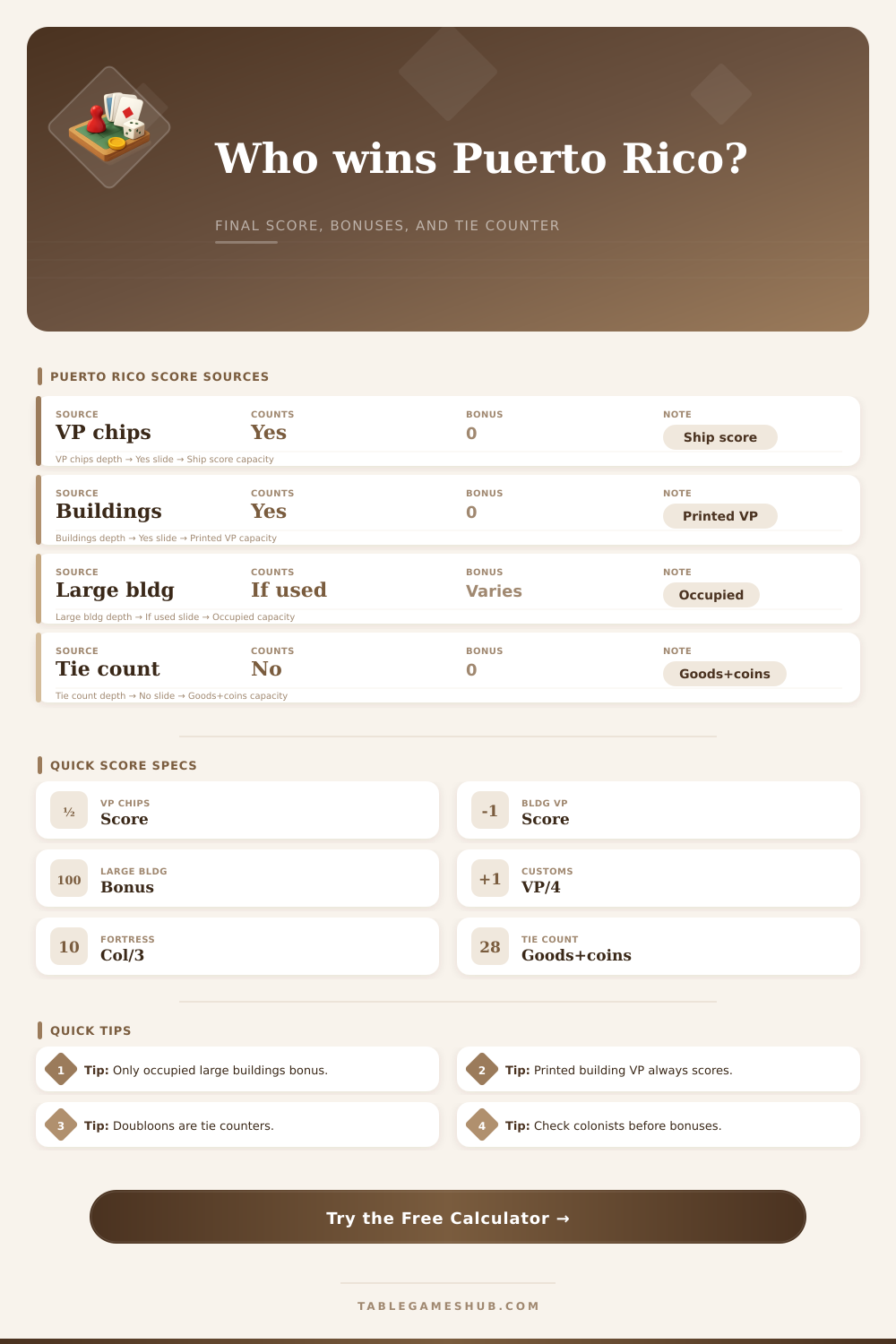
| Victory chips | Victory chips earned from shipping | Yes | Count chips exactly; goods shipped is only a balance check. |
| Printed buildings | Printed victory points on buildings | Yes | Owned buildings score printed values whether occupied or empty. |
| Large-building text | Selected occupied large buildings | Yes | Bonus formulas apply only when that large building has a colonist. |
| Remaining goods | Goods remaining for tie counter | No | Used with doubloons only after final scores are tied. |
| Doubloons | Doubloons remaining as tie counter | No | Tracked as an in-game counter, not as victory points. |
| Large building | Occupied requirement | Bonus formula | Calculator field |
|---|---|---|---|
| Guild Hall | Colonist on Guild Hall | 2 points per production building | Production buildings owned |
| Residence | Colonist on Residence | 4, 5, 6, or 7 by occupied island spaces | Occupied island spaces |
| Fortress | Colonist on Fortress | 1 point per 3 colonists, rounded down | Colonists on board and San Juan |
| City Hall | Colonist on City Hall | 1 point per occupied violet building | Occupied violet buildings |
| Customs House | Colonist on Customs House | 1 point per 4 victory chips, rounded down | Victory chips earned from shipping |
| Residence band | Occupied island spaces | Bonus points | Entry cue |
|---|---|---|---|
| Partial island | 0 through 9 | 4 | Use when several plantation or quarry spaces are empty. |
| Ten spaces | 10 | 5 | Common for a developed board with two empty spaces. |
| Eleven spaces | 11 | 6 | Nearly full island, one empty space remaining. |
| Full island | 12 | 7 | All plantation and quarry spaces occupied. |
| Score profile | Typical signal | Calculator reading | Best audit check |
|---|---|---|---|
| Shipping-heavy | Victory chips over half the total | Shipping share above 50% | Recount chips and goods shipped notes. |
| Building-heavy | Printed buildings exceed victory chips | Building share above chip share | Confirm every owned building value is included. |
| Bonus-heavy | Two or more occupied large buildings | Large bonus above 12 points | Check each large building has a colonist. |
| Tie-sensitive | Close target margin and high leftovers | Tie counter over 8 | Count doubloons and remaining goods separately. |
| Occupancy risk | More bonus buildings than colonists suggest | Alert appears in breakdown | Verify occupied buildings before finalizing. |
Large-building occupancy
Before using a bonus formula, verify the matching large building has a colonist. Printed building points still score even if the building is empty.
Tie counter separation
Keep remaining goods and doubloons outside the victory-point total. They are only compared when players finish with the same final score.
Calculating the final score for Puerto Rico require that you keep track of several different sources of points for a player. Each of these scoring sources have a slightly different set of rules to determine the points for each source, so it is important to keep these scoring sources separate from one another. The sources of points to track include victory chip, printed building values, and large-building bonuses.
Additionally, you must track the number of goods and doubloon that a player has, as these value are used as tiebreakers in the case of a tie between players, but do not themselves contribute to a player’s total victory points. A calculator may assist in keep track of each of these different scoring sources. The calculator will handle the arithmetic for each scoring source, allowing players to focus on the significance of each number that is calculated.
How to Calculate Your Final Score in Puerto Rico
Victory chips are often earned through the shipping phase of the game. The number of victory points from printed building values is the total number of printed points on all of a player’s buildings, regardless of whether those buildings are occupied by a colonists. The number of victory points from large-building bonuses is calculated more different than the other two scoring sources: a player must own a large-building and have at least one colonist occupying that large-building to earn any bonus point from that building.
For instance, the guild hall award victory points for every production building that a player owns, but only if at least one colonist occupies the guild hall itself. Thus, players must calculate large-building bonus points separately from printed building values. The number of colonists that a player control is one of the factors that influence a player’s score.
The number of colonists can impact a player’s score in relation to bonuses from large-building such as the fortress, which provide points for every three colonists that a player controls. Additionally, it is necessary to have a high number of colonists to ensure that one has enough colonists to occupy the buildings that claim to be occupied by those colonists. If the number of colonists that a player controls is too low relative to the number of buildings that a player claims to occupy, then the player’s score will be incorrect.
Despite the fact that goods and doubloons are not victory points for a player, it is still important to calculate how many goods and doubloon that a player has earned during there game. Should other players have the same score as a player, then the number of goods and doubloon that a player has can be used to differentiate between players with the same total score. Thus, a player must track goods and doubloons, even though those points will not contribute to a player’s total score.
Furthermore, a calculator will help to avoid incorrect adding goods and doubloons to a player’s total score by providing for those goods and doubloons a separate line for that score to be tracked. The number of player that are playing on the table will impact the rate at which players score during the game. With five player playing, for instance, players will usually have higher total scores than in a game between only two players.
The calculator can adjust for this different number of players, allowing players to compare their scores against others who may be playing the same game. Common error include mixing scoring sources. For instance, a player may mix the values of printed buildings with the bonuses from large-buildings, or a player may consider remaining goods as victory points.
To avoid these errors, it is important to use the calculator for each scoring source. Furthermore, the calculator will provide for players the shipping share for their score as a percentage. This percentage will reveal from which scoring source the player earned there victory points.
After entering the data for each scoring source into the calculator, the game will display a breakdown table that displays the number of victory points that were earned from each source. Each of these scores can be individually viewed, such as the points earned from the guild hall, the residence, or the customs house. Furthermore, because players can edit the data that is entered into the calculator, players can modify their score to determine the impact that an additional building or colonist could have upon the total score for that player.
Thus, players can use the game to compare the value of different potential ending for the same game.