🎳 Bowling Petersen Point Calculator
Total a Petersen-style bowling round with match points, pinfall blocks, handicap, rank points, bonus awards, and carryover adjustments.
| Component | Formula | Your value | Points |
|---|
| Format | Common games | Primary point source | Best calculator setup |
|---|---|---|---|
| Classic match card | 3 to 4 | Win, tie, total pins | Use match points plus margin block pinfall. |
| Scratch sweeper | 4 to 8 | Total pins and rank | Disable handicap or set percent to 0. |
| Team Petersen block | 2 to 6 | Net team total | Enter team pinfall totals and team average. |
| Position round | 1 to 3 | Direct opponent result | Use higher match points and small rank step. |
| Ladder point round | 4 to 8 | Margin bracket | Use ladder pinfall mode with a clear cap. |
| Component | Typical range | Formula basis | Audit note |
|---|---|---|---|
| Match win points | 10 to 30 | Net pins beat opponent | Confirm if ties split or reset. |
| Pinfall points | 0 to 20 | Completed blocks of pins | Use floor math, then apply cap. |
| Rank points | 0 to 25 | Max minus rank step-down | Clamp at zero for low ranks. |
| Manual bonus | 0 to 15 | Event sheet award | Keep a note for high-game or clean block. |
| Carryover points | -10 to 20 | Prior approved adjustment | Do not hide it inside bonus points. |
| Rule choice | Formula | When it fits | Calculator field |
|---|---|---|---|
| 90 percent of 220 | (220 - avg) x .90 | Mixed-average Petersen events | Percent 90, base 220 |
| 80 percent of 230 | (230 - avg) x .80 | Scratch-leaning handicap rounds | Percent 80, base 230 |
| Scratch only | No handicap added | Open scratch sweepers | Percent 0 or cap 0 |
| Split tie | Tie points plus half pin points | Most league sheets | Split match and pinfall |
| Roll-off pending | Hold match award | Position finals and playoffs | Treat tie as roll-off pending |
| Scoring setup | Match weight | Pinfall weight | Best use |
|---|---|---|---|
| Head-to-head heavy | 20 to 30 points | 0 to 8 points | Position night, bracket finals, standings chase. |
| Balanced Petersen | 15 to 20 points | 8 to 15 points | League-style sheets with both result and pins. |
| Pinfall ladder | 5 to 15 points | 15 to 25 points | Large field sweeper where total pins drive rank. |
| Rank bonus layer | 10 to 20 points | 0 to 15 points | Multi-entry blocks needing a leaderboard boost. |
| Handicap team card | 10 to 20 points | 5 to 12 points | Team events where net pins must stay visible. |
Point Sheet Tip
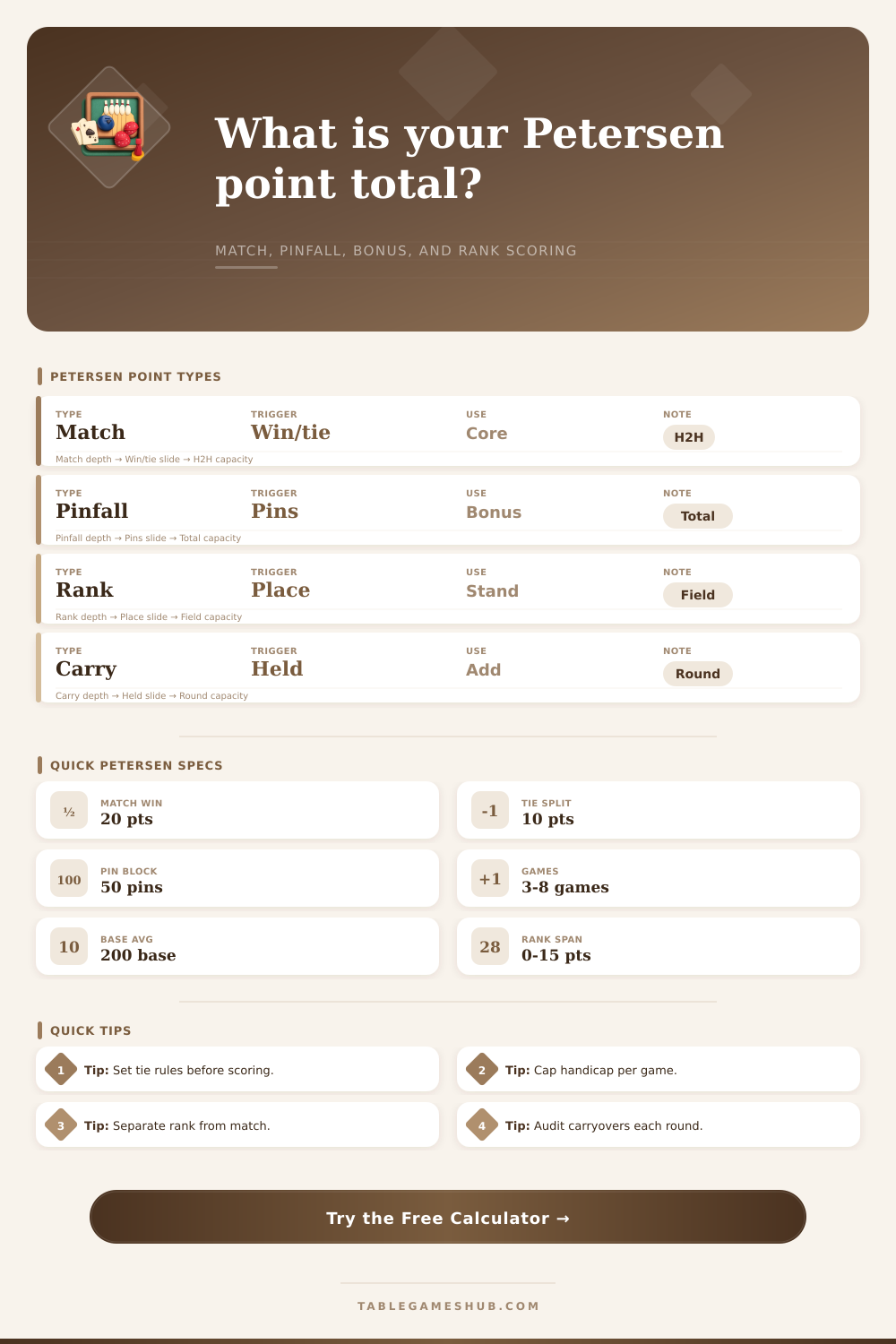
Write the match value, tie rule, pin block, and cap at the top of the sheet before the round starts. Petersen totals become hard to audit when pinfall points and rank points are blended together.
Handicap Tip
Compute handicap per game, apply the cap per game, and then multiply by games in the block. That keeps a four-game Petersen card comparable to a shorter position round.
The Petersen system are a method that calculates bowling scores. Specifically, the Petersen system is design to calculate the standings of each player in a league. There are several component to the Petersen system, including match points, total pinfall, rank points, and carryover points.
Match points works to show which players beat which opponent. However, total pinfall is also a crucial component of the Petersen system because it determines the total number of pins each player knock down. A player will earn points for knocking down extra pins in there game, even if they did not win the match.
How the Petersen System Works in Bowling Leagues
The Petersen system use these two component to ensure that it works for different type of bowling night. Bowlers will use the handicap component of the Petersen system to even out the average for each bowler in the league. The goal is for each bowler to have an even chance to win each match.
However, the score must be scaled correctly for the higher-average bowler so that the system does not ignore their skill. Some league also put a cap on the number of points given to each player for the handicap. This ensures that a low-average bowler dont earn too many points in a game block.
If the Petersen system changes the base for the handicap in the middle of a league season, then the standings will not be consistent between each week of the league. The rank points component reward each team for their performance in the standings. The more points a player earns, the more higher they will be in the standings.
The farther a bowler is from first place, the less rank points they will earn. The size of the point reduction for each rank determine how much the Petersen system reward the top bowlers in the league. Carryover points are given to players in specific circumstance, such as a roll-off that is postponed.
Carryover points are not bonus points. Instead, they should have there own separate line on the score sheet so that everyone can see where these points on the sheet comes from. If carryover points are not listed separately, people may discuss the accuracy of the score sheet.
There are also tie rules in the Petersen system. Some leagues will split the match points should there be a tie between two bowlers. Other leagues will give the match points to both team in the case of a tie but use the total pinfall to determine which bowler win the game.
These rules will impact the strategy of each player as to whether they focus on winning match or avoiding ties altogether. A league using the Petersen system will have to pick a format and stick to it. Some leagues use the match-plus-pin or scratch format for scoring based off total pins knocked down and rank points earned.
A league that change the Petersen system format during the season will find it impossible to compare the score of players between different week of the season. Bowling scorekeepers must be careful to not combine different type of bonus points for players. For example, high-game award and clean-game award should be kept separate in a bonus column on the score sheet.
Combining these two category in one cell will make it impossible for anyone to determine from which competition a player earn their bonus points. The scorekeeper must also ensure that the per-game handicap is not combined with the total-block handicap for the pin. By calculating the per-game handicap and plugging in the number of game played, the scorekeeper can ensure that both four-game and two-game block can be compared with one another on the same standings line.
The Petersen system is considered to be successful if the bowlers can read the score sheet and understand how the total score for each player was calculated. To ensure that each league follow this standard, the match value, tie rule, pin block size, and carryover point should be written at the top of each score sheet. By writing these at the top of each sheet, the league will ensure that each bowler will understand the Petersen system.
Additionally, the Petersen system measure the consistency of the method used to calculate scores. The league will earn the trust of the player if the same formula is used throughout the bowling season.