Kite Angle Calculator
Solve the four interior angles of a geometric kite from its symmetry diagonal, cross diagonal, apex split, and area relationship.
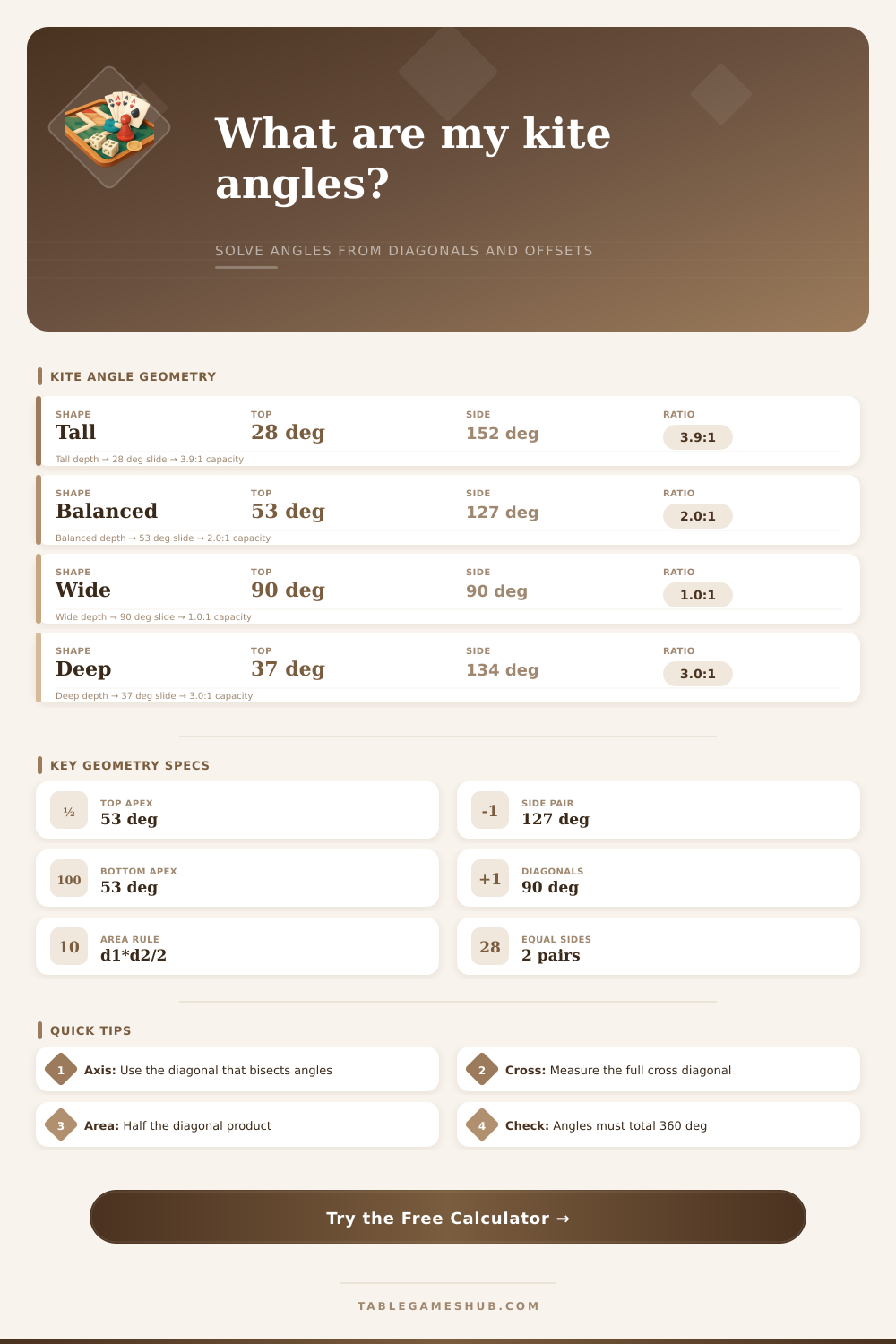
| AC:BD ratio | Centered top angle | Centered side angle | Typical geometry reading |
|---|---|---|---|
| 4:1 | 28.1 degrees | 151.9 degrees | Very slender kite with sharp apexes |
| 3:1 | 36.9 degrees | 143.1 degrees | Long axis, strong vertical emphasis |
| 2:1 | 53.1 degrees | 126.9 degrees | Common balanced diamond layout |
| 1:1 | 90.0 degrees | 90.0 degrees | Square-like diamond when centered |
| Quantity | Formula | Uses | Geometry note |
|---|---|---|---|
| Area | AC x BD / 2 | Template coverage | Works because diagonals are perpendicular |
| Top apex angle | 2 atan((BD/2) / AO) | Angle A | Uses the upper right triangle |
| Bottom apex angle | 2 atan((BD/2) / OC) | Angle C | Uses the lower right triangle |
| Side angle pair | (360 - A - C) / 2 | Angles B and D | Equal because the symmetry axis mirrors them |
| Preset family | Axis split | Cross diagonal | Angle behavior |
|---|---|---|---|
| Centered diamond | 50% / 50% | Moderate | Top and bottom apex angles match |
| Shield kite | 35% / 65% | Wide | Top opens while lower apex stays sharper |
| Long-tail kite | 25% / 75% | Narrow | Bottom section lengthens the lower side angles |
| Rhombus-like kite | 50% / 50% | Same as axis | All four angles approach right angles |
| Check | Expected value | Why it matters | Correction clue |
|---|---|---|---|
| Diagonal crossing | 90 degrees | Kite area and angle formulas assume perpendicular diagonals | Square the cross diagonal to the axis |
| Side angle pair | B = D | The symmetry diagonal reflects the left and right halves | Recheck that BD is bisected |
| Angle sum | 360 degrees | Every convex quadrilateral has this interior total | Round only after summing exact values |
| Adjacent sides | Two equal pairs | A kite has two pairs of neighboring equal side lengths | Compare top pair and bottom pair separately |
A kite is a quadrilateral that have two pair of equal adjacent sides. Because a kite has two pairs of equal adjacent sides, it has one main axis of symmetry. The axis of symmetry are necessary for the stability of the kite, and the symmetry of the kite ensures that it will remain balanced in the air.
If you use a calculator to measure the angles of a kite, you are finding how the symmetry of the kite are distributed. If the cross diagonal of a kite is centered on the axis of symmetry, then the kite will be a rhombus. A rhombus is a type of kite in which the diagonals is evenly divided in half at the center of the symmetry axis of the rhombus.
Kite parts and how they keep it balanced
However, most functional kite are not constructed as rhombuses because the top and bottom apexes of the kite often require different shape. A kite contains two main diagonal: the symmetry diagonal and the cross diagonal. The symmetry diagonal is the long spine of the kite, while the cross diagonal is the bar that provides the width of the kite.
The intersection of these two diagonals is the most important point for determine the shape of the kite. If the designer makes the bottom section of the symmetry diagonal longer than the top section of the symmetry diagonal, the kite will have a long tail effect. Such an effect on the kite will alter the way that the kite’s center of gravity, and how the kite will pivot in the wind.
A calculator can define these ratios, which allow the kite designer to avoid having to measure these distance every time the kite is constructed. The side angles of a kite are the two vertices where the top sides of the kite meet the bottom sides of the kite. These angle must be equal due to the axis of symmetry of the kite reflecting the sides and their angles.
If the side angles are not equal, then the kite will be asymmetrical, and will lean towards one side of the kite. Such a kite will likely spiral into the ground. Thus, ensuring that the side angles are identical is a requirement to succesfully launch the kite.
The ratio of a kite is determine by the relationship between the symmetry diagonal and the cross diagonal of the kite. A high ratio indicate that the symmetry diagonal of the kite is much longer than the cross diagonal of the kite. A high ratio of a kite will result in a slender kite shape, which is often use to represent kites that are meant to remain stable in high winds.
A low ratio is created when the symmetry diagonal is not much longer than the cross diagonal of the kite. A kite with a low ratio will be wide in shape, and such a kite will be stable in light wind due to it’s wide shape. The area of the kite is another factor to consider in the creation of a successful kite.
A person can calculate the area of the kite to determine the amount of fabric that will be required to create the kite. Additionally, if the person solves for the area of the kite, the diagonal lengths of the kite can also be determined. Thus, knowing the area of the kite allows the kite designer to determine how much material is required for the kite build, and to avoid wasting valuabel material, such as nylon.
Finally, the two diagonals of a kite must be perpendicular to each other. Perpendicular indicates that the cross diagonal of the kite must create a 90 degree angle in relation to the symmetry diagonal. If the cross diagonal is not perpendicular to the symmetry diagonal, then the mathematical equation for calculating the apex angles of the kite will not work.
Additionally, if the frame of the kite is not made perpendicular to one another, the symmetry of the kite will vanish, and the kite will not fly correct. A tool can be used to ensure that the kites frame is created in a perpendicular manner.