Junior Golf Club Length Calculator by Height
Match a young player's height, wrist-to-floor, posture, and growth room to a safer starting length.
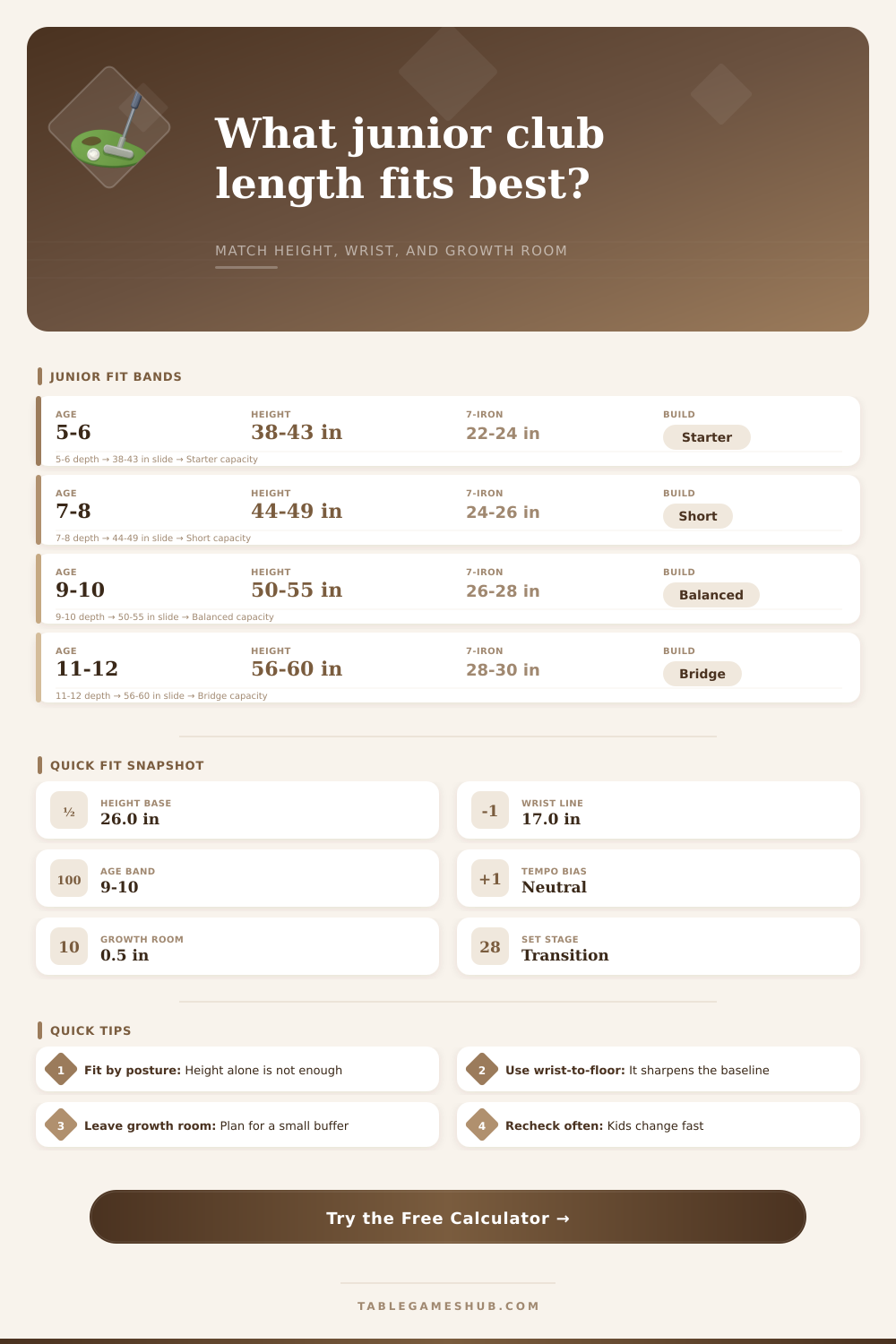
| Age band | Height range | 7-iron band | Build note |
|---|---|---|---|
| 5-6 | 38-43 in | 22-24 in | Starter |
| 7-8 | 44-49 in | 24-26 in | Short set |
| 9-10 | 50-55 in | 26-28 in | Balanced |
| 11-12 | 56-60 in | 28-30 in | Bridge |
| Wrist-to-floor | Change | Effect | Fit clue |
|---|---|---|---|
| Below average | -0.5 in | Shorter set | Compact |
| Average | 0.0 in | Neutral base | Center |
| Above avg | +0.5 in | Longer set | Taller |
| Very long | +1.0 in | Fuller set | Bridge |
| Club family | Target length | Use case | Note |
|---|---|---|---|
| Driver | +5.5 in | Tee shots | Long arc |
| 7-iron | Base length | Setup anchor | Fit center |
| Hybrid | +2.5 in | Easy launch | Bridge club |
| Wedge | -3.5 in | Control | Short game |
| Stage | Clubs | Growth room | Recheck |
|---|---|---|---|
| Starter | Half set | 0.5 in | 6 months |
| Junior | Short set | 0.5-1.0 | 6-9 months |
| Transition | Bridge set | 1.0 in | Seasonal |
| Near-adult | Full set | 1.0-1.5 | Growth spurt |
The calculator blends height, wrist-to-floor, posture, tempo, and growth room into a junior-length baseline, then spreads that fit into driver, iron, and wedge targets.
That keeps the recommendation useful for a new player, a growing player, or a junior moving from a starter half-set into a bridge set.
To ensure that a child can swing a pair of junior golf club properly, the clubs must be of the correct length for that child. If the length of the clubs are too long for the child, that child will struggle to make contact with the golf ball. Alternatively, if the clubs are too short for that child, the child will struggle to maintain proper posture when swinging.
Proper club length will allow the child to develop proper swing mechanic, and proper swing mechanics will lead to better contact with the golf ball. Height is one of the primary factors to consider when purchasing clubs for a child. However, height is not the only factor to consider.
How to Choose Golf Clubs for Kids
Besides the height of the child, another measurement that you should take is the wrist to floor distance of the child. To measure the wrist-to-floor distance, the child should be standing barefoot, and you should measure the distance from the child’s wrist to the floor. This specific measurement will determine the child’s correct playing posture.
Children that have a short wrist-to-floor distance will need junior clubs that are shorter in length to avoid forcing the child to hunch over there ball. Clubs that are longer will be needed for children with a long wrist-to-floor distance so that the child can stretch when swinging their club. The age of the child is another factor to consider when purchasing clubs for a child.
However, age is not the only factor to consider. While each child of each age range may be of similar heights, children of similar ages may have different body proportions. For this reason, while age is a factor to consider when purchasing clubs for a child, it is not a definitive factor.
Along with measuring the child and knowing their age, these two factor will allow you to purchase clubs that will properly fit the child. Using only the age of the child as a factor to purchase clubs for that child may result in the purchase of clubs that the child will outgrow very quickley. Another factor to consider when purchasing clubs for a child is the growth of the child.
Young children may grow quick, and a growth of several inches may occur in a single season. For this reason, you should purchase clubs with a buffer of around a half inch built into the clubs for the child. Clubs with this added half-inch of length will last the child for longer.
However, clubs that are too long will cause the child to begin to experience reaching problems when attempting to swing the clubs. The measurements of the child should be checked every six months or after the child experience a growth spurt. One of the clubs that you should measure for the child when fitting clubs is the 7-iron club.
The 7-iron will be the anchor club for the child’s clubs set. Based off the length of the clubs’ 7-iron clubs, you can determine the length of the child’s driver clubs and the child’s wedge clubs. The child’s driver clubs will be longer than the 7-iron clubs, while the child’s wedge clubs will be shorter in length than the 7-iron clubs.
For beginners, buying a half-set of clubs may be sufficient. As the child begins to develop skill with the clubs, a full set of clubs should of been purchased. Avoid buying clubs for the child based solely on age charts.
The age charts will provide a good estimate of the length of clubs that the child should possess. However, the charts dont account for the individual physical make-up of each child. For example, an eight year old child may be taller than the average eight-year-old, while a twelve-year-old child may be shorter than the average twelve-year-old for that age.
It is also crucial to avoid purchasing clubs for the child that focus on distance over clubs that provide control. While clubs that are longer in length may allow the child to hit the ball further, they may cause the child to make contact with the ball less. Control is the best way to foster confidence in a child that is learning to play golf.
Another factor to consider is the child’s swing tempo. A child that has a quick tempo can handles clubs that are more slightly longer than a child that has a smooth tempo. Children that have a quicker tempo are better at gaining the speed needed to swing the clubs.
Finally, another factor to consider when purchasing clubs for a child is the weight of the clubs and the size of the grips on the clubs. The clubs should have light shafts to avoid fatigue developing in the child when they are practicing to improve their swing. The grip size for the clubs should also be scaled down to accommodate the child so that the child does not overpower their swing when hitting the ball.
By considering each of these factors, the clubs will be of the correct length, weight, and grip size for that child. When the clubs are of the correct fit for the child, the child will enjoy playing golf more and experience less frustration when learning to play the game.