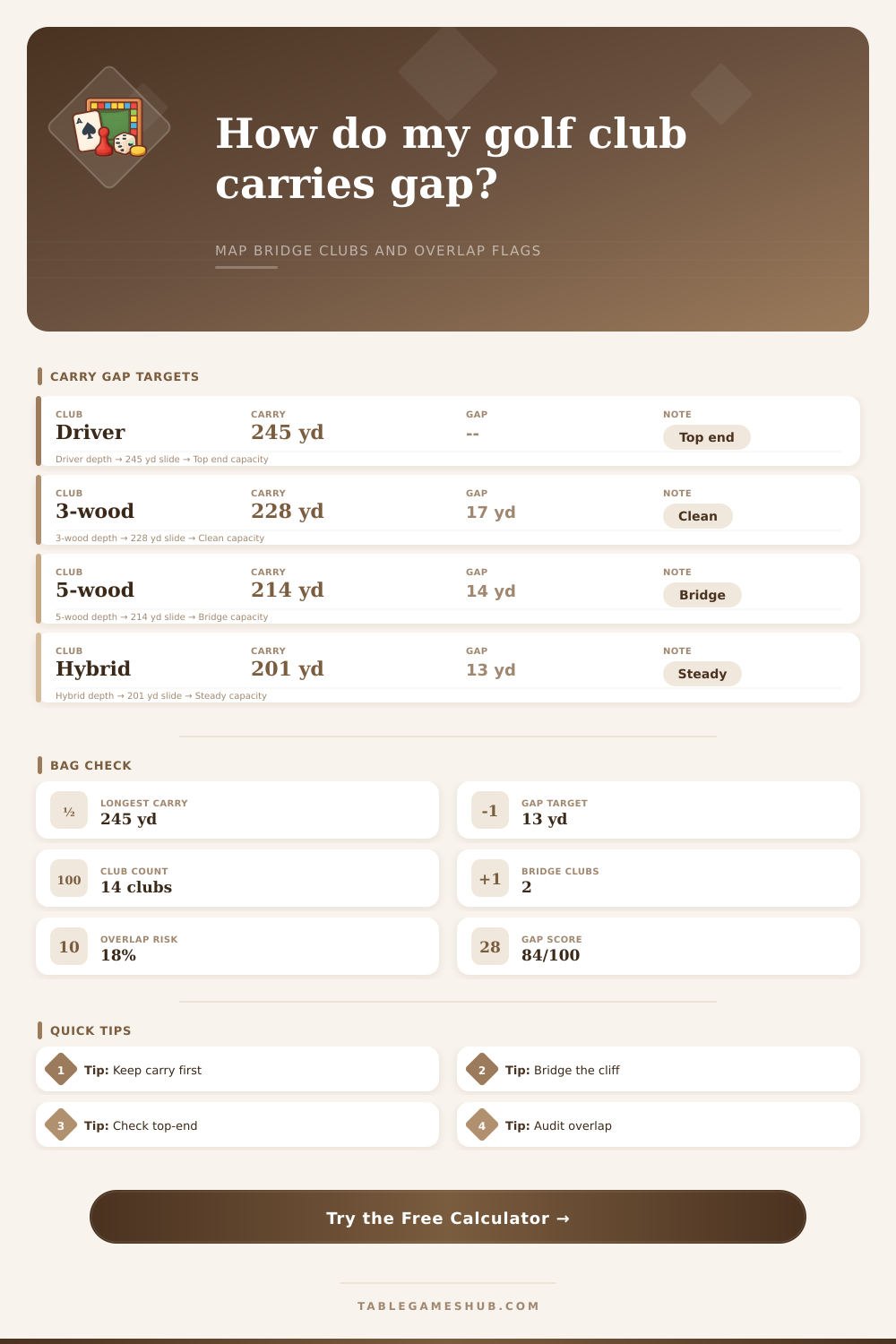
Golf Club Gapping Calculator for Carry Spacing
Translate carry numbers into a real ladder, expose overlap pressure, and decide where a bridge club earns its keep.
| Gap Segment | Typical Carry | Desired Spread | Why It Matters |
|---|---|---|---|
| Driver to 3-wood | 15 to 20 yd | Wide enough to justify the fairway wood | Controls tee-shot choice and approach distance. |
| 3-wood to 5-wood | 11 to 16 yd | Stable transition | Keeps the top of the bag from bunching up. |
| 5-wood to hybrid | 9 to 14 yd | Bridge-sized span | Decides whether the rescue club earns a slot. |
| Hybrid to long iron | 8 to 12 yd | Playable overlap only | Too tight here usually means one club is redundant. |
| Transition | Carry Window | Bridge Decision | Watch For |
|---|---|---|---|
| Driver to fairway wood | 10 to 18 yd | Add a 3-wood if the drop is more than your comfort line. | Low-launch drivers can shrink the first step. |
| Fairway wood to hybrid | 8 to 15 yd | Use a stronger-loft hybrid when long-game carry stalls. | Wind can erase a clean range on open courses. |
| Hybrid to longest iron | 7 to 13 yd | Insert a utility iron only if the strike window is repeatable. | Ball speed loss creates false confidence here. |
| Scoring wedge ladder | 8 to 12 yd | Keep the final bridge clean before the partial wedge zone. | Partial swings create misleading gap measurements. |
| Condition | Carry Change | Gap Impact | Suggested Response |
|---|---|---|---|
| Open wind | -3 to -9 yd | Top-end gaps widen unevenly | Prefer a bridge club with more launch and spin. |
| Cold air | -2 to -6 yd | Mid-bag spacing compresses less than you expect | Re-test the first three full-swing clubs. |
| Firm turf | +1 to +4 yd | Rollout can disguise poor carry separation | Do not var bounce create fake coverage. |
| Soft turf | -1 to -3 yd | Carry becomes the whole story | Lean on loft gaps, not rollout assumptions. |
| Player Profile | Bridge Pattern | Average Gap | Verdict |
|---|---|---|---|
| Balanced 14-club player | One fairway wood and one hybrid bridge | 12 to 14 yd | Usually clean if the top-end is not crowded. |
| Fast swinger | Low-spin bridge with a stronger hybrid | 13 to 16 yd | Needs more overlap checks near the driver slot. |
| Compact bag user | Mixed bridge ladder | 14 to 18 yd | Acceptable only when each club owns a distinct job. |
| Scoring-first player | Wedge-centered final spacing | 10 to 12 yd | Best when the long end is already stable. |
Long Game Spine
- Driver, 3-wood, and longest hybrid stack the opening distances.
- Best when top-end gaps stay above the overlap limit.
- Should lead the rest of the bag into a reliable middle ladder.
Bridge Zone
- Fairway wood or utility club that seals the distance cliff.
- Most sensitive part of the calculator because it controls redundancy.
- Needs the most careful checking in wind and cold.
Scoring Core
- Mid-irons and short irons should step down with predictable spacing.
- Protects approach-shot selection from awkward half-club choices.
- Should not be squeezed by an oversized long-game bridge.
Short Game Finish
- Wedges and gap wedges close the bag with deliberate separation.
- Too much overlap here steals precision from scoring shots.
- Should support yardages your full-swing wedges can repeat.
Tip Box One
- Build the ladder from carry gaps first, then var rollout become a bonus instead of the plan.
- If two clubs land inside the overlap limit, one of them is probably stealing the other's job.
- Bridge clubs should solve a distance hole, not simply add another head to the bag.
Tip Box Two
- Check the top end in the worst-weather conditions you regularly play.
- When the gap score falls, look for a cleaner transition before chasing more yardage.
- A smaller bag can still be well spaced if every club owns a distinct carry window.
Club gapping is a process of measuring the distances between each club within a golf bag. Club gapping is important to ensure that there are no large distance between clubs within a golf bag. If the distances between two club in a bag are very large, a golfer will struggle to understand which club to use to cover that distance.
Many golfers has gaps within there clubs because they dont measure the distances of their clubs. When measuring club gapping, golfers must focus on the carry distance of each club in there bag. The carry distance of a club is the distance that the ball will travel in the air before it hits the ground.
How to Gap Your Golf Clubs
The total yardage of a club is the distance that the ball will travel in the air plus the distance that the ball will travel after it hits the ground. Total yardage will change with the firmness of the ground, but carry distance will not. Carry distances should be used to create a ladder of club for a bag.
Within a bag are clubs that cover a range of distance, and the bridge zone is the area in between the woods and the irons. This zone will contain clubs like hybrid or fairway woods. Within this zone, the distances of the clubs should not overlap.
Clubs with an overlap indicate that a golfer has redundant club. Having redundant clubs makes it difficult for a golfer to decide which club to use for a specific distance. Beyond the clubs that are within a golf bag, there are other factor that will impact the distances of the clubs.
Environmental conditions will play a role in the distances of the clubs. For example, the temperature in the area will impact the distances of the clubs. Cold air is more dense than warm air.
This means that carry distances will be less in cold air, spesifically for the mid-irons. Additionally, the wind will play a role in the distances of the clubs. A headwind will decrease the distances that clubs travel, while a tailwind will increase the distances.
Another way to organize clubs within a golf bag are according to different club bag profile. The most common club bag profiles include 14 clubs with 13-yard increments between clubs, or 12 clubs with 16-yard increments between clubs. Additionally, you can tighten the gaps between the wedges within a bag to allow for more precision with the shorter club.
Many people make mistake in their club gapping analysis. One of the most common mistakes is focusing on the driver to determine club distances, but ignoring the distances of the other clubs in the bag. The carry distances of the shortest clubs should be measured first, and then the analysis should proceed up to the driver’s clubs.
Additionally, when measuring the carry distances of clubs, golfers should use full swings to determine each club’s carry distance. Using partial swings will produce inaccurate data, which will impact the club gapping analysis. Finally, after completing a club gapping analysis, golfers should test there clubs on a driving range.
Use this information to determine if the club distances need to be change. For clubs with too much overlap in distances, you can replace those clubs with clubs of different lofts. For clubs with large distances between clubs, a club should be added to the bag to ensure that there is a club for each distance.
Club gapping analysis ensure that there will be a club for each distance in the bag.