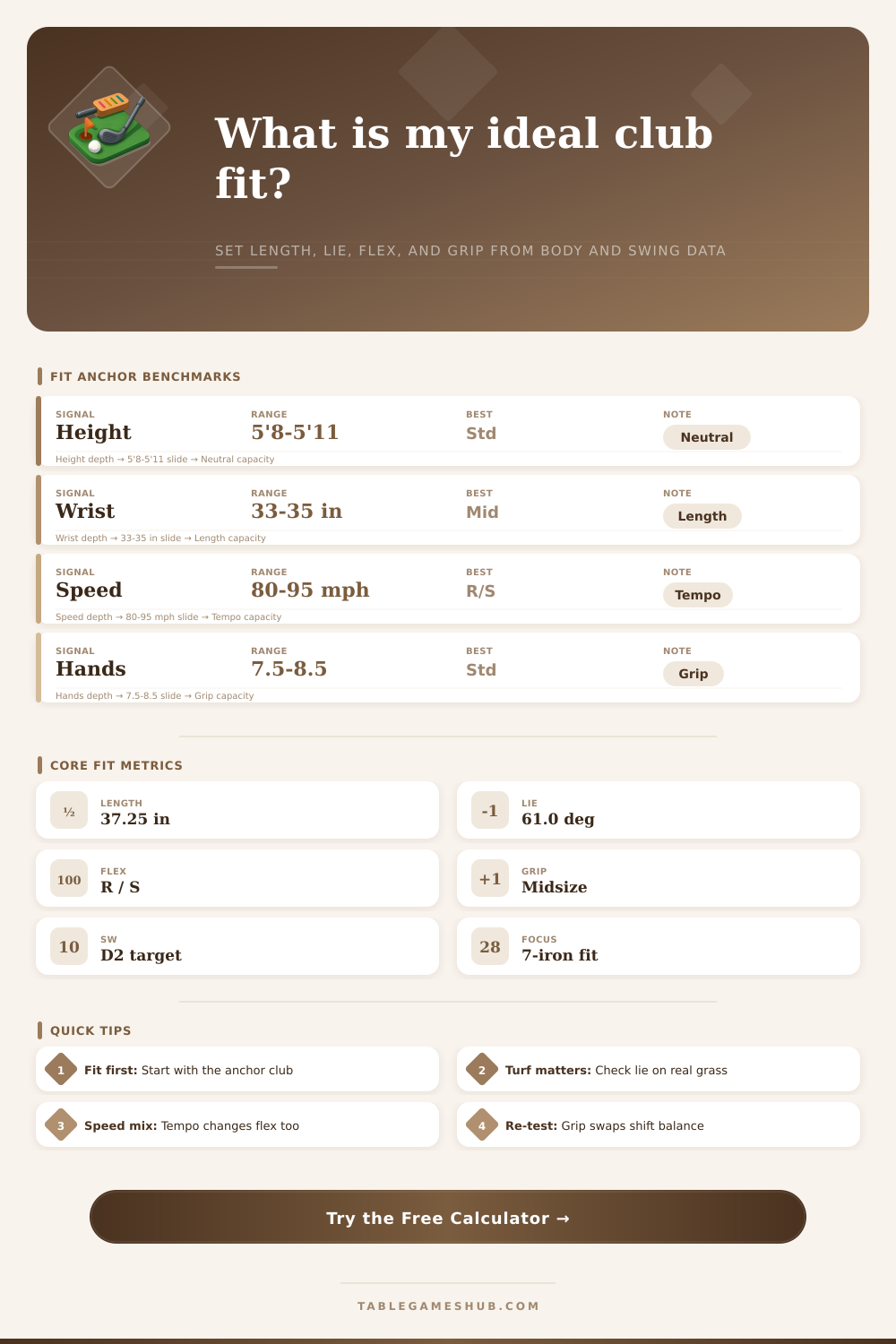
Golf Club Fitting Calculator
Map your body geometry and swing profile to a sharper starting spec.
| Body Signal | Range | Best Fit | Note |
|---|---|---|---|
| Short setup | Under 5'7 | Shorter | More control |
| Neutral setup | 5'8-5'11 | Std | Mid window |
| Tall setup | 6'0-6'3 | Longer | Add length |
| Long arms | WTF 35+ | Flatter | Lie check |
| Speed Band | Score | Flex | Launch |
|---|---|---|---|
| Easy tempo | Under 72 | L | High |
| Steady tempo | 72-81 | A | Mid-high |
| Tour pace | 82-91 | R | Mid |
| Fast load | 92+ | S/X | Lower |
| Miss Pattern | Lie Bias | Length Bias | Why |
|---|---|---|---|
| Toe side | Upright | +0.05 | Toe down |
| Heel side | Flatter | -0.05 | Heel up |
| Left bias | Upright | +0.03 | Path help |
| Right bias | Flatter | -0.03 | Face help |
| Hand Length | Grip Size | Wrap Note | Use Case |
|---|---|---|---|
| Under 7.2 | Undersize | Thin feel | Small hands |
| 7.2-7.8 | Standard | Neutral | Most players |
| 7.9-8.5 | Midsize | More fill | Stronger grip |
| 8.6+ | Jumbo | Maximum fill | Large hands |
Custom club fitting are used to ensure that the golf club is matched to a golfer. Clubs that doesnt match the golfer may cause mistake in the golfer’s game, such as hitting the ball too far then the right or hitting the ground before the ball. Golfers may attempt to fix these mistakes by altering they swing, but the specifications of the club typically cause the mistakes rather than the swing of the golfer.
Custom club fitting allow a person to establish a baseline for the specifications of the club so that the club may be adjusted accordingly. The physical measurement of the golfer create the specifications that is required for the clubs. Length is one of the primary specifications for clubs, as the length of the club will determine the golfer’s comfort in gripping the club.
How Custom Golf Club Fitting Helps Your Game
Lie angle is another of the primary specifications of clubs, as the lie angle will determine the way in which the sole of the club interact with the ground. Flex is a specification of clubs that must match the golfer, as the flex will impact clubs bending during the golfers’ swing. Grip size is another specification for clubs to ensure that the golfer’s hands does not move during their swing.
Additionally, each golfer should be measured for their height and their wrist to floor measurements. These two measurements are used to determine the specs of clubs for each individual. For instance, a tall individual will typicaly require clubs that are more long to avoid bending their knees too much during address.
By bending too much at address, the golfer may have a steep angle of attack. Resulting in the golfer hitting the ground before the ball. Swing speed and tempo are two specifications of clubs that must match the swing of the individual.
Clubs has flexibility within their shafts so that the clubs match the swing tempo of the individual. For instance, an individual that has a smooth and deliberate swing may have clubs with softer flexibility in the shafts than an individual that has a quick and aggressive swing. Additionally, each individual will have a specific swing speed in miles per hour, but each individual may have varying swing speed when blending speed with rhythm.
Miss patterns will also help determine the specifications of clubs. For instance, if an individual continuously hits the ball off the toe of the club, the lie angle of the club may be too flat. If the individual hits the ball off the heel of the club, the lie angle may be too upright; adjusting the lie angle of the club by a small amount may help to even out the way in which the sole of the club sits flush to the ground.
The posture of the individual when addressing the ball will impact the individual’s clubs. An individual with an upright posture will feel that the shaft of the club is longer than an individual with a bent over posture. Additionally, the grip size may impact clubs with different grip sizes.
For instance, if an individual have small palms, their clubs may slip during their swing. In this case, using a midsize grip for the clubs may help to prevent slipping of the clubs during the swing. Using a midsize grip will change the swingweight of the clubs, which may lead to a change in the weight of the club head or club shaft.
Each individual can use reference tables to establish a baseline for clubs. Reference tables will suggest club lengths according to the height of the individual. Reference tables can also suggest the lie angle bias of clubs according to the wrist-to-floor measurements of the individual.
Finally, reference tables can suggest clubs with specific flex according to the individual’s swing speed. For instance, an individual with a steady swing speed of around 80 mph may not require clubs with the flexibility of tour-stiff clubs. Additionally, another set of reference tables exist to help the individual to understand their grip size.
These reference tables are not rules, but they can provide a baseline of clubs specifications from which adjustments can be made. However, it is important for each individual to understand the interaction between each specification. For instance, tempo can affect flex, and flex can affect length.
Grip size can impact swingweight, and swingweight can impact the weight of the club head. Any changes to the specifications of clubs should be tested by the individual. Additionally, each individual may have a change in their posture during their round of golf due to fatigue.
Thus, posture can change, which impact the clubs interaction with the ground. Overall, the goal of club fitting is to increase the consistency of the clubs that are used by each golfer. Clubs that is fitted to each individual will allow for the individual to use their natural swing, and the clubs will minimize the number of compensation that each individual must make to play with their clubs.
Each individual should seek custom club fittings after they change their swing technique or after they experience a change in their bodys geometry. Thus, while the goal of a club fitting is not to immediately achieve perfection with clubs, it is with building a specification of clubs that reflect the golfer’s true swing.