Golf Club Swing Weight Calculator
Estimate feel, compare build changes, and dial in a matched set with clear swing-weight guidance.
Results
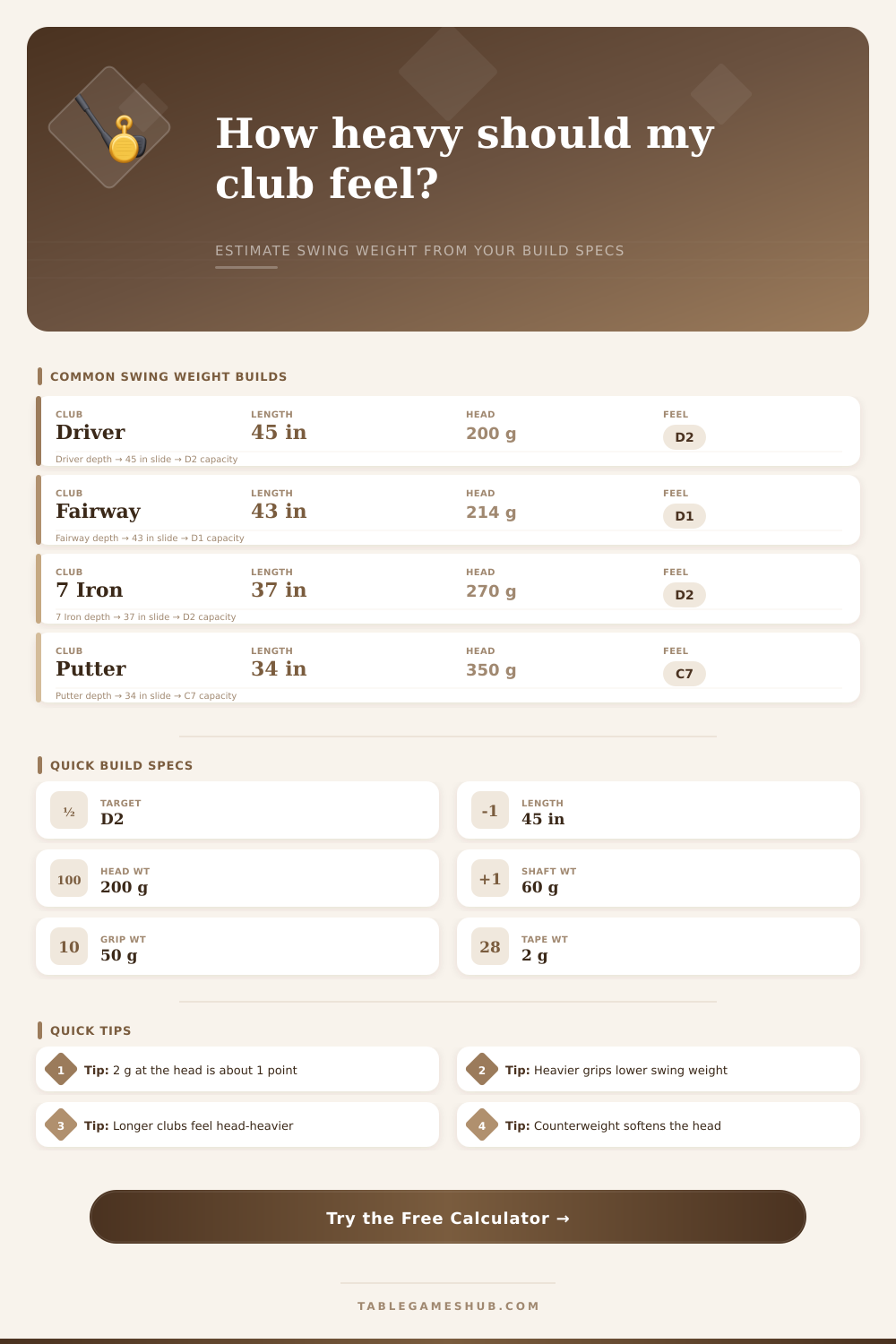
| Club Type | Typical Length | Head Weight | Common Feel |
|---|---|---|---|
| Driver | 45 in | 200 g | D2 |
| Fairway | 43 in | 214 g | D1 |
| 7 Iron | 37 in | 270 g | D2 |
| Putter | 34 in | 350 g | C7 |
| Swing Weight | Feel | Use Case | Note |
|---|---|---|---|
| C7-C9 | Light | Putters | Fast tempo |
| D0-D2 | Neutral | Most woods | Balanced |
| D3-D4 | Head heavy | Wedges | More feedback |
| D5+ | Very heavy | Special builds | Strong feel |
| Part | Typical Mass | Effect | Example |
|---|---|---|---|
| Grip | 45-60 g | Lowers SW | Tour grip |
| Shaft | 55-130 g | Small shift | Steel / graphite |
| Lead tape | 1-6 g | Raises SW | Head strip |
| Counterweight | 4-16 g | Lowers SW | Butt plug |
| Adjustment | Points | Approx grams | Result |
|---|---|---|---|
| Head +2 g | +1 | 2 g | More head feel |
| Grip +4 g | -1 | 4 g | Less head feel |
| Length +0.5 in | +1 to +2 | 0.5 in | More leverage |
| Counter +8 g | -2 | 8 g | Softer head |
Swing weight are a measurement of how a golf club feel during a swing. However, swing weight isnt the same thing as a total weight of the golf club. The total weight of the club is the amount of mass that the persons feels in there arms when they hold the clubs.
However, the swing weight measure how the mass of the club is distribute within the club. The swing weight is a measurement of the rotational inertia of the club head around a fulcrum located 14 inches from the end of the grip. If the swing weight of the clubs is incorrect, then the club head may feel too heavy or too light, which will cause the person to compensate for the club during their swing.
What is swing weight in golf clubs
Manufacturers use a scale of letters and numbers to denote the swing weight of there clubs. Many use D2 as the standard swing weight for their driver. However, other clubs will use a different swing weight, such as C7 for putter because a lower swing weight is suitable for player with a soft swing tempo.
Wedges will typically have a higher swing weight, such as D4, to allow for more clubhead feedback when performing partial swing to get the ball into the target area. If the clubs have different swing weight, it will be difficult for a player to maintain a consistent swing with the clubs. The length of the club will affect the swing weight of that particular club.
The longer the club, the more higher the swing weight of that club. This is due to the increased leverage that a player will have when swinging the club with more length. For example, a 45-inch driver will have a different swing weight than a 44.5-inch driver.
Another club feature that will affect swing weight is the weight of the grip. Adding more weight to the grip will create a drop in swing weight. For example, using a 65-gram grip instead of a 50-gram grip will drop the swing weight from D2 to D0. This can make clubs feel less stable when they hit the ball bad.
A person can adjust the swing weight of clubs using lead tape, counterweights, hot melt, and using heavier grip on the clubs. Using lead tape on the club head will increase the swing weight of that club. For example, adding two grams of lead tape to the toe of the club will increase the swing weight by one point.
Using a counterweight in the butt end of the club will decrease the swing weight of the club. For example, adding eight grams of counterweight to the butt end will decrease the swing weight by two points. Using a counterweight in clubs such as drivers will help prevent hooking of the clubs.
Additionally, using hot melt in the hosel of irons will allow clubs to be weight. Using heavier grips will decrease the swing weight of clubs and increase the thickness of the handle of the clubs. Swing weight is also related to the tempo that a person use when swinging the clubs.
Individuals with a smoother swing tempo will have a preference for clubs with a lighter swing weight for ease of loading the clubs. For individuals who exhibit an aggressive transition phase in their swing tempo, clubs with a higher swing weight can be preferred to prevent clubs from swinging through the arc too quick. Many clubs, such as drivers, use counterbalances in the butt end of the club to allow for a soft pull from the club head.
Clubs with swing weights that is not matched within a set will impact the player’s timing with each club. For example, a 7 iron will feel sluggish when compared to a hybrid club with a lighter swing weight. There are some mistake that players should avoid when adjusting the swing weight of clubs.
Adding too much lead tape to the club head will result in a decreased club head speed. A player has to be careful when reshafting clubs since this will change the swing weight of clubs. Additionally, the type of club must be consider when adjusting the swing weight.
For example, a player may find that their mallet putters have their best swing weight at C7, while their blade putters may require a swing weight of D0 for the best toe-hang. Testing the swing weight of clubs is important to allow players to optimize there swing. Using a launch monitor will display the swing weight of clubs in relation to the smash factor of the clubs.
A high smash factor will show the player that their club head speed is being translate to the ball speed. Additionally, by tracking the player’s round of the course, players can determine if the clubs have a matched swing weight. If the dispersion of the ball increase, this could be due to clubs with an incorrect and mismatched swing weight.
Maintaining a consistent swing weight with clubs will ensure that each club feel like an extension of the player’s swing.