Golf Exceptional Score Calculator
Check whether a posted round crosses the USGA exceptional score threshold and estimate the resulting handicap reduction.
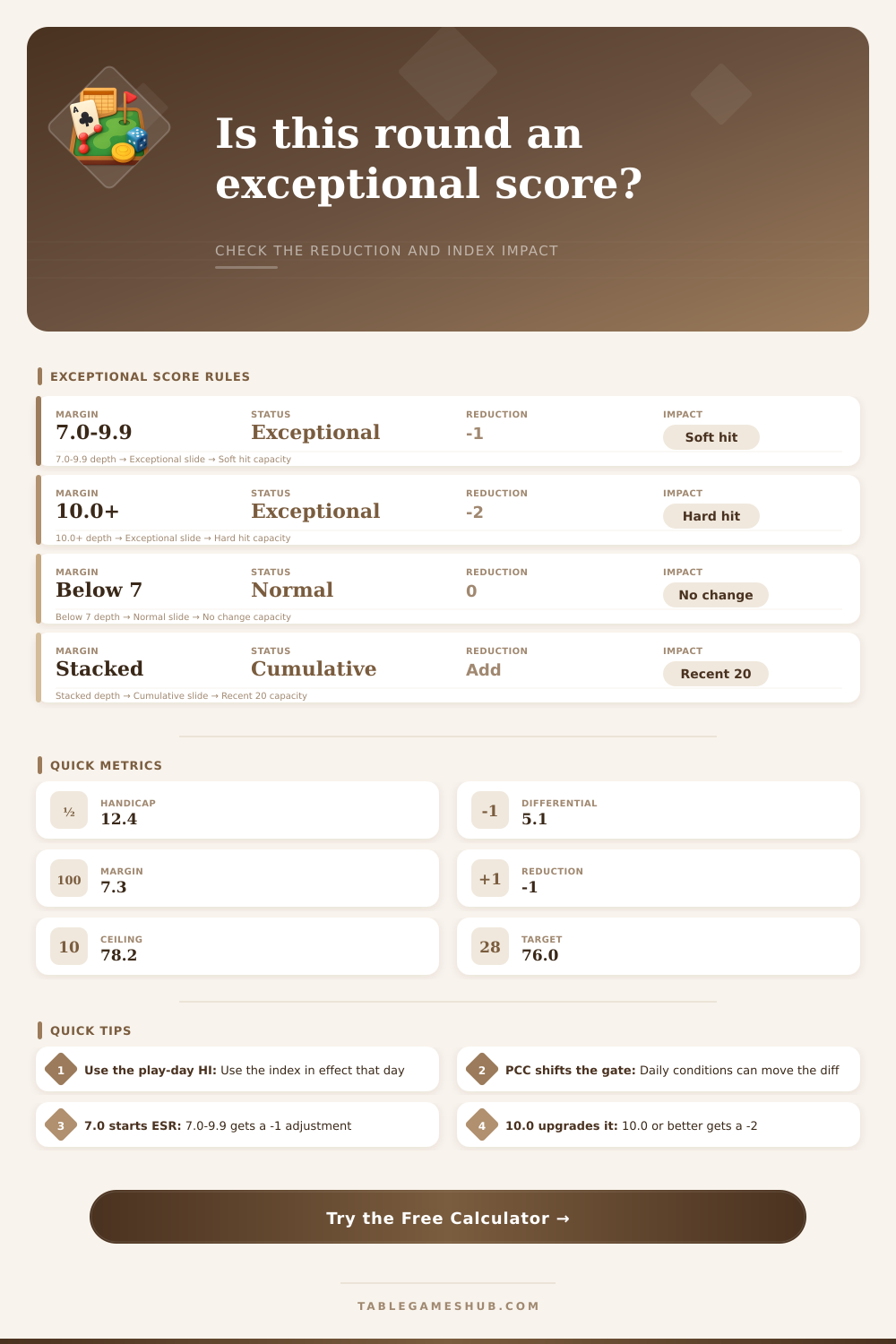
| Margin | Status | Reduction | Effect |
|---|---|---|---|
| Below 7.0 | Normal | 0 | No ESR |
| 7.0-9.9 | Exceptional | -1 | Soft cut |
| 10.0+ | Exceptional | -2 | Hard cut |
| Multiple | Cumulative | Stacks | Adds up |
| AGS | Course | Slope | Diff |
|---|---|---|---|
| 72 | 72.0 | 113 | 0.0 |
| 74 | 72.0 | 113 | 2.0 |
| 78 | 70.0 | 140 | 6.5 |
| 80 | 72.0 | 130 | 6.1 |
| HI | -1 Ceiling | -2 Ceiling | Note |
|---|---|---|---|
| 4.0 | 71.0 | 68.0 | Tight gate |
| 9.0 | 77.0 | 74.0 | Mid range |
| 12.0 | 80.0 | 77.0 | Common case |
| 18.0 | 86.0 | 83.0 | Higher index |
| Scenario | Margin | Reduction | Result |
|---|---|---|---|
| Very hot round | 10.0+ | -2 | Largest cut |
| Solid spike | 7.0-9.9 | -1 | Modest cut |
| Average score | Under 7 | 0 | No change |
| Stacked events | Many | Mixed | Stacked cut |
Use this calculator to compare a posted round with your Handicap Index, see whether the score is exceptional, and estimate the -1 or -2 reduction that would follow.
The USGA handicap systems includes rules for exceptional score reductions. These exceptional score reductions is made to lower a person’s handicap index in the case that a person posts an exceptionally good score. If a person’s score differential is significantly lower than there handicap index, then an exceptional score reduction can be applied to their score differential.
If a person’s score differential is 7 strokes lower than their handicap index, the system will reduce their score differential by one stroke. If their score differential are 10 strokes lower than their handicap index, their score differential will be reduced by two stroke. These reductions exist in the system as a means of ensuring that the handicap system remain stable for all individual.
How exceptional score reductions work in the USGA handicap system
These stroke reductions prevent the handicap index from experiencing a wildly swing if a person should score exceptional well on one round of golf. In order to understand how exceptional score reduction work for a person, it is first important to gain an understanding of the concept of score differential. A score differential is not the same as a person’s gross score for a round of golf.
The difficulty of the course that a person played calculates a score differential. The difficulty of the golf course can be calculated by looking at the course rating and the slope rating of the golf course. Additionally, another factor that can be included in the calculation of a score differential is the Playing Conditions Calculation, or the PCC.
The PCC is used to adjust a person’s score differential according to the weather and playing condition on the day that the round of golf was played. A person must use their handicap index as it was active on the day of play to calculate their score differential. Using their current handicap index will lead to an incorrect calculation of their score differential.
The Playing Conditions Calculation is one of the factor that can lead to a change in whether or not a person is eligible for an exceptional score reduction. If a person’s score differential is calculated using a Playing Conditions Calculation that indicates, for instance, that the weather was poor on the day of play, then that person’s score differential will be increased. An increased score differential may allow that person to reach the threshold that is required in order to earn an exceptional score reduction.
For instance, if a person has a handicap index of 18.0, and their score differential by earning an exceptional score reduction, their score differential will be reduced by two strokes. These stroke reduction will be applied to the 20 most recent score differentials of a person. Many people will make mistake when calculating their score differential.
Two of the most common mistakes include using the wrong handicap index and ignoring the Playing Conditions Calculation. A person may input their current handicap index rather than the handicap index that was active on the day of play. Additionally, a person may believe that the Playing Conditions Calculation is an optional calculation for score differentials, but this isnt true.
A person’s score differential will be incorrect calculated if the person ignores the Playing Conditions Calculation. Because the Playing Conditions Calculation has the ability to change a person’s score differential by as much as one or two strokes, it is one of the most important factor to consider in relation to exceptional score reductions. Low handicap indexes has different requirements for exceptional score reductions than high handicap indexes.
A person with a low handicap index will, generaly, have to score a much lower gross score in order to earn a score differential that is significantly lower than their handicap index. For instance, a person with a handicap index of 4.0 will have to score a very low score in order to earn an exceptional score reduction, but a person with a handicap index of 18.0 will have to score a gross score of around 86 to earn such a score reduction. These rules are establish to ensure that the exceptional score reduction rules are fair for all golfers of all skill level.
There are various ways that a person can use their knowledge of the rules of exceptional score reductions for their benefit. For instance, a person who desire to earn an exceptional score reduction can use their knowledge to calculate the gross score that they need to shoot in order to earn such a score reduction. However, a person will rarely earn such a score reduction for their rounds of golf.
The USGA handicap system rely on a person to honestly post their scores for each round of golf. The USGA handicap system will reward a person who consistently posts solid scores. Exceptional score reductions are a means of rewarding a person for there best rounds of golf.