🌳 Cascadia Score Calculator
Project habitat corridors, wildlife patterns, and endgame bonuses from your current board.
| Line | Input mix | Math used | Reading |
|---|
| Terrain | Score method | Strong signal | Weak signal |
|---|---|---|---|
| Forest | Largest corridor | Long spine | Split grove |
| Mountain | Largest corridor | Anchor ridge | Broken peaks |
| Prairie | Largest corridor | Wide meadow | Patchwork bits |
| Wetland | Largest corridor | Linked marsh | Small islands |
| River | Largest corridor | Clean stream | Snapped turns |
| Animal | Pattern | Good shape | Watch for |
|---|---|---|---|
| Bear | Pairs | Stacked twins | Lonely singles |
| Fox | Neighbor mix | Rich variety | One-note clumps |
| Hawk | Spacing | Open sight lines | Close clusters |
| Elk | Herd size | Long chain | Short fragments |
| Salmon | Run length | Smooth stream | Sudden breaks |
| Players | Largest bonus | Second bonus | Read |
|---|---|---|---|
| 1 | 0 | 0 | Solo set |
| 2 | 2 | 0 | Head-to-head |
| 3 | 3 | 1 | Top two matter |
| 4 | 3 | 1 | Same spread |
| Score band | Label | Board feel | Tuning note |
|---|---|---|---|
| 0-39 | Loose | Scattered | Too many gaps |
| 40-59 | Fair | Mixed | Needs glue |
| 60-79 | Tight | Stable | Plan is live |
| 80-100 | Sharp | Clean | Very efficient |
Keep one lane ahead
If one habitat is clearly leading, protect that corridor before you chase smaller gains elsewhere.
Wildlife value stacks fast
Hawk spacing, fox variety, and bear pairs can swing a score quickly when the board already looks stable.
Use this Cascadia score calculator to compare corridors, wildlife patterns, nature tokens, and majority pressure, then decide which board lane should get your next attention.
Cascadia is a game that involves placing tiles and wildlife token to score points. To play the game effective, a person must have a basic understanding of how the habitat and wildlife tokens will score for a person playing the game. The game uses habitat corridor to score points for the player, and the points earned from habitat are based on the size of the largest group of a specific tile type connected to one another.
For example, a player can create a corridor of forest tiles connected to one another. The size of that group of forest tile will score the player points for that habitat type. Because habitat tokens score the most points for a player, a player should aim to create long chains of habitat tiles connected to one another.
How to Score Points in Cascadia
A player who creates many small group of mountain tiles will score fewer points from those habitat than a player who creates a long chain of connected mountain tiles. Wildlife tokens will score a player additional points on top of the habitat points score. The bears will score a player points if the bear token are placed on adjacent habitat tiles.
The more bears on a habitat pair, the more points a player score. Fox tokens will score more points if they are on a habitat tile of a different type than the habitat the fox is on. Hawks will score points for a player if they are placed on habitat tile that are isolated from other hawks on the player’s tiles.
A player can score points for hawks if they are also on specific adjacent pair of habitat tiles. Elk tokens will score a player points based on the length of the row of elk tokens. The longer the elk herd of tokens, the more points a player will score.
Salmon tokens will score a player points based on the length of the run of salmon tokens on the players habitat tiles. The points for a players salmon tokens will use a mathematical equation to calculate the total point for a salmon run of that length. Each of these animal type will score a player points differently, so a person must choose which animal type will be their priority when placing those tokens on the game board.
In addition to the habitat and wildlife tokens, there are also nature and keystone game tokens. Nature tokens will score a player one point each. These tokens dont have any rules associated with them other than scoring one point each.
Keystone tokens are also worth one point each. Like nature tokens, a person scores a point for each keystone token placed on the game board, but if a player place a keystone token adjacent to a specific animal type, a player will score additional points for that keystone token. The value of each of these tokens is only one point, so many players will use these tokens to supplement the score earned from habitat and wildlife tokens.
The number of people playing the game will also influence the way in which a person score points in Cascadia. With only two other players on the game board, the top scoring habitat bonus will be more valuable to each player. For four players, however, the habitat bonuses will score fewer points for each player because the points will be spread thin among the number of players vying for those points.
Because the number of players on the game board change the value of these scoring bonuses, the number of players will impact the strategy each player should use in the game. Another way to improve a players performance in the game is to use the concept of projection to project future score for a player. A player uses projection to anticipate the types of habitats and wildlife tokens that will score them the most points.
The most common mistake with projection for wildlife and habitat tokens is creating each habitat and placing each type of wildlife token equally on the game board. A player should focus on one main habitat to score points for that habitat type. By focusing on one habitat, the player ensures that the habitat will score a player the most points based on the number of connected habitat tiles of that type.
A player can also use projection to anticipate the placement of wildlife tokens to work in conjunction with the habitat tiles that will score the player the most points. For instance, if a player projects that a wetland habitat will score the most points for their placed habitat tiles, the player can plan to place salmon tokens in that wetland habitat to score the most points for that habitat. A player can also score points in Cascadia based on other measure of the game board.
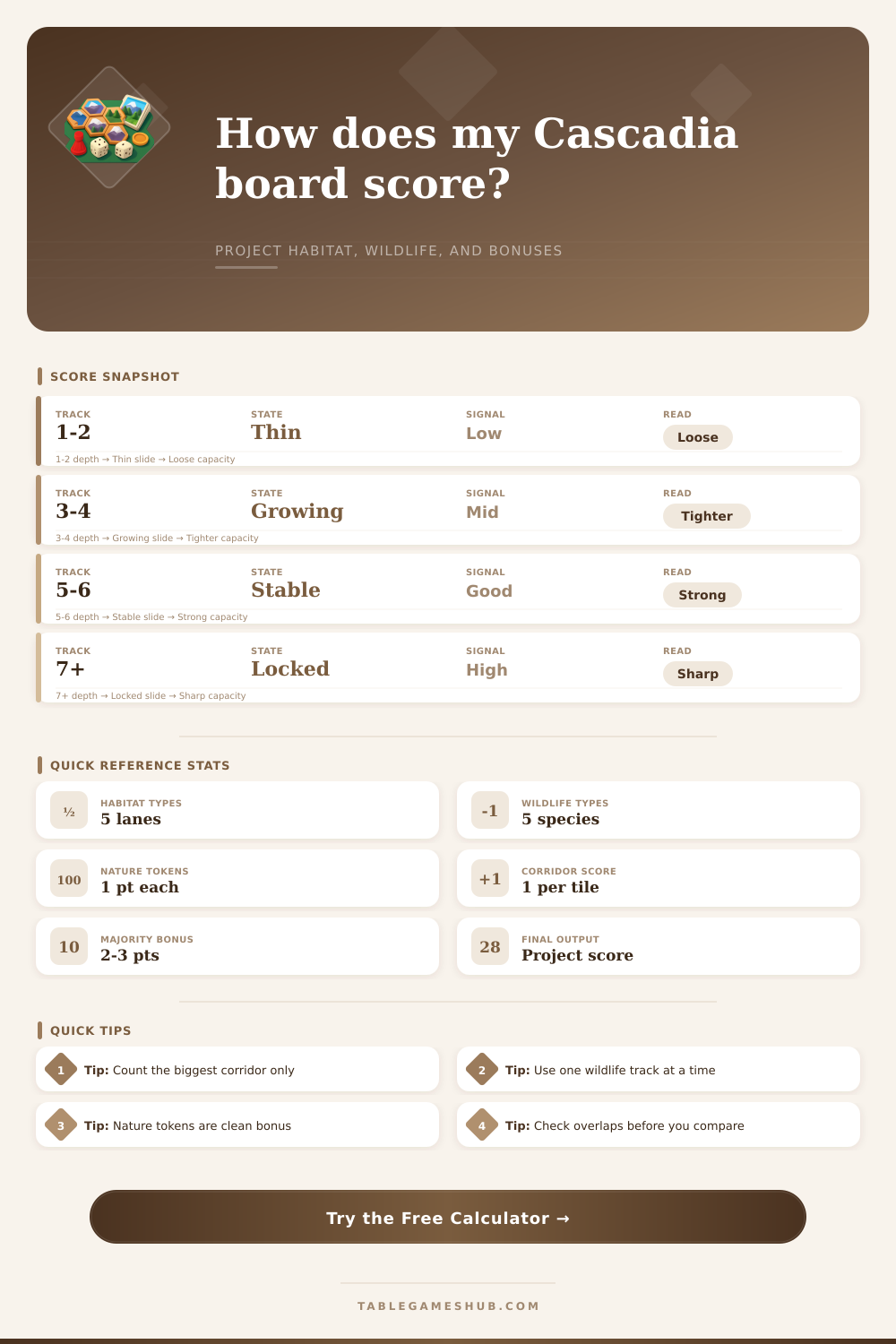
For example, the length of the habitat tiles in a habitat will help to determine if the game board is stable or not. A habitat of one to two tiles in length is thin. Three to four tiles in length for a habitat is considered to be of mid-sized length.
Five to six tiles of one habitat type is considered to be stable. Seven or more tiles in length for one habitat type is considered to be a high-scoring habitat. The total number of points that a player scores can also help to indicate the efficiency of a players game board.
Scores of zero to thirty-nine points is considered to be a scattered score. Forty to fifty-nine points is a fair score for a game board. Scores between sixty and seventy-nine points represent a stable score for a game board.
Scores of eighty points or more is considered to be an efficient game board for the player. Each of these measures can help to indicate if a player has created a good game board for Cascadia or if their game board is scattered and lacking in point.