🎯 D&D 2024 Point Buy Calculator
Assign ability scores using the 27-point buy system
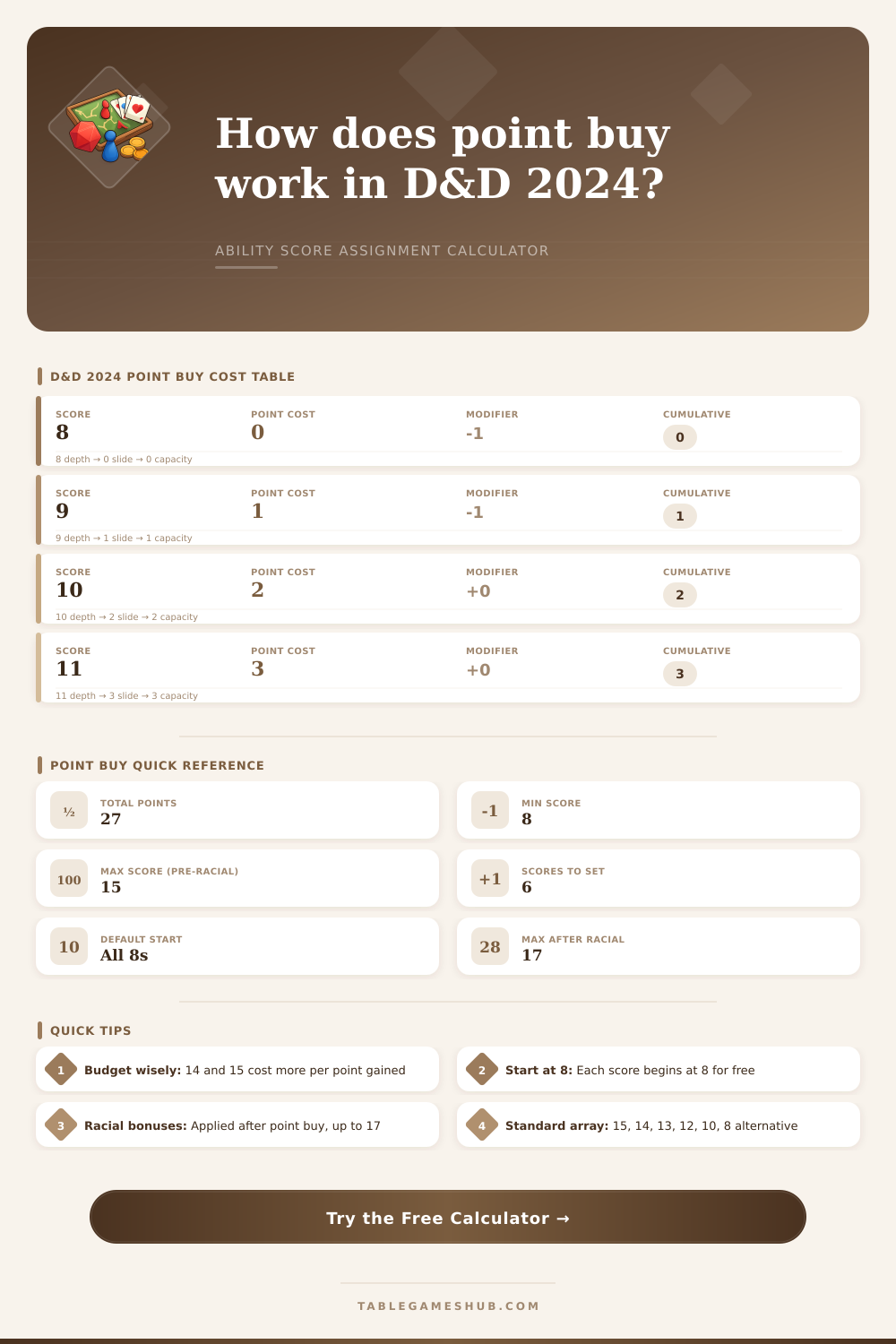
| Ability Score | Point Cost | Modifier | Marginal Cost |
|---|---|---|---|
| 8 | 0 | -1 | — |
| 9 | 1 | -1 | 1 |
| 10 | 2 | +0 | 1 |
| 11 | 3 | +0 | 1 |
| 12 | 4 | +1 | 1 |
| 13 | 5 | +1 | 1 |
| 14 | 7 | +2 | 2 |
| 15 | 9 | +2 | 2 |
| Method | Scores | Total Modifiers | Highest Mod |
|---|---|---|---|
| Standard Array | 15, 14, 13, 12, 10, 8 | +5 | +2 |
| Point Buy (min/max) | 15, 15, 15, 8, 8, 8 | +3 | +2 |
| Point Buy (balanced) | 13, 13, 13, 12, 12, 8 | +4 | +1 |
| Point Buy (SAD) | 15, 14, 14, 8, 8, 8 | +3 | +2 |
Point buy in DnD 5e is an optional way to set the six ability scores of a player: Strength, Dexterity, Constitution, Intelligence, Wisdom and Charisma. Instead of rolling dice, players get 27 “points” to use. All scores start at 8, and the higher you want it, the more it costs.
For example, choosing Strength 15 costs 9 of the 27 points. A score of 8 costs 0, while 15 costs 9. Using this system you cannot initially have a score under 8 or above 15
Point Buy Rules for DnD 5e
The system puts a “premium” on very high scores. Increasing a score from 10 to 12 costs two points, but raising it from 13 to 15 costs four. Such a difference really matters when making a charactre.
Point buy gives more customization and more variety between players, and it helps some classes that depend on several attributes become more viable. For example, classes like Monk are very hard if you start with the standard array. With point buy, players “buy” every score from the pool of 27 points and put them in any attributes they want.
Point buy or the standard array helps to keep players as close as possible in power level. For groups that want to play the same players through the hole campaign (or at least try), that really matters for balance. Actually, point buy or the standard array is the required method for official DnD organized play to ensure fairness between all participants.
Rolling dice for scores gives a slightly better average (12.24 against 12.125 for point buy), but also a much bigger range of results. Point buy limits the maximum score to 15. When rolling you usually use 4d6 and drop the lowest, which usually gives a set of about 16, 14, 13, 12, 10, 9.
With rolling, random scores almost certainly cause “wasted” odd rolls, while point buy lets players build exactly and do not waste a point.
Some groups mix both methods. A popular house rule is to roll 4d6 and keep 3 for all six scores, but if the total is under 70, the player can instead use point buy. Another option is that all roll, and later anyone unhappy can switch to point buy.
Some folks notice that point buy can lead to absolute min-maxing, according to the idea that if players get the chance, they will optimize the fun out of the game. Before racial changes, common point buy sets look like 15, 14, 13, 12, 11, 10 or 15, 14, 14, 10, 10, 8. There are also online point buy calculators that count point costs, racial bonuses, total scores, modifiers and a summary of traits to make the process easier.