🏆 Tournament Bracket Calculator
Calculate rounds, byes, total games, and full bracket structure for any tournament format
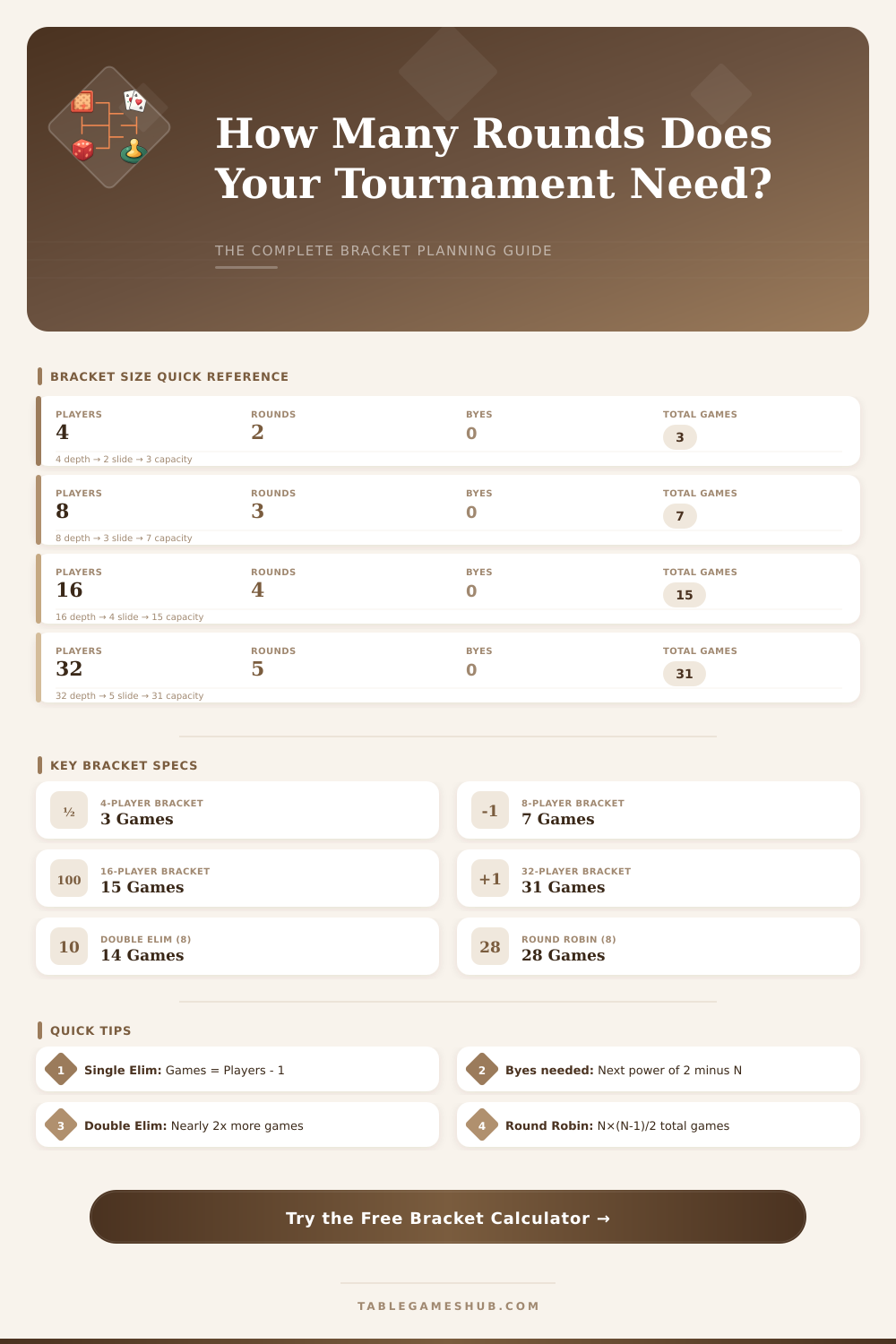
| Players / Teams | Rounds | Byes Needed | Total Games | 1st Round Games |
|---|---|---|---|---|
| 4 | 2 | 0 | 3 | 2 |
| 5 | 3 | 3 | 4 | 1 |
| 6 | 3 | 2 | 5 | 2 |
| 7 | 3 | 1 | 6 | 3 |
| 8 | 3 | 0 | 7 | 4 |
| 10 | 4 | 6 | 9 | 2 |
| 12 | 4 | 4 | 11 | 4 |
| 16 | 4 | 0 | 15 | 8 |
| 24 | 5 | 8 | 23 | 8 |
| 32 | 5 | 0 | 31 | 16 |
| 48 | 6 | 16 | 47 | 16 |
| 64 | 6 | 0 | 63 | 32 |
| 128 | 7 | 0 | 127 | 64 |
| Format | Min Games (N=8) | Max Games (N=8) | Fairness | Best For |
|---|---|---|---|---|
| Single Elimination | 3 | 3 | Low—1 loss out | Quick, large fields |
| Double Elimination | 7 | 15 | Medium—2 losses out | Competitive leagues |
| Round Robin | 28 | 28 | High—everyone plays | Small groups, clubs |
| Swiss System | N rounds | N rounds | High—paired by score | Chess, card games |
| Pool + SE Playoff | Varies | Varies | Medium-High | Large tournaments |
| Sport / Game | Avg Game Duration | 8-Player SE Total | Setup Time / Game | Court / Table Size |
|---|---|---|---|---|
| Tennis | 60–90 min | ~10.5 hrs | 10 min | 2,808 sq ft |
| Basketball (5v5) | 40 min | ~5 hrs | 15 min | 4,700 sq ft |
| Soccer | 90 min | ~14 hrs | 20 min | 115,000 sq ft |
| Table Tennis | 20–40 min | ~4 hrs | 5 min | 45 sq ft |
| Volleyball | 45–60 min | ~7.5 hrs | 10 min | 1,800 sq ft |
| Chess | 30–90 min | ~7 hrs | 5 min | 4 sq ft |
| Badminton | 20–45 min | ~5 hrs | 5 min | 880 sq ft |
| Poker (Tournament) | 120–180 min | ~21 hrs | 20 min | 60 sq ft |
At the base, a Tournament Bracket simply shows who faces who in the contest. It covers every match from the first phase until the final fight for the title. The main point is that there are several kinds of Tournament Brackets, and the choice between them depends on two main things: the number of players or teams that you work with, and how many chances to win you want to give to each of them.
Simple elimination is probably the most basic form. If you lose one time, you end… Fully out of the tournament.
Types of Tournament Brackets
The winners move on to the next stage. One sets up and follows such Tournament Brackets very easily, which makes them great for big groups of players. For example in an eight-team tournament you need three stages to choose the champion.
The last two teams fight for the victory, and the winner takes the prize home. There is something nice in that too, every game has big weight, because one loss ends everything for you.
Double elimination changes the deal, giving teams a safety net. You lose your first match? It does not matter.
You go into the Tournament Bracket for losers, where you can recover and rejoin the main contest. That works great when you want each team to leave feeling that they had fair chances to fight. On the other hand, if you lack time or tables, the Tournament Bracket for losers can clash with the main one.
That can leave the winners waiting without action, while several stages end.
Round robin offers yet another mode. Here every player meets all their opponents one time. Wins give one point, losses nothing, and ties share the point between them.
Such setups work well for smaller groups of players. Some tournaments mix it with other forms, they start with a general game to sort teams by there results, then send the best into simple elimination for the last part.
When you have an uneven number of players, some receive a free step. They pass forward without playing and reach the next stage. Such free steps usually happen in the first phase.
The seeding also matters here, because better players or teams end up in more favorable spots in the Tournament Bracket.
There are a lot of free generators for Tournament Brackets online now. Most support simple elimination, double elimination, Swiss system and round-robin setups. You can manage up to 128 teams in simple elimination, while double limits to close to 32 and round robin to around 26.
Those programs usually include automatic free steps, random seeding and the option to export the Tournament Bracket as an image to share. Many work fully online without needing a download, and some accept even more folks, over 256 insome kinds.
Tournament Brackets are used not only in sports. Board games, cards, video games, esports and even fun leagues for competition, everything benefits from them. Folks like to create images for interactive matches in a Tournament Bracket, to sort almost anything.