🧊 Rubik's Cube Calculator
Calculate combinations, move counts, solve times, algorithm sets & cube statistics for any puzzle size
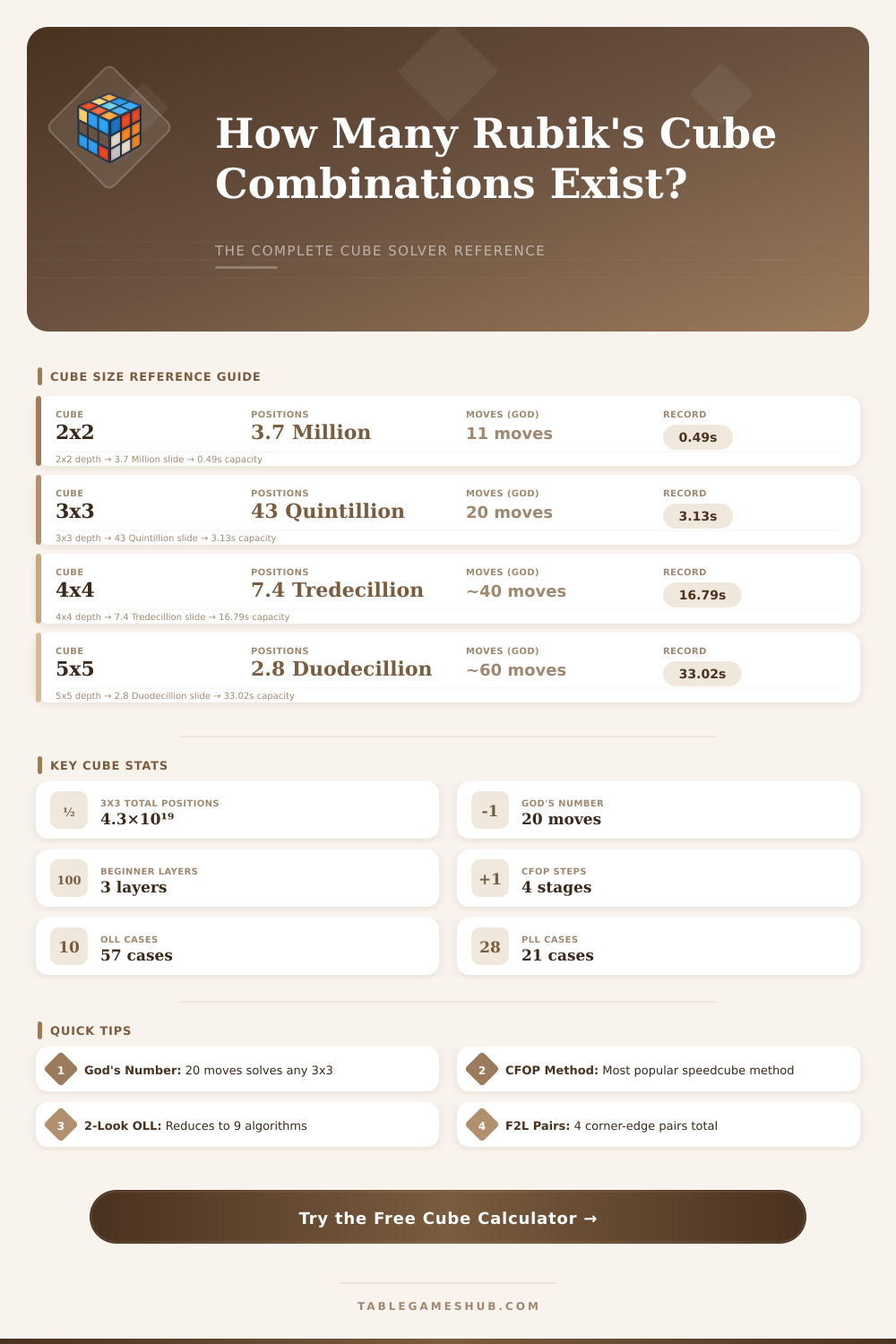
| Cube Type | Total Positions | God's Number | Movable Pieces | WR Single | Avg Beginner (s) |
|---|---|---|---|---|---|
| 2x2x2 | 3.7 Million | 11 moves | 8 corners | 0.49s | 30–60 |
| 3x3x3 | 43.3 Quintillion | 20 moves | 20 pieces | 3.13s | 60–180 |
| 4x4x4 | 7.4 Tredecillion | ~40 moves | 56 pieces | 16.79s | 300–600 |
| 5x5x5 | 2.83 Duodecillion | ~60 moves | 98 pieces | 33.02s | 600–1200 |
| Megaminx | 1.01 x10^68 | ~50 moves | 50 pieces | 25.24s | 600–900 |
| Pyraminx | 75,582,720 | 11 moves | 14 pieces | 0.91s | 20–60 |
| Skewb | 3,149,280 | 11 moves | 14 pieces | 0.93s | 20–60 |
| Method | Cube | Algorithms Needed | Avg Move Count | Skill Level | Typical Time Range |
|---|---|---|---|---|---|
| Layer-by-Layer | 3x3 | 7–10 | 100–120 | Beginner | 60–180s |
| CFOP (Fridrich) | 3x3 | 78–119 | 50–60 | Advanced | 5–30s |
| Roux Method | 3x3 | 40–60 | 45–55 | Intermediate | 8–40s |
| ZZ Method | 3x3 | 60–80 | 48–58 | Intermediate | 8–40s |
| Ortega | 2x2 | 12–16 | 12–18 | Intermediate | 2–10s |
| Reduction | 4x4/5x5 | 10–20 | 80–120 | Intermediate | 60–300s |
| Basic Layer | Megaminx | 10–15 | 150–200 | Beginner | 300–900s |
| Sarah's System | Skewb | 8–12 | 15–25 | Intermediate | 3–15s |
| Notation | Face / Layer | Direction | Degrees |
|---|---|---|---|
| U / U' | Up face | Clockwise / Counter | 90° |
| D / D' | Down face | Clockwise / Counter | 90° |
| R / R' | Right face | Clockwise / Counter | 90° |
| L / L' | Left face | Clockwise / Counter | 90° |
| F / F' | Front face | Clockwise / Counter | 90° |
| B / B' | Back face | Clockwise / Counter | 90° |
| U2 / D2 | Up / Down face | Double turn | 180° |
| M / E / S | Middle slices | As defined | 90° |
| x / y / z | Whole cube | Rotation axis | 90° |
| Skill Level | Avg Solve (3x3) | TPS (turns/sec) | Algos Known | Daily Sessions |
|---|---|---|---|---|
| Complete Beginner | 10+ min | 0.5–1 | 7–10 | 1–2 |
| Beginner | 2–5 min | 1–2 | 10–20 | 2–3 |
| Intermediate | 30–120s | 2–4 | 20–60 | 3–5 |
| Advanced | 15–30s | 4–8 | 60–119 | 5–10 |
| Expert / Sub-10 | Under 10s | 8–15 | 119+ | 10–20 |
| World Class | Under 5s | 15+ | 119 (full) | 20+ |
The Rubik Cube is a 3D combination puzzle, that was invented in 1974 by the Hungarian sculptor and architecture professor Ernő Rubik. Originally it was called the Magic Cube. Later the puzzle received licences for sale from Pentangle Puzzles in United Kingdom in 1978 and later from Ideal Toy Corp. In 1980.
Soon it became one of the most known games globally.
All About the Rubik’s Cube
Why does it attract so much? The Rubik Cube has six coloured sides, and every side has nine squares. Eight of those bits on every side can be turned separately.
The task is to twist and rotate the squares, until every side has only one colour. It seems easy, but reality shows otherwise. The Rubik Cube forms a mechanical 3×3×3 spinning puzzle, whose trouble comes from cleverly arranged internal core with interlocked piece structure.
Every arm of the central fixtures keeps one central piece in position.
Ernő Rubik created the cube first as a test. He wanted to build an object, that moves itself, spins and moves, while it keeps its basic form. Later he coloured every side and accidentally mixed it.
As a professor, he presented that tricky riddle to his students.
Although there are about 43 quintillion possible positions, the Rubik Cube can be solved with less than 15 algorithms. One famous beginner mode splits the Rubik Cube into seven layers and arranges every part without destroying the before finished elements. For that way you only need to know six actions.
The final stage commonly involves turning the corners, which requires attention, because one mistake can send everything back to the start.
Knowing the basic notation helps a lot. In sequences the letters point to different sides: F for front, R for write, U for upper, L for left and D for bottom. Combining videos with written explanations makes the stages much more clear.
Taking time to pause and practice slowly is a good plan.
Solving the Rubik Cube is like solving a math equation. When one knows the rule, the solution appears itself. Kids in high school commonly succeed in around two minutes.
The fastest players average six to eight seconds for one solution. In tournaments one takes the average of five attempts, removing the fastest and slowest, then averaging the three middle ones. Global records commonly are born, when an expert player has luck and the upper layers already end up settled after the two first.
There are also various methods for growing players, for example the famous CFOP-method. Some prefer brands like MoYu instead of the official Rubik Cube. The passion can become a habit, that leads tobigger cubes, mirror forms and other spinning puzzles.