🏓 Table Tennis Handicap Calculator
Calculate fair point handicaps for players of different ratings & skill levels
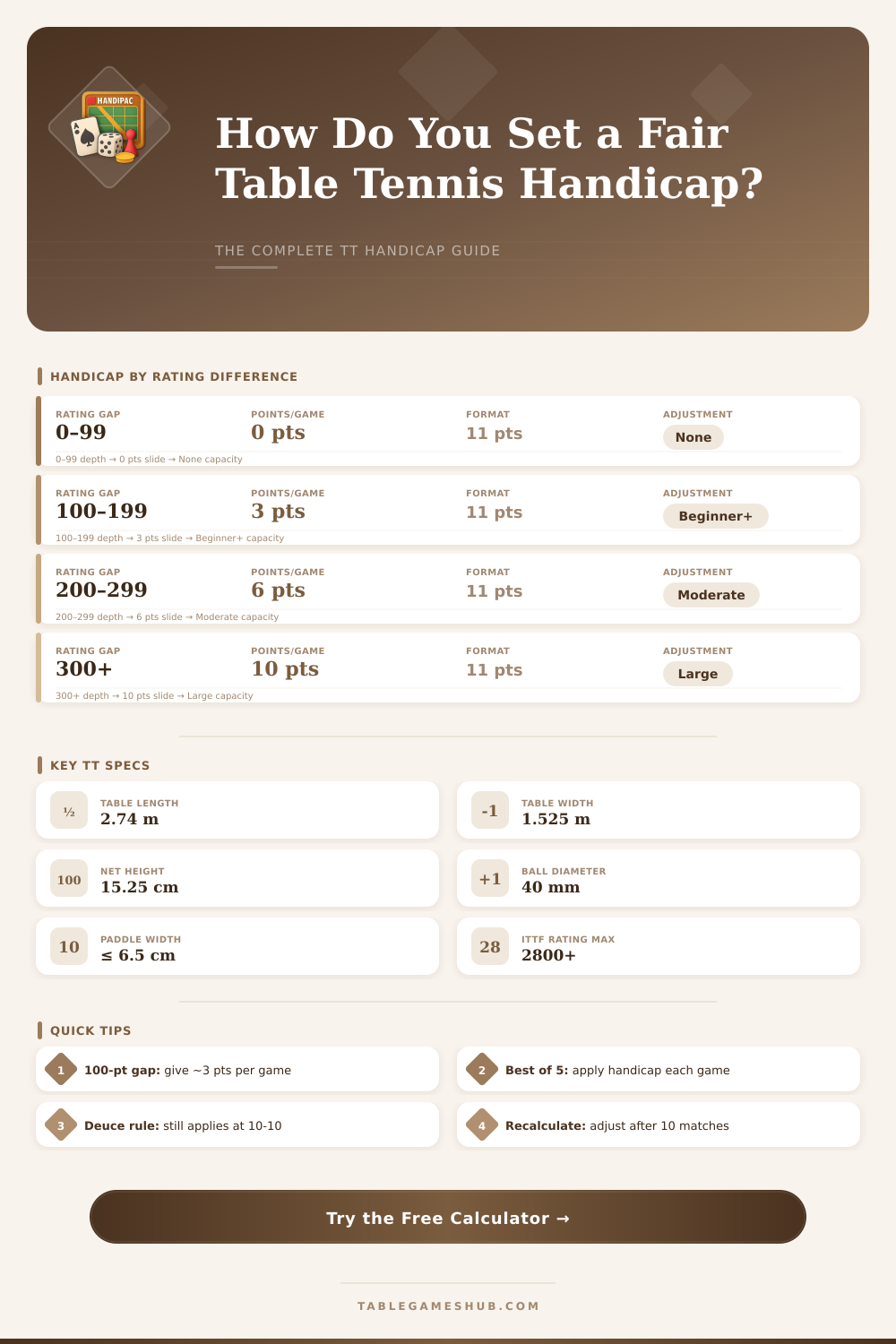
| Rating Gap | Handicap (11-pt game) | Handicap (21-pt game) | Win Probability (Stronger) | Recommended Format |
|---|---|---|---|---|
| 0 – 50 | 0 pts | 0 pts | 52–55% | No handicap needed |
| 51 – 100 | 1 pt | 2 pts | 55–60% | Optional 1-pt start |
| 101 – 200 | 2–3 pts | 4–5 pts | 60–68% | 2-3 pt head start |
| 201 – 300 | 4–5 pts | 7–8 pts | 68–75% | 4-5 pt head start |
| 301 – 400 | 5–6 pts | 9–10 pts | 75–82% | 5-6 pt or reduce target |
| 401 – 500 | 7 pts | 12 pts | 82–87% | 7 pt head start |
| 501 – 700 | 8–9 pts | 14–15 pts | 87–93% | Serve advantage + pts |
| 700+ | 10 pts | 17+ pts | 93%+ | Target reduction to 7 pts |
| Format | Games Needed to Win | Max Games | Est. Duration (min) | Common Use |
|---|---|---|---|---|
| Best of 1 | 1 | 1 | 10–15 | Quick casual play |
| Best of 3 | 2 | 3 | 20–30 | Club & recreational |
| Best of 5 | 3 | 5 | 30–50 | Standard tournament |
| Best of 7 | 4 | 7 | 45–70 | Elite / finals |
| 11-pt game | — | — | 8–15 | ITTF standard since 2001 |
| 21-pt game | — | — | 15–25 | Legacy / recreational |
| Skill Level | ITTF Rating Range | Typical Profile | Avg. Rally Length |
|---|---|---|---|
| Beginner | 0 – 500 | Just learning basic strokes | 2–4 shots |
| Novice | 501 – 800 | Consistent forehand, learning backhand | 4–6 shots |
| Intermediate | 801 – 1200 | Club player, basic topspin | 6–10 shots |
| Advanced | 1201 – 1600 | Strong loops, spin variation | 8–14 shots |
| Expert | 1601 – 2000 | Regional / national competitor | 10–20 shots |
| Elite | 2001 – 2800+ | National / international level | 12–25+ shots |
| Match Context | Handicap Style | Adjustment Factor | Notes |
|---|---|---|---|
| Recreational / Casual | Points head start | 0–5% | Keep it fun, don't over-calculate |
| Club Practice | Points head start | 10% | Encourage development |
| Tournament | Target reduction | 10–15% | Use official ITTF rating gap |
| Coaching Session | Serve advantage | 15–20% | Coach lets student win more |
| League Match | Points head start | 10% | Balanced division placement |
Table Tennis Handicap is a kind of match, where the players start with different points. When one player greatly beats his opponent that stronger player starts at a lower point. That helps to reach more equal results between players of different levels.
So, the game becomes more fun and exciting for all players.
How Table Tennis Handicap Works
In local ties of Table Tennis in United Kingdom there is a long custom about Handicap contests. One gives players an advantage or disadvantage according to their ranks. This way matches stay fair, although the skills of the players really differ.
In some Handicap forms one plays every game until 31 points. Every player receives a Handicap, that can be positive or negative. Even so in some versions they do not use negative Handicap spots.
Here every round is one game until 42 points, and the players swap ends at 21. One does not play deuces in taht system.
A new mode to address different skills is the step serve game with set numbers. The more expert player needs to reach 30 points, while the weak only 10. This allows both to go until the finish without control.
One adjusts the Handicap until the matches become quite equal. Some players even find creative ways to use it. For instance, a clever player can use the left hand against a newcomer in the sport.
That forces him to play hard, although the opponent is not that good. Besides that, a funny effect is to play with both hands together, with elbows pinned to the body, like T-rex arms. It looks silly, but it works.
Between friendly tournaments, giving two spots too the opponent deserves thought. Whether that is useful really depends on the difference in skills between the players.
Handicap spots also have a betting side. In betting about Table Tennis, the favorite gets a Handicap, that he must beat to win. That extends the match and creates fairer chances.
A common Handicap is 1.5 games, especially if the match is the best of five.
A problem of Handicap systems is, that at big differences in skill, the winning chances can become 50/50. For instance, a player rated at 900 spots against one of 2100 maybe ends equally, because the maximum Handicap is only 8. That can feel unfair for the stronger player.
A truly strong player probably should not lose points against a much weaker opponent, when one plays hard.
A special prize waits for the player, that gets the most points in a match, including doubles. If two or more players match, the one with the highest score between them wins. With a good Handicap system each plays equally many matches, andnone sits still watching the others all day.