🎳 Duckpin Bowling Score Calculator
Enter your ball-by-ball results for each frame — get your complete running score with strikes, spares & bonuses
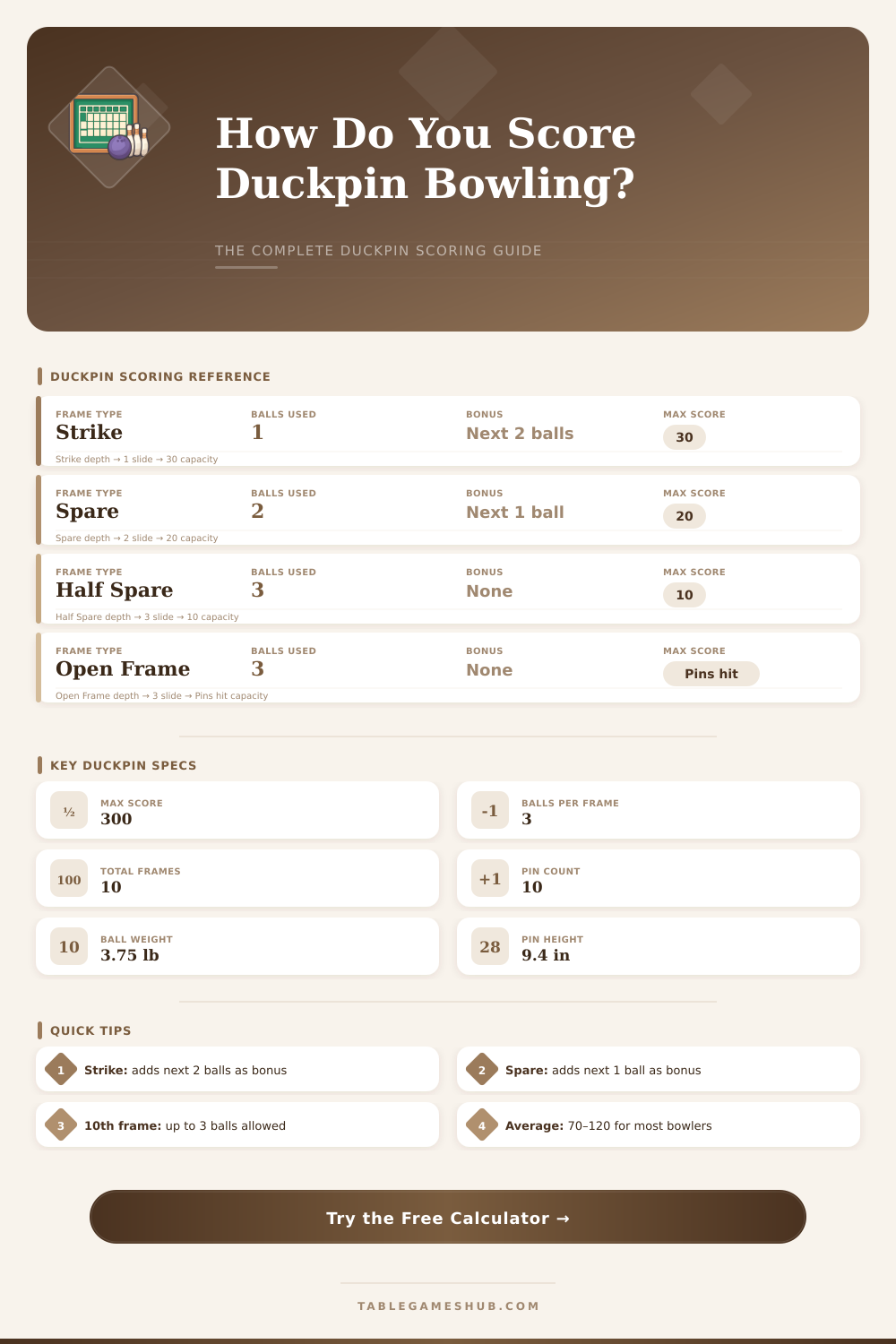
In duckpin bowling, each frame allows up to 3 balls. Enter pins knocked down per ball (0–10). Leave blank for unused balls. Strike = X (10 on ball 1), Spare = / (all remaining on ball 2 or 3).
| Frame Result | Balls Used | Bonus Scoring | Max Frame Score | Notes |
|---|---|---|---|---|
| Strike (X) | 1 | Next 2 balls added | 30 | All 10 pins on first ball |
| Spare (/) | 2 | Next 1 ball added | 20 | All remaining pins on 2nd ball |
| Half Spare (HS) | 3 | None | 10 | All pins cleared with 3rd ball |
| Open Frame | 3 | None | 9 | Pins left standing |
| 10th Frame Strike | Up to 3 | 2 bonus balls | 30 | Must complete all bonus balls |
| 10th Frame Spare | Up to 3 | 1 bonus ball | 20 | Third ball is bonus |
| Gutter Ball | 1 | None | 0 | Ball off lane = 0 pins |
| Specification | Duckpin | Tenpin | Candlepin |
|---|---|---|---|
| Max Score | 300 | 300 | 300 |
| Balls Per Frame | 3 | 2 | 3 |
| Pin Height | 9.4 in (23.9 cm) | 15.0 in (38.1 cm) | 15.75 in (40.0 cm) |
| Pin Weight | 1 lb 8 oz | 3 lb 6 oz–3 lb 10 oz | 2 lb 8 oz |
| Max Ball Weight | 3 lb 12 oz (3.75 lb) | 16 lb | 2 lb 7 oz |
| Finger Holes in Ball | None | 3 | None |
| Avg Rec Score | ~70–100 | ~120–150 | ~70–100 |
| Perfect Game Achieved | Never recorded | Common | Never recorded |
| Score Range | Player Level | Typical Frame Pattern | Avg Pins/Frame |
|---|---|---|---|
| 0–39 | Very Beginner | Mostly 0–3 pins, many gutter balls | 0–3.9 |
| 40–69 | Beginner | 3–6 pins avg, rare spares | 4–6.9 |
| 70–99 | Recreational | 6–9 pins avg, occasional spares | 7–9.9 |
| 100–129 | Intermediate | Regular spares, few strikes | 10–12.9 |
| 130–159 | Advanced | Frequent spares, regular strikes | 13–15.9 |
| 160–199 | Expert / League | Mostly spares and strikes | 16–19.9 |
| 200+ | Elite | Consistent strikes & spares | 20+ |
| Format | Games Per Session | Frames | Handicap System |
|---|---|---|---|
| Standard League | 3 | 10 per game | 80% of 200 |
| Scratch Tournament | 4–6 | 10 per game | None |
| Handicap Tournament | 4–6 | 10 per game | 90% of 200 |
| Youth League | 2–3 | 7–10 per game | 100% of 150 |
| Baker Team Format | 4 | 10 per game (shared) | 80% of 200 |
| Practice Session | 1–2 | 5–10 per game | None |
Duckpin bowling is similar to regular bowling in many ways, but it has enough unique traits to stay interesting and challenging. The points add up frame after frame, building during the game so that each frame adds to your total. In a full game you have 10 frames and the total of everything you score across them becomes your final score.
What if you manage to knock all 10 pins with your first ball? That is called a strike. You right away receive 10 points, plus what you manage to knock down with the next two rolls.
How Scoring Works in Duckpin Bowling
In duckpin bowling strikes are really rare. They pretty much shape the whole game. The skill to get them often is what sets good bowlers apart from the others.
The max for one frame is 30 points, which happens during three strikes one after the other. In theory it is possible to reach a perfect 300 points, just like in regular bowling. That would need about 12 strikes during the whole game.
Here is the main challenge though, nobody has ever done that under official rules. It is the kind of target that folks chase, even though it almost never happens.
So here comes the open frame, which happens when you do not get a strike or a spare. For such a frame the points are simply the number of pins that you knocked down with three balls, without any extra bonus. For example, if you drop 3 pins with the first roll, then 6 with the second and 1 with the third, that gives 10 points total for that frame.
Open frames happen often, even among players of higher level. This is wear the real trouble of duckpin bowling shows its teeth.
When you manage to knock all pins with three rolls, but not with the first ball, that is a spare, which is worth 10 points. Another thing is that unlike strikes, the next frame does not affect the points of your spare. Still, if you get a spare or strike in the tenth frame, you receive one or two extra rolls.
Getting past 100 points deserves real celebration. Most average bowlers stay around that limit. Good home players average close to 130 or 135.
Looking at the professional level, you find scores around 140 for most players, while only some elites stay around 150. Anything above 180 is a pretty rare event. A game of more than 200 in duckpin bowling matches 300 in regular bowling in difficulty, that is how hard it is.
Three games with a total of 500 in duckpin bowling match an 800 series in regular bowling. If you usually score 200 to 220 in regular bowling, you will probably end in the middle to high 100s or even lower in duckpin bowling, becausestrikes simply do not happen that easily.
There are also online calculators for points in duckpin bowling that go around, with the option to track several games and fix mistakes.