3 Dice Probability Calculator – Find Any Roll Outcome Fast
🎲 3 Dice Probability Calculator
Calculate exact odds, sums, combinations, and outcomes for rolling three standard dice
⚡ Quick Presets
🧮 Calculator Inputs
📊 Probability Results
📊 3 Dice Sum Probability Reference
| Sum | Ways to Roll | Probability | Cumulative (≥) | Odds (1 in X) |
|---|
🎲 Dice Game Configurations
216
Total Outcomes (3d6)
10 / 11
Most Likely Sums
6
Possible Triples
12.50%
Peak Probability
10.5
Expected Sum (Mean)
2.96
Std Deviation
120
All-Different Outcomes
42.13%
Chance of Any 6
🎯 Common Dice Game Scenarios
| Game / Scenario | Dice Used | Key Target | Probability | Notes |
|---|---|---|---|---|
| Yahtzee – Three of a Kind | 3d6 | Any Triple | 2.78% | 6 ways / 216 |
| Farkle – Triple 1s | 3d6 | 1-1-1 | 0.46% | 1 way / 216 |
| Farkle – Triple 6s | 3d6 | 6-6-6 | 0.46% | 1 way / 216 |
| Street Dice – Lucky 7 | 3d6 | Sum = 7 | 2.78% | 6 ways / 216 |
| Bunco – Target Round | 3d6 | All match round | 2.78% | Round 1 = 1-1-1 |
| Catan – High Probability | 2d6 (+1) | Sum 6–8 | ~41.67% | 2d6 reference |
| D&D Damage Roll | 3d6 | Sum 15+ | 9.26% | 20 ways / 216 |
| Crown & Anchor | 3d6 | Specific symbol x3 | 0.46% | 1 way / 216 |
| Chuck-a-Luck – Any Match | 3d6 | At least one target | 42.13% | 91 ways / 216 (for 6) |
🧠 Special Combination Counts
| Combination Type | Ways to Occur | Probability | Example |
|---|---|---|---|
| Exact Triple (specific) | 1 | 0.46% | 4-4-4 |
| Any Triple | 6 | 2.78% | 1-1-1 through 6-6-6 |
| All Three Different | 120 | 55.56% | 1-2-3, 2-4-5, etc. |
| Exactly Two the Same | 90 | 41.67% | 2-2-5, 3-3-1, etc. |
| At Least One Six | 91 | 42.13% | 6-x-x, x-6-x, x-x-6 |
| Straight (1-2-3 or 4-5-6) | 12 | 5.56% | Any 3-consecutive order |
| Sum is Even | 108 | 50.00% | Sum 4,6,8,10,12,14,16,18 |
| Sum is Odd | 108 | 50.00% | Sum 3,5,7,9,11,13,15,17 |
💡 Probability Tips
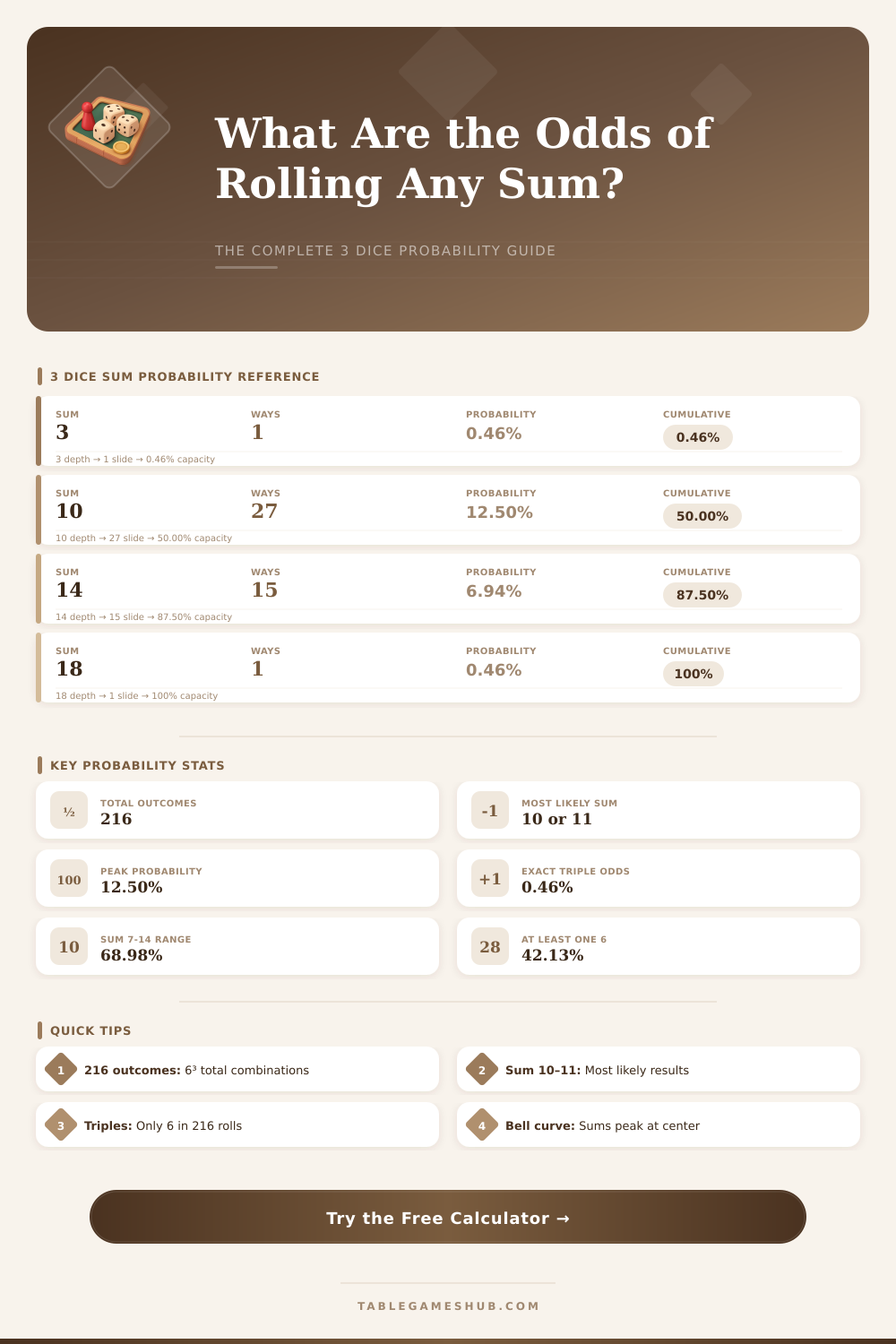
🎲 The Bell Curve Rule: With 3 dice, sums cluster toward the middle. Sums 10 and 11 each have 27 ways to occur (12.5% each), making them the most likely outcomes. Sums of 3 and 18 have only 1 way each (0.46%).
🧮 Total Outcomes Formula: For N dice each with F faces, total outcomes = F⁰. For 3 standard dice: 6³ = 216. For custom dice (e.g. 3d8): 8³ = 512. Always start here before calculating any probability.
🎯 Complement Rule: P(event) = 1 – P(not event). Instead of counting all ways to roll sum ≤ 9, count all ways to roll sum ≥ 10 and subtract from 1. This simplifies many calculations significantly.
📈 Multiple Rolls: If P is the probability of an event on one roll, the probability of it happening at least once in N rolls = 1 – (1–P)⁰. For 10 rolls at 2.78% chance, the cumulative probability is about 24.8%.
Standard die has six sides, and each of them has equal chance to fall up. Like this the chance to get some particular number comes to 1/6. For instance, cast 3 happens just as commonly as cast 5.
So everything stays very simple.
Dice Rolls, Sums and Chances
When one uses two dice, the situation becomes more interesting. Casting two normal six-sided dice, one gets 36 different possibilities. The sum 7 results most commonly, because it happens by means of 6 ways from those 36.
Rather, values like 2 or 12 only once are possible from 36. Here the whole list: 3 and 11 always twice, 4 and 10 thrice, 5 and 9 four times, while 6 and 8 each five times from 36. That shows, why 7 shows like this often when folks cast two dice.
The spread of chances for one single die is even, so each number has same chance. Even so, casting several dice and adding their values, the curve of the spread starts to look like a bell curve. Big numbers appear less commonly, and results meet around the average.
Two dice give a pyramid, but three or more create a real blel curve.
The space of samples is made up of all possible results. During tossing of dice, this space stores everything, that can happen. Counting it forms the first step in any chance analysis.
On the net there are calculators for chances of dice, that simplifies all such cases. Some of them were made for rolling games, for instance AnyDice. That website works with many kinds of dice, not only six-sided.
It covers four-sided, eight-sided and even twenty-sided. One can figure the chance for a certain sum or for values above or under a set number.
A useful trick is the rule of complement. Assume, some one casts four dice and wants, that at least one of them show 5 or 6. Rather than count all winning cases, more easy to estimate the opposite event.
For one die, the chance to be under 5 match 2/3. Like this, for all four to bee under 5, one raises (2/3) to the fourth power. One takes that from 1, and gets 65/81.
Comparing 2d6 against 1d12 forms another fun idea to think about. With one twelve-sided die, every number of 1 until 12 is just as likely. But two six-sided dice form a bell curve, where centers appear more dense.
Dungeons and Dragons apply this trick: cast four dice and dump the weakest, for better skill points. Like this, 18 shows almost 20 times more commonly.
Even about odd and even values the cases follow rules. When the first die is even, the sum of two dice is even in 50% and odd in 50%. In the same way, if the first is odd.
Alwaysstays half against half.