12-Sided Dice Probability Calculator – D12 Odds & Results
🎲 12-Sided Dice Probability Calculator
Calculate exact odds, sums, and probabilities for d12 dice rolls — single die or multiple dice
⚡ Quick Presets
⚙️ Calculator Settings
📊 Probability Results
🎲 D12 Key Statistics
12
Total Faces
6.5
Average Roll
8.33%
Each Face (1 die)
144
2D12 Combos
1728
3D12 Combos
3.45
Std Deviation (1d12)
13
2D12 Most Likely Sum
50%
Roll 7+ (single die)
📋 Single D12 Roll Probabilities
| Target Roll | Exact (= X) | At Least (≥ X) | At Most (≤ X) |
|---|---|---|---|
| 1 | 8.33% | 100.00% | 8.33% |
| 2 | 8.33% | 91.67% | 16.67% |
| 3 | 8.33% | 83.33% | 25.00% |
| 4 | 8.33% | 75.00% | 33.33% |
| 5 | 8.33% | 66.67% | 41.67% |
| 6 | 8.33% | 58.33% | 50.00% |
| 7 | 8.33% | 50.00% | 58.33% |
| 8 | 8.33% | 41.67% | 66.67% |
| 9 | 8.33% | 33.33% | 75.00% |
| 10 | 8.33% | 25.00% | 83.33% |
| 11 | 8.33% | 16.67% | 91.67% |
| 12 | 8.33% | 8.33% | 100.00% |
📋 2D12 Sum Probability Distribution
| Sum | Combinations | Probability | Cumulative (≥) |
|---|---|---|---|
| 2 | 1 | 0.69% | 100.00% |
| 3 | 2 | 1.39% | 99.31% |
| 4 | 3 | 2.08% | 97.92% |
| 5 | 4 | 2.78% | 95.83% |
| 6 | 5 | 3.47% | 93.06% |
| 7 | 6 | 4.17% | 89.58% |
| 8 | 7 | 4.86% | 85.42% |
| 9 | 8 | 5.56% | 80.56% |
| 10 | 9 | 6.25% | 75.00% |
| 11 | 10 | 6.94% | 68.75% |
| 12 | 11 | 7.64% | 61.81% |
| 13 | 12 | 8.33% | 54.17% |
| 14 | 11 | 7.64% | 45.83% |
| 15 | 10 | 6.94% | 38.19% |
| 16 | 9 | 6.25% | 31.25% |
| 17 | 8 | 5.56% | 25.00% |
| 18 | 7 | 4.86% | 19.44% |
| 19 | 6 | 4.17% | 14.58% |
| 20 | 5 | 3.47% | 10.42% |
| 21 | 4 | 2.78% | 6.94% |
| 22 | 3 | 2.08% | 4.17% |
| 23 | 2 | 1.39% | 2.08% |
| 24 | 1 | 0.69% | 0.69% |
📋 Multi-Dice Summary Reference
| Dice Count | Min / Max Sum | Average Sum | Std Deviation |
|---|---|---|---|
| 1d12 | 1 / 12 | 6.5 | 3.45 |
| 2d12 | 2 / 24 | 13.0 | 4.88 |
| 3d12 | 3 / 36 | 19.5 | 5.98 |
| 4d12 | 4 / 48 | 26.0 | 6.90 |
| 5d12 | 5 / 60 | 32.5 | 7.71 |
📋 Advantage / Disadvantage Probabilities (1D12)
| Roll ≥ X | Normal | With Advantage | With Disadvantage |
|---|---|---|---|
| Roll ≥ 7 | 50.00% | 75.00% | 25.00% |
| Roll ≥ 9 | 33.33% | 55.56% | 11.11% |
| Roll ≥ 10 | 25.00% | 43.75% | 6.25% |
| Roll ≥ 11 | 16.67% | 30.56% | 2.78% |
| Roll ≥ 12 | 8.33% | 15.97% | 0.69% |
💡 Tip: The Complement Rule — To find the probability of rolling less than X, subtract the "at least X" probability from 100%. For example, rolling less than 8 on a d12 = 100% – 41.67% = 58.33%. This avoids counting all individual outcomes separately.
💡 Tip: Advantage Boosts Your Odds Significantly — Rolling with advantage (take the higher of two dice) boosts your probability of hitting 10+ from 25% to 43.75%, nearly doubling your chances. Use the Advantage mode in this calculator to see the exact effect for any target number.
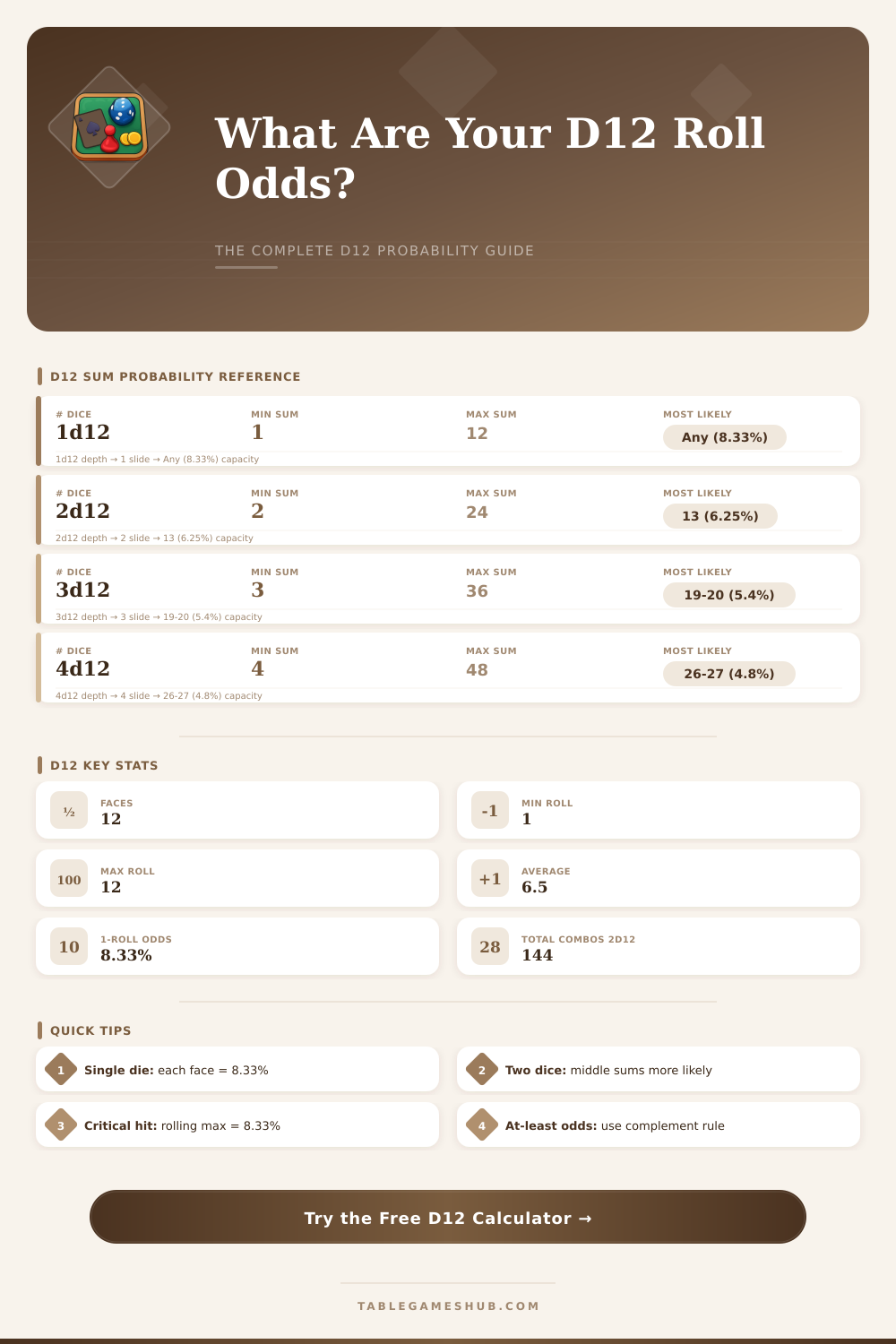
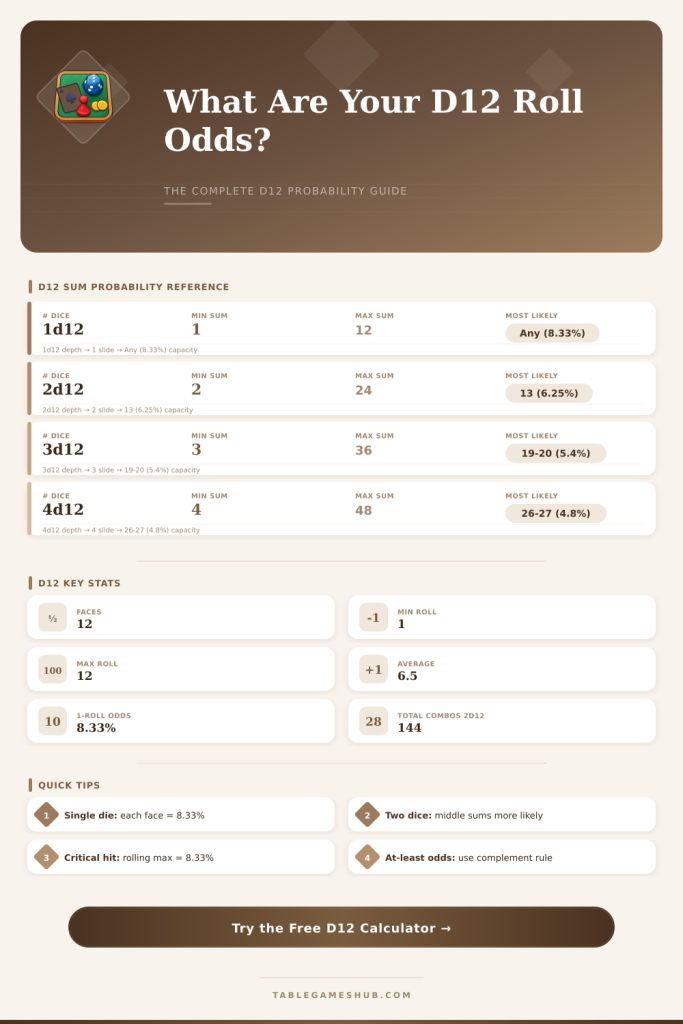
A 12-sided dice also known as a dodecahedron, can show any number between 1 and 12. The sample space is made up of a simple set: 1, 2, 3, 4, 5, 6, 7, 8, 9, 10, 11, 12. Like this there are fully 12 possible outcomes from one roll.
To get some particular face up the chance is 1 from 12, so around 0.0833. For instance, to get 8, it stays exactly 1/12.
Chance with a 12-sided die versus two six-sided dice
Because a good 12-sided dice has six even numbers and six odd, one has half of chance for an odd number. In case of even or odd, the faces do not weigh that much. Even each dice gives only one half chance for either end.
Comparison between a 12-sided dice and two six-sided dice makes everything more interesting. One alone 12-sided dice gives equal Probability of 1 from 12 for every number. Two six-sided dice work otherwise, because many ways to reach some amounts exist.
For 12 with two six-sided dice, you need both to show 6, so Probability is 1/6 times 1/6, what matches 1/36. It is much less then 1 from 12 with one 12-sided dice. For 2 or 12 with two dice, only one way for each, for instance (1,1) or (6,6).
On the other hand, 7 is the most common amount with two six-sided dice, hence expert players call it the typical outcome with 2d6.
Such differences play a big role in board games like Settlers of Catan. Having a tile with number 7, 8 or 9 helps a lot. Rather, tiles on 2, 3, 11 or 12 can leave the player waiting the whole game for one gather.
Rolling two dice makes variety with a bell curve spread of outcomes. One d12 allows to assign up to 12 equally likely results directly to various game causes. Or one can group ranges like 1-3, 4-9 and 10-12 for other targets.
The average of two 12-sided dice reaches 13, what averages 6.5 each dice, while the lowest amount is 2. Also, nice detail: the difference between two 12-sided dice has exactly 50 percent of chance tobeat 4.
Calculators for dice Probability easily handle all such cases. They cover four-sided, six-sided, eight-sided, ten-sided, twelve-sided and twenty-sided dice. That tool is useful for any dice game or for teaching basic statistical ideas like sample space and p-values.
A typical sample is counting Probability for the sum of two six-sided dice, however 12-sided dice answer just as well. Tabletop role games use all kinds of shaped dice, each called after its faces, and d12 adds Probability options and gives a good reason for game creation.