Yahtzee Probability Calculator – Calculate Every Roll Odds
🎲 Yahtzee Probability Calculator
Calculate exact odds for any Yahtzee combination — single roll, multi-roll & full turn probabilities
⚡ Quick Presets
⚙️ Calculator Settings
📊 Probability Results
📋 Yahtzee Game Specs
5
Dice Per Turn
3
Max Rolls / Turn
13
Scoring Categories
7,776
Total 5-Dice Outcomes
6
Faces Per Die
63
Upper Bonus Threshold
35
Upper Bonus Points
50
Yahtzee Bonus Pts
🎯 Combination Probability Reference
| Combination | 1-Roll Prob. | 2-Roll Prob. | 3-Roll Prob. | Score Value |
|---|---|---|---|---|
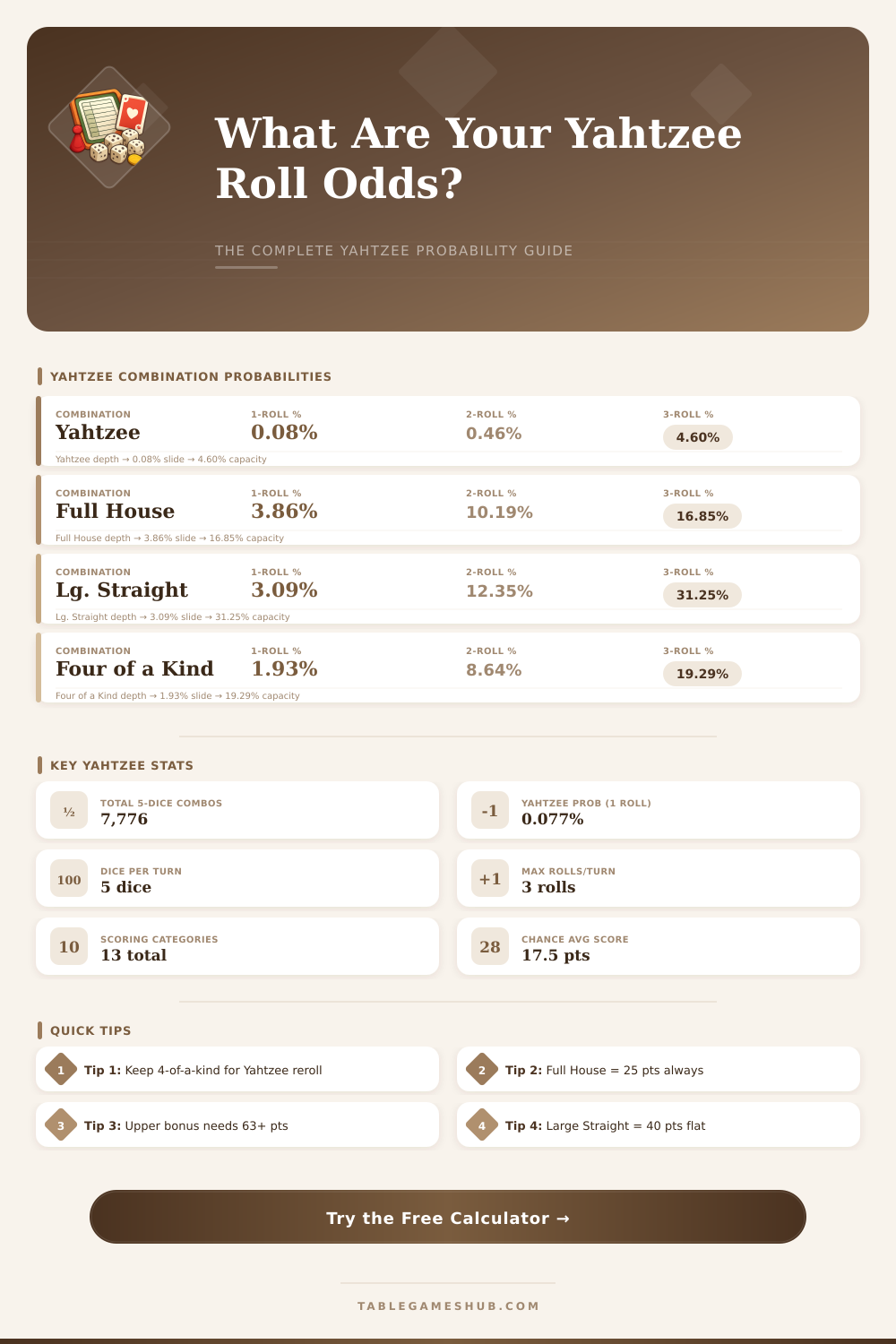
| Yahtzee (5 of a kind) | 0.077% | 0.46% | 4.60% | 50 pts |
| Four of a Kind | 1.93% | 8.64% | 19.29% | Sum of all 5 dice |
| Full House | 3.86% | 10.19% | 16.85% | 25 pts |
| Large Straight | 3.09% | 12.35% | 31.25% | 40 pts |
| Small Straight | 12.35% | 28.10% | 55.56% | 30 pts |
| Three of a Kind | 15.43% | 35.42% | 58.64% | Sum of all 5 dice |
| Two Pairs | 23.15% | 49.27% | 72.14% | Sum of all 5 dice |
| Chance (any roll) | 100% | 100% | 100% | Sum of all 5 dice |
⬆️ Upper Section — Expected Scores Per Category
| Category | Min Score | Max Score | Avg (3 rolls) | Need for Bonus |
|---|---|---|---|---|
| Aces (1s) | 0 | 5 | 2.1 | 3 |
| Twos (2s) | 0 | 10 | 4.2 | 6 |
| Threes (3s) | 0 | 15 | 6.3 | 9 |
| Fours (4s) | 0 | 20 | 8.4 | 12 |
| Fives (5s) | 0 | 25 | 10.5 | 15 |
| Sixes (6s) | 0 | 30 | 12.6 | 18 |
| Total | 0 | 105 | 44.1 | 63 |
📝 Scoring Category Reference
| Category | Section | Scoring Rule | Max Points | Approx. Freq. |
|---|---|---|---|---|
| Aces – Sixes | Upper | Sum of matching dice | 5–30 | Very High |
| Three of a Kind | Lower | Sum of all 5 dice | 30 | High |
| Four of a Kind | Lower | Sum of all 5 dice | 30 | Moderate |
| Full House | Lower | Fixed 25 pts | 25 | Moderate |
| Small Straight | Lower | Fixed 30 pts | 30 | Moderate |
| Large Straight | Lower | Fixed 40 pts | 40 | Low |
| Yahtzee | Lower | Fixed 50 pts | 50 | Very Low |
| Chance | Lower | Sum of all 5 dice | 30 | Always |
| Yahtzee Bonus | Bonus | +100 pts each extra | Unlimited | Rare |
| Upper Bonus | Bonus | +35 pts if upper ≥ 63 | 35 | Moderate |
🔄 Reroll Outcomes — Probability by Dice Kept
| Target | Dice Kept | Dice Rerolled | Single Roll Hit % | Best Strategy |
|---|---|---|---|---|
| Yahtzee | 4 matching | 1 | 16.67% | Keep 4, reroll 1 |
| Yahtzee | 3 matching | 2 | 2.78% | Keep 3, reroll 2 |
| Four of a Kind | 3 matching | 2 | 30.56% | Keep 3, reroll 2 |
| Full House | Pair + trio | 0 | 100% | Already complete |
| Full House | 3 of a kind | 2 | 16.67% | Keep 3, hope for pair |
| Large Straight | 4 in a row | 1 | 33.33% | Keep 4, reroll 1 |
| Small Straight | 3 in a row | 2 | 55.56% | Keep 3, reroll 2 |
| Upper Section | 3 matching | 2 | 30.56% | Keep 3, reroll 2 |
💡 Calculation Tips
🎲 Yahtzee Probability Math: The probability of rolling a Yahtzee in one roll is 6 ÷ 65 = 6/7,776 ≈ 0.077%. Over 3 rolls with optimal play, the probability rises to approximately 4.6%. Each additional roll significantly increases your odds.
📊 Upper Bonus Strategy: To earn the 35-point upper bonus, you need exactly 63 points from the upper section. This equals an average of 3 matching dice per category (e.g., three 6s = 18 pts). Keeping 3-of-a-kind on each upper roll gives you the best shot at reaching 63.
Yahtzee may look like something entirely based on luck, but really it is a game about probabilities. It stays fun, even when one strips the math secrets, one finds always one best strategy for any roll. The game turns around five dice, and one has three chances for every turn to arrange them.
Because the dice are fair and every result depends only on themselves, one works with an entire space of possibilities.
How Likely Is a Yahtzee and What to Do
How hard is it to roll Yahtzee? It is five equal, worth 50 points; the top number in any one category. With five dice, the possibilities are 6^5, so entirely 7776 different combos.
Only six of them give Yahtzee, what makes the chance 6 from 7776. That matches around 0.08 percent Genuinely cruel odds for one single roll.
The logic behind that is quite easy. Every die has one from six chance to fall on a certain face. Multiply that for five dice, and you have 1 from 7776.
That calculation assumes, that one targets one exact value. For instance, all fives. But here the tirck: Yahtzee accepts any value for the five equal, so really there are six different ways to reach it.
The cause becomes much more complex when one considers the three rolls for one turn. The real odds for getting Yahtzee within three attempts rise too around 4.6 percent. The math gets harder because of the several attempts and all strategic choices, that one makes.
The way one plays matters very much. For instance, if one keeps two different faces, Yahtzee becomes mathematically impossible. Similarly happens, if one keeps a pair in hope of full house or keeps a sequence for a straight.
The figures become wonderful, when one tries stacking several Yahtzees one after the other. Roll three Yahtzees in consecutive turns during three different rolls? That is around 1 from 2 billion.
Get two Yahtzees in the first roll of two different turns comes to about 1 from 600 000. Because one game has 13 rounds, technically there are 12 occasions, where that could happen for one player.
Here is a good example: to feel 95 percent sure about Yahtzee, one needs around 23 rolls. The 50 percent limit comes in around the 10th roll. From then the chance steadily grows toward 100 percent, though it never really reaches that.
The scoring categories look surprising, because some have fixed values, while others depend clearly on what falls on the dice. The decisions in the game end up being surprisingly subtle. Whether to choose four fives for 20 points against three fours and two fives for full house worth 25 points?
Suchchoices appear always.