Warhammer Wound Calculator: Roll Dice Results Fast
⚔️ Warhammer Wound Calculator
Calculate expected hits, wounds, failed saves & casualties for any unit matchup in Warhammer 40K & Age of Sigmar
⚡ Quick Presets
🎮 Attack Profile
⚔️ Combat Results
📊 Key Wound Roll Reference
83.3%
2+ Roll Success
66.7%
3+ Roll Success
50.0%
4+ Roll Success
33.3%
5+ Roll Success
16.7%
6+ Roll Success
+16.7%
Reroll 1s Bonus
AP -3
Ignores 3+ Saves
6++
Min Invuln Save
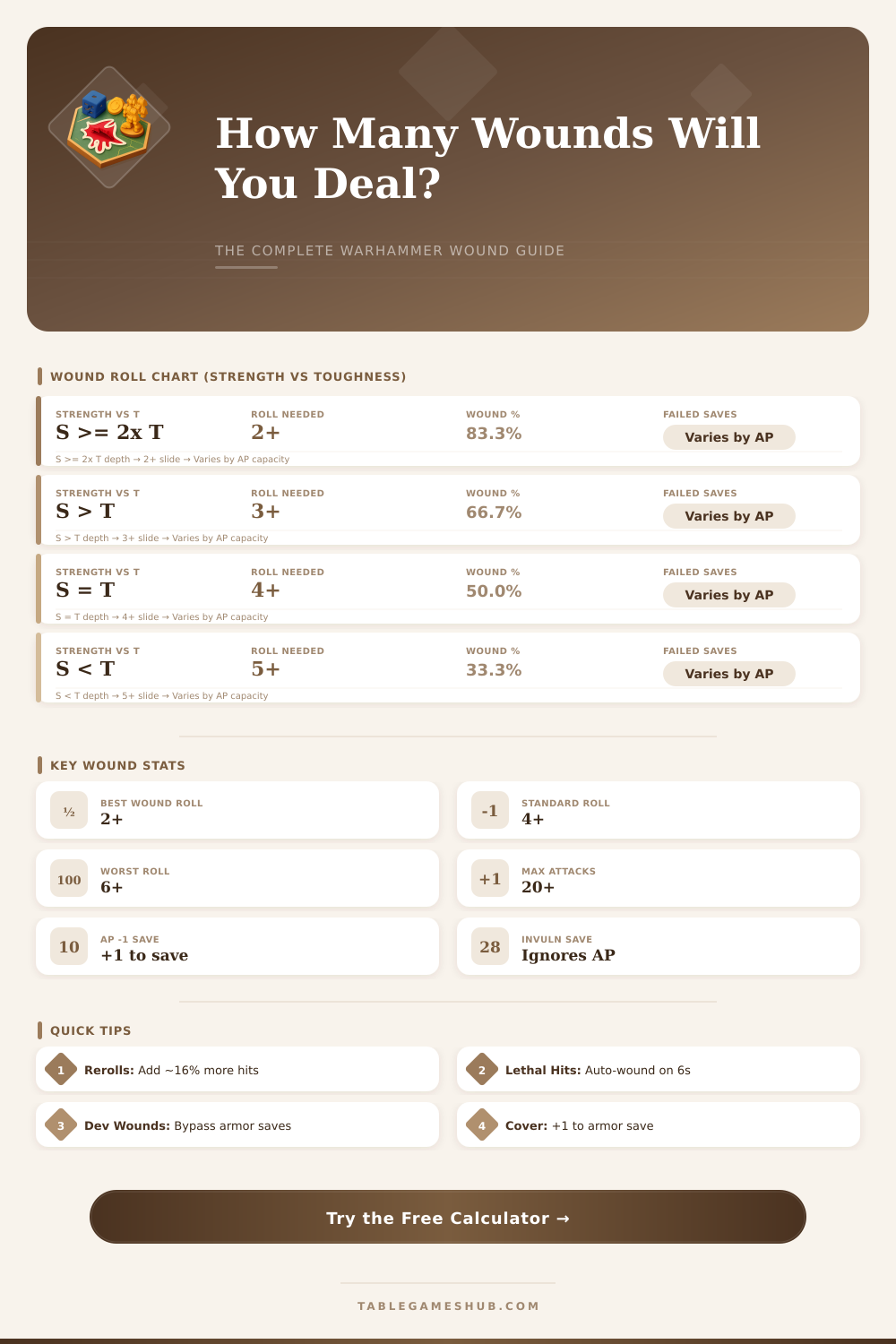
📋 Wound Roll Chart (Strength vs Toughness)
| Strength vs Toughness | Wound Roll Needed | Success Chance | Example Matchup |
|---|---|---|---|
| S >= 2x T | 2+ | 83.3% | S8 vs T4 (Lascannon vs Marine) |
| S > T | 3+ | 66.7% | S5 vs T4 (Plague Marine vs Marine) |
| S = T | 4+ | 50.0% | S4 vs T4 (Bolter vs Marine) |
| S < T (half or above) | 5+ | 33.3% | S4 vs T5 (Bolter vs Ork Warboss) |
| S <= half T | 6+ | 16.7% | S3 vs T6 (Lasgun vs Dreadnought) |
🛡 Standard Armour & Save Reference
| Unit / Armour Type | Armour Save | Invuln Save | FNP | Toughness (T) |
|---|---|---|---|---|
| Space Marine (Power Armour) | 3+ | — | — | 4 |
| Terminator | 2+ | 4++ | — | 5 |
| Chaos Space Marine | 3+ | — | — | 4 |
| Plague Marine | 3+ | — | 5+++ | 5 |
| Ork Boy | 6+ | — | — | 5 |
| Tau Fire Warrior | 4+ | — | — | 3 |
| Necron Warrior | 4+ | — | — | 4 |
| Grey Knight | 2+ | 5++ | — | 4 |
| Eldar Guardian | 5+ | — | — | 3 |
| Rubric Marine | 3+ | 4++ | — | 4 |
🔫 Common Weapon Profiles (40K 10th Ed)
| Weapon | Attacks | BS/WS | Strength | AP | Damage |
|---|---|---|---|---|---|
| Bolter | 2 | 3+ | 4 | 0 | 1 |
| Heavy Bolter | 3 | 3+ | 5 | -1 | 2 |
| Lascannon | 1 | 3+ | 12 | -3 | D6+1 |
| Plasma Gun (Supercharged) | 1 | 3+ | 8 | -3 | 2 |
| Thunder Hammer | 3 | 4+ | 8 | -2 | 3 |
| Power Fist | 3 | 4+ | 8 | -3 | 2 |
| Pulse Rifle | 2 | 4+ | 5 | -2 | 1 |
| Shuriken Catapult | 2 | 3+ | 4 | 0 | 1 |
| Ork Slugga | 1 | 5+ | 4 | 0 | 1 |
| Meltagun | 1 | 3+ | 9 | -4 | D6+2 |
💡 Tips & Rules Reference
Reroll Mechanics: Rerolling 1s on hit rolls adds approximately +1/6 (~16.7%) to your base hit chance. Rerolling all failures effectively adds (1 - hit chance) x hit chance bonus hits. Always apply rerolls before special rule triggers.
Lethal Hits vs Devastating Wounds: Lethal Hits (6s auto-wound, skip wound roll) are best against high-toughness targets. Devastating Wounds (6s to wound bypass saves and deal mortal wounds equal to damage) are best against high-armour targets with no invuln save.
Invulnerable vs Armour Save: The better (lower number) of the armour save (modified by AP) and the invulnerable save is always used. AP has NO effect on invulnerable saves. A 4++ always remains 4++ regardless of weapon AP value.
Models Killed Calculation: Total damage dealt divided by target model wounds gives models removed. Damage does not spill over between models in 10th Ed (unless specified). Account for FNP rolls to reduce final damage taken.
In Warhammer, the Wound helps to estimate how much damage a model can last before it falls on the ground. They are like health points in a computer game. Some creatures last more than others whether because of their strong build or because they simply do not feel pain as strongly.
That forms the base of the game, whether in Warhammer 40k or in other versions.
How Wounds Work in Warhammer
Here it gets a bit complex. In the roleplay mode of Warhammer, Wound counts grow upward, they do not disappear. A character stays healthy with a low number of Wound counts.
It dies when it reaches the maximum. Some versions of the game do the opposite and treat Wound counts as normal health points, which can seem odd if you are used to the roleplay mode.
When attacking in the game, there is a whole series of steps. During close combat, you roll D6 for every attack that hits. Later you compare the strength of the attacker with the toughness of the target, to estimate the chance to injure.
For every successful Wound, the opponent chooses a model and tries to save. If the armor piercing of teh weapon reduces their normal save compared to the unbreakable save, they use the unbreakable save.
The damage values decide how many Wound points one model suffers from a successful attack, not the whole group. If the damage matches or beats the remaining Wound points of the model, that model dies. Any extra damage from that attack simply goes away and does not transfer to another model, unless a separate rule allows that.
There are also deadly Wound results. Weapons with that trait are truly terrible. If an attack causes a critical Wound, no kind of save can defend against it, not even the unbreakable.
Fatal Wound results work the same, because they skip armor and unbreakable saves. The trait Feels No Pain protects against both. If a unit receives six fatal Wound results, you must make six rolls for Feel No Pain.
The word “anti” is another useful part. For instance, Anti-vehicle 4+ means that the attack causes a critical Wound on a roll of 4 or better against vehicles, without needing too check strength or toughness.
Because of the need to track Wound counts during a game, some players lay dice by the models. Others buy special tools for Wound tracking, with spinning dials or clickable buttons from websites like Etsy. D12 dice work well for Dreadnoughts and tanks, while D20 dice suit bigger machines like Repulsors.
Wound counts on single models mattера lot, because with bigger damage the model is less able to defenditself.