UNO Score Calculator – Track Points Every Round
🎴 UNO Score Calculator
Track points every round, manage multi-player totals, and find out who reaches 500 first
⚡ Quick Presets
⚙️ Game Settings
🏆 Player Scores This Round
📊 Cumulative Scores (Running Total)
📋 Score Results & Standings
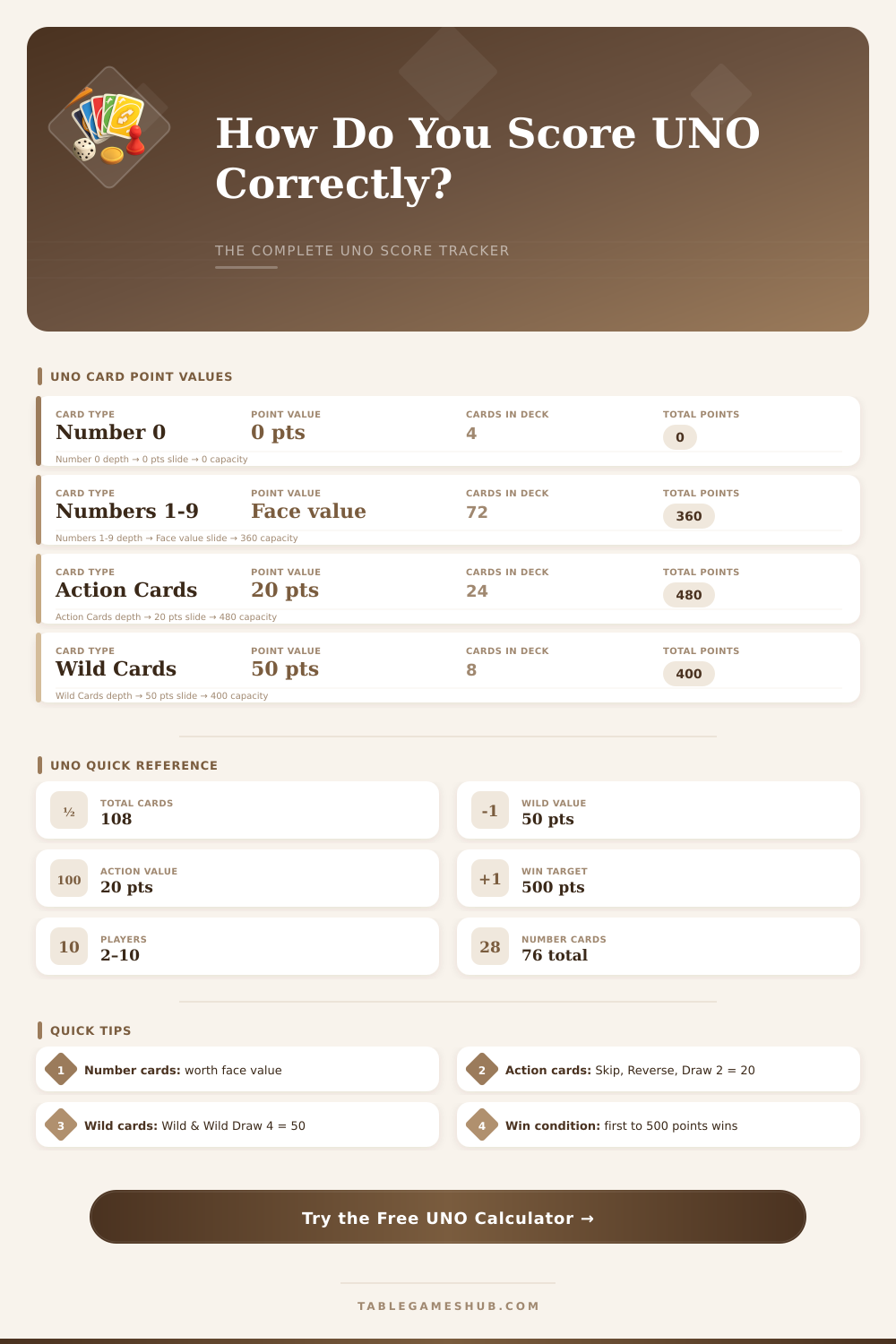
🃏 UNO Card Point Values
0
Card “0” Value
1–9
Number Cards
20
Action Card Points
50
Wild Card Points
108
Cards per Standard Deck
76
Number Cards Total
24
Action Cards Total
8
Wild Cards Total
📄 UNO Deck Composition Reference
| Card Type | Quantity | Point Value | Colors/Notes |
|---|---|---|---|
| Number 0 | 4 cards | 0 pts each | One per color |
| Numbers 1–9 | 72 cards | Face value | Two per color per number |
| Skip | 8 cards | 20 pts each | Two per color |
| Reverse | 8 cards | 20 pts each | Two per color |
| Draw Two | 8 cards | 20 pts each | Two per color |
| Wild | 4 cards | 50 pts each | No color assigned |
| Wild Draw Four | 4 cards | 50 pts each | No color assigned |
| Total | 108 cards | Max ~1,240 pts | 4 colors standard |
🎮 UNO Variant Scoring Reference
| Game Variant | Deck Size | Win Target | Special Rules |
|---|---|---|---|
| Classic UNO | 108 cards | 500 pts | Standard card values |
| UNO Flip | 112 cards | 500 pts | Flip side adds heavy penalties |
| UNO DOS | 108 cards | 200 pts | 2-card discard option |
| UNO Attack | 112 cards | 500 pts | Launcher replaces draw pile |
| UNO Stacko | 45 blocks | 500 pts | Physical stacking game |
| UNO Extreme | 112 cards | 500 pts | Card shooter mechanism |
| UNO No Mercy | 168 cards | 500 pts | Stacking allowed, +2/+4 |
| 2-Player UNO | 108 cards | 500 pts | Reverse acts as Skip |
👥 Player Count Setup Guide
| Players | Starting Hand | Avg. Rounds to 500 | Est. Game Duration |
|---|---|---|---|
| 2 Players | 7 cards each | 4–6 rounds | 20–30 min |
| 3 Players | 7 cards each | 5–8 rounds | 25–40 min |
| 4 Players | 7 cards each | 6–10 rounds | 30–45 min |
| 5 Players | 7 cards each | 7–12 rounds | 35–55 min |
| 6 Players | 7 cards each | 8–14 rounds | 40–65 min |
| 7–8 Players | 7 cards each | 10–16 rounds | 50–80 min |
| 9–10 Players | 7 cards each | 12–20 rounds | 60–100 min |
💡 Scoring Tip: The winner of a round scores points equal to all cards remaining in other players' hands. Number cards score their face value, Action cards (Skip, Reverse, Draw 2) score 20 points each, and Wild cards (Wild and Wild Draw 4) score 50 points each.
🏆 Win Condition Tip: The first player to accumulate 500 points across multiple rounds wins the entire game. For shorter games, set the target to 200–300 points. For tournament play, 1,000 points is sometimes used to extend competition across more rounds.
Uno forms a group of card games that existed since 1971 through the original publication. The main task seems easy: remove all cards from your hand more quickly than the opponents. Players take turns laying cards that match by colour or number with the top card on the discard pile.
When someone stays with only two cards and plays one of them, he must shout “Uno!”. In case of forgetting, if someone catches him before the next turn starts, the guilty player must take two additional cards as penalty. That shout must happen always when someone gets to the last card.
How to Score in Uno
When one player succeeds to remove all his cards, the round ends. He wins that party, and points add up based on the remaining cards of the otehr players. Here enters the scoring system, and truly, many folks not even know that it exists.
Most simply say “you won this round” and start new, without any calculation.
However the official rules include clear score. Cards with numbers have value based on their face. For instance, yellow two values 2 points.
Action types, as Draw 2, Reverse and Skip, count each 20 points each. Wild cards and Wild Draw 4 count 50 points each. The first that reaches 500 points threw several rounds, beat the whole party.
Like this one alone round does not decide everything.
There is also another way to score the results. In some versions lower score is better. One adds the values of the remaining cards in the hands of the losers.
Like this having less many and less precious cards staying give better score. It depends on the way the group choose to play.
Tracking points can be difficult. Here is why programs like Uno Score Counter appeared. They allow to add players, start new parties and type in cards after every round.
Some even let you enter points directly or mark how many of every kind of cards stayed with the losers, and the app does the math alone. There are also free printable score sheets online for those that like to write with pen on paper. Those sheets have simple structure that helps to follow the progress of everyparticipant.
In Uno the hands can grow very quickly. It is totally possible to end with a huge crowd of cards. Even so they also can shrink soon, so that the game changes direction often.
The scoring adds an element of tactics, because high values in the hand become dangerous to hold.