Tic Tac Toe Calculator – Analyze Every Move & Outcome
❌ Tic Tac Toe Calculator
Analyze win probabilities, board outcomes, and game statistics for any Tic Tac Toe configuration
⚡ Quick Presets
⚙️ Game Configuration
📋 Interactive Board Analyzer
Click squares to place X and O pieces. X moves first.
📊 Game Analysis Results
📊 Key Game Statistics
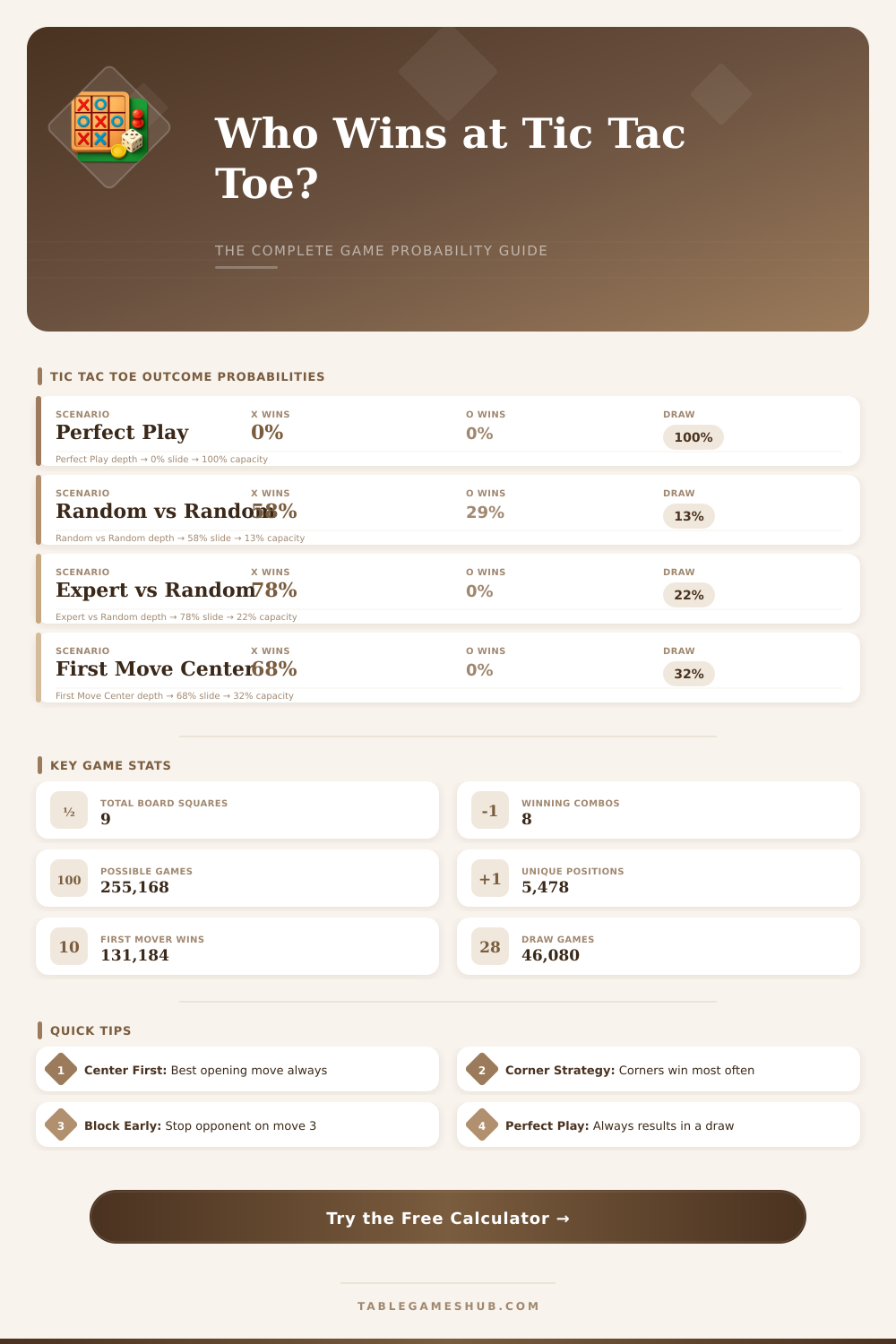
255,168
Total Possible Games
8
Winning Combinations
5,478
Unique Board Positions
9
Total Board Squares
131,184
X Wins (First Mover)
77,904
O Wins (Second Mover)
46,080
Draw Outcomes
~5 min
Avg. Game Duration
🎯 Outcome Probability Table
| Matchup | X Wins % | O Wins % | Draw % | Avg Moves |
|---|---|---|---|---|
| Expert vs Expert | 0% | 0% | 100% | 7–9 |
| Expert X vs Random O | ~78% | 0% | ~22% | 5–7 |
| Random X vs Expert O | 0% | ~58% | ~42% | 5–7 |
| Random vs Random | ~58% | ~29% | ~13% | 6–8 |
| Center Opening (X) | ~68% | 0% | ~32% | 5–7 |
| Corner Opening (X) | ~72% | ~5% | ~23% | 5–8 |
| Edge Opening (X) | ~48% | ~15% | ~37% | 6–8 |
| Misère Mode | varies | varies | ~50% | 6–9 |
📏 Board Configuration Reference
| Grid Size | Squares | Win Length | Possible Positions | Complexity |
|---|---|---|---|---|
| 3×3 (Standard) | 9 | 3 in a row | 255,168 | Solved |
| 4×4 | 16 | 4 in a row | >10 million | High |
| 5×5 | 25 | 4 in a row | >1 billion | Very High |
| Ultimate (9×9) | 81 | Win sub-boards | Astronomical | Extremely High |
| 3D 3×3×3 | 27 | 3 in line | >100 million | Very High |
🧰 Game Set Specifications
| Set Type | Board Size | Pieces (X+O) | Players | Avg Game Time |
|---|---|---|---|---|
| Classic Paper & Pencil | Any size | N/A (drawn) | 2 | 1–2 min |
| Wooden Board Set | 8–12 in (20–30 cm) | 10 (5+5) | 2 | 2–5 min |
| Magnetic Travel Set | 6–8 in (15–20 cm) | 10 (5+5) | 2 | 2–3 min |
| Giant Outdoor Set | 24–48 in (60–120 cm) | 10 (5+5) | 2+ | 3–8 min |
| Token-Based Set | 10–14 in (25–36 cm) | 10 (5+5) | 2 | 2–5 min |
| 3D Stacking Version | 8–10 in (20–25 cm) | 18+ pieces | 2 | 5–10 min |
| Rope & Ring Set | 18–24 in (45–60 cm) | 10 rings | 2 | 3–6 min |
| Digital / App Version | Screen size | Unlimited | 1–2 | 1–3 min |
📋 Common Position Win Rates
| First Move Position | Position Number | Win Rate vs Random | Optimal Counter |
|---|---|---|---|
| Center | 5 | ~68% | Take any corner |
| Corner (any) | 1,3,7,9 | ~72% | Take center immediately |
| Edge (any) | 2,4,6,8 | ~48% | Take center, then opposite corner |
💡 Probability Tip: With perfect (minimax) play from both sides, every standard 3×3 Tic Tac Toe game ends in a draw. The first player has a strict mathematical advantage only against non-optimal opponents. Center is the strongest opening square, controlling 4 of 8 winning lines.
🎯 Strategy Tip: There are exactly 8 winning combinations in standard Tic Tac Toe: 3 rows, 3 columns, and 2 diagonals. The center square participates in 4 winning lines, corners in 3 each, and edge squares in only 2. Always prioritize squares with the most winning-line participation.
Tic Tac Toe belongs to those games that almost every person has played. The name changes based on the place where one lives. Americans call it Tic Tac Toe, while in United Kingdom one says noughts and crosses.
In Canada or Ireland you commonly hear Xs and Os. The phrase “Tic Tac Toe” comes from old English rhyming words, like “tick-tack-toe” and became the usual word in United States.
How to Play Tic Tac Toe and Ultimate Tic Tac Toe
Two folks play turns for marking the cells of a three by three grid. One picks Xs, the second Os. The task is to reach three own signs in a line.
Such line can go horizontally, vertically or along a diagonal. Normally there are eight ways to win: three rows, three columns and two diagonals. Each corner cell connects to two possible winning lines, but the middle cell to four.
Although it seems easy, Tic Tac Toe requires tactics and fast decisions. If you start, pick a corner rather than the centre. When you follow, take the centre, if the prior player did not do that.
In case they chose the centre, pick a corner. Always base your steps on a plan instead of guesses.
Here is the key spot. Tic Tac Toe is an already settled game. If both players play perfectly, every game ends in a draw.
One can make sure that one never loses simply following the write rules. Hence some folks feel it boring after a bit of time.
Here comes the Ultimate Tic Tac Toe. This version has nine little games arranged as one big board. The place of your mark in a little board decides where the opponent must play after.
For instance, if they mark the upper left cell of their board, you must go to the upper left board. Beating a little board, you take the right place on the big one. The first that gets three little boards in a line wins the whole thing.
It requires nine times more tactics than the usual Tic Tac Toe and everything deals about thinking ahead.
The game exists for more than 3 000 years. It helps with child growth of skills in solving problems, spatial thought, hand and eye teamwork and turn taking. One can play it free online against a computer or with a friend.
Also physical versions exist, also wooden tables withbig pieces that are not easily lost.