Ten Pin Bowling Time Calculator – How Long Does a Game Take?
🎳 Ten Pin Bowling Time Calculator
Estimate exactly how long your bowling session will take based on players, skill level & game format
⚡ Quick Presets
⚙️ Game Configuration
⏱️ Your Bowling Time Estimate
📊 Key Bowling Facts
10
Frames Per Game
10
Pins Per Frame
300
Perfect Game Score
60 ft
Standard Lane Length
3.5 ft
Lane Width
12 lbs
Avg Adult Ball Weight
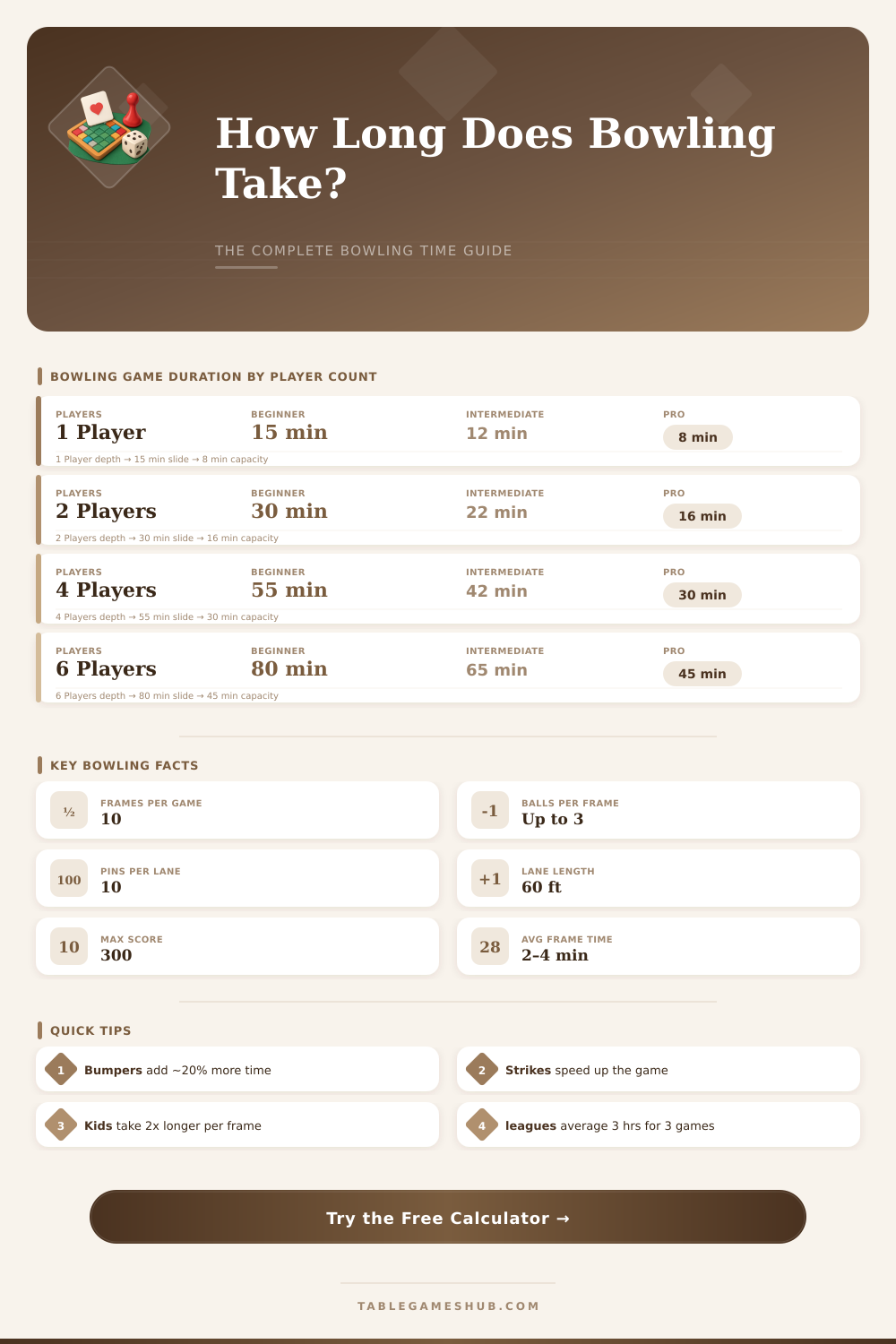
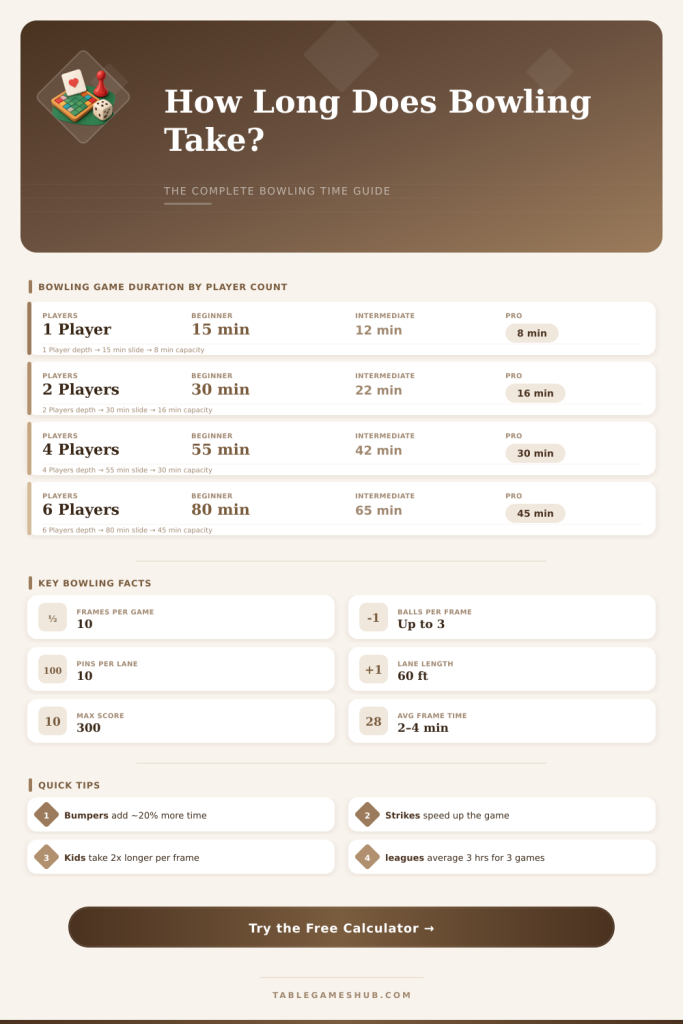
~2–4 min
Avg Time Per Frame
21
Max Balls Per Game
📋 Bowling Duration by Player Count & Skill
| Players | Beginner / Kids | Casual | Intermediate | Advanced | Pro / Tournament |
|---|---|---|---|---|---|
| 1 | 20–25 min | 14–18 min | 10–13 min | 8–11 min | 6–9 min |
| 2 | 35–45 min | 25–32 min | 18–24 min | 14–20 min | 12–16 min |
| 3 | 50–65 min | 36–46 min | 27–35 min | 21–28 min | 17–22 min |
| 4 | 65–85 min | 46–60 min | 35–46 min | 28–38 min | 22–30 min |
| 5 | 80–105 min | 57–74 min | 43–56 min | 35–46 min | 28–37 min |
| 6 | 95–125 min | 68–88 min | 52–68 min | 42–54 min | 33–44 min |
| 8 | 125–165 min | 90–115 min | 68–88 min | 55–72 min | 44–58 min |
| 10 | 155–200 min | 110–145 min | 85–110 min | 68–89 min | 55–72 min |
🏓 Game Format Time Modifiers
| Format | Description | Time Modifier | Typical Players | Frames Bowled Per Player |
|---|---|---|---|---|
| Standard | Regular 10-frame game | Baseline (1.0x) | 1–10 | 10 |
| Bumper Bowling | Rails up, mostly kids | +20–30% | 2–6 | 10 |
| Cosmic / Glow | Lights out, music on | +15–25% | 2–8 | 10 |
| 9-Pin No-Tap | 9 pins = strike | –5–10% | 2–8 | 10 |
| Baker Format | Team rotates frames | –40–50% | 4–6 (team) | 2 per player |
| Scotch Doubles | Partners alternate balls | –30–40% | 4 (2 teams) | 5 per player |
📐 Standard Ten Pin Bowling Dimensions
| Measurement | Imperial | Metric | Notes |
|---|---|---|---|
| Lane Length (foul line to pin deck) | 60 ft | 18.29 m | USBC Regulation |
| Lane Width | 41.5 in (3.46 ft) | 105.4 cm | USBC Regulation |
| Approach Area Length | ~15 ft | ~4.57 m | Minimum required |
| Pin Spacing (center to center) | 12 in | 30.5 cm | Equilateral triangle |
| Headpin to Back Pin | 36 in | 91.4 cm | 4 rows deep |
| Ball Diameter (max) | 8.595 in | 21.83 cm | USBC max spec |
| Ball Weight (max) | 16 lbs | 7.26 kg | USBC max spec |
| Pin Weight | 3 lbs 6 oz – 3 lbs 10 oz | 1.53–1.64 kg | USBC range |
📅 Multi-Game Session Planning
| Session Type | Games | Players | Est. Total Time | Recommended Lanes |
|---|---|---|---|---|
| Quick Solo Practice | 2 | 1 | 30–45 min | 1 |
| Date Night | 2 | 2 | 60–90 min | 1 |
| Family Outing | 2 | 4 | 90–150 min | 1–2 |
| Kids Birthday Party | 2 | 8 | 120–180 min | 2 |
| League Night | 3 | 5 | 150–210 min | 1 |
| Office Team Event | 2 | 10 | 150–210 min | 2 |
| Tournament Block | 5 | 2 | 150–200 min | 1 |
| All-Day Tournament | 8 | 4 | 360–480 min | 2 |
💡 Tip 1 — Plan for Transitions Between Frames: Each bowler needs roughly 30–60 seconds between frames for ball return, approach, and settling. With 4 players and 10 frames, that adds 20–40 minutes of transition time alone — always account for this in your session booking.
💡 Tip 2 — Two Lanes Cuts Time Nearly in Half for Large Groups: Booking two adjacent lanes for 6+ players dramatically reduces wait time. With 6 players on 1 lane, each player waits for 5 others; on 2 lanes (3 per lane), wait time drops by ~45%. Most bowling alleys recommend 2 lanes for groups of 6 or more.
In Ten Pin Bowling one rolls a heavy ball down a long wooden or plastic lane straight to a group of ten pins. They stand in four rows, that creates a triangle at the finish of the lane. The basic idea seems quite easy: one must knock down as many pins as possible with the allowed rolls.
If you knock down all ten pins in the first attempt, that one calls a strike. When some stay standing you receive a second chance. The clear goal is to reach the rest of them in the second roll, which is the spare.
How to Play Ten Pin Bowling
The best score in that game reaches 300 points. To reach this mark, a bowler needs only 12 strikes each frame. Indeed that is possible, because the tenth frame allows several attempts to knock down new groups of pins.
However Ten Pin Bowling is only one version of the sport. Versions like candlepin, duckpin, ninepin and fivepin all exist also. In duckpin one uses smaller balls and pins, that look quite different, although the game happnes on the same standard Ten Pin Bowling lanes.
Here exists even more old history: ninepins arrived from Europe in America many centuries ago. That version used nine pins arranged in a diamond pattern. When ninepins were banned in many regions, some person had the clever idea to simply add one more pin, thus modern Ten Pin Bowling was born.
What attracts Ten Pin Bowling too everyday folks is its real access. No need to buy crowds of special gear. On the other hand, expert players commonly have their own balls and work to add spin to them.
New bowlers give time to footwork and to aiming with the eyes. Practise the 10-pin spare appears sometimes rich in training for many players. Sometimes the ball turns to that 10th pin after contact, instead of going across the pins behind it (that one calls a flat 10-pin miss).
The commonly used fix is to aim at the pocket with a different approach. Using hard plastic balls to help with the 10th pin does not hook that much strongly as reactive rubber.
The Brooklyn strike is a funny thing. The ball crosses to the opposite pocket than where the player sent it. That happens because of a clever throw, that hits the 1-2 pocket instead of the usual spot.
Over time, the competition for attention really grew. Children and families now have more choices than before. Even so, simple lanes did not disappear, they stay alive in many areas.
Modern places with dozens of lanes beside arcade games, go-karts, laser tag, mini golf and canteens bring together everything in one building. Even video games join in the fun. Strike!
Ten Pin Bowling for Nintendo Switch allows players to roll using motion controllers with Joy-Con or touchscreengame in handheld mode.