Spades Bid Calculator – Score & Track Every Hand
♠ Spades Bid Calculator
Calculate bids, track scores, manage bags & nil bids for 2–4 player spades games
⚡ Quick Presets
⚙️ Game Settings
📊 Current Running Scores
🂡 This Hand — Bids & Tricks Won
♠ Team 1: North & South
♦ Team 2: East & West
♠ Hand Score Results
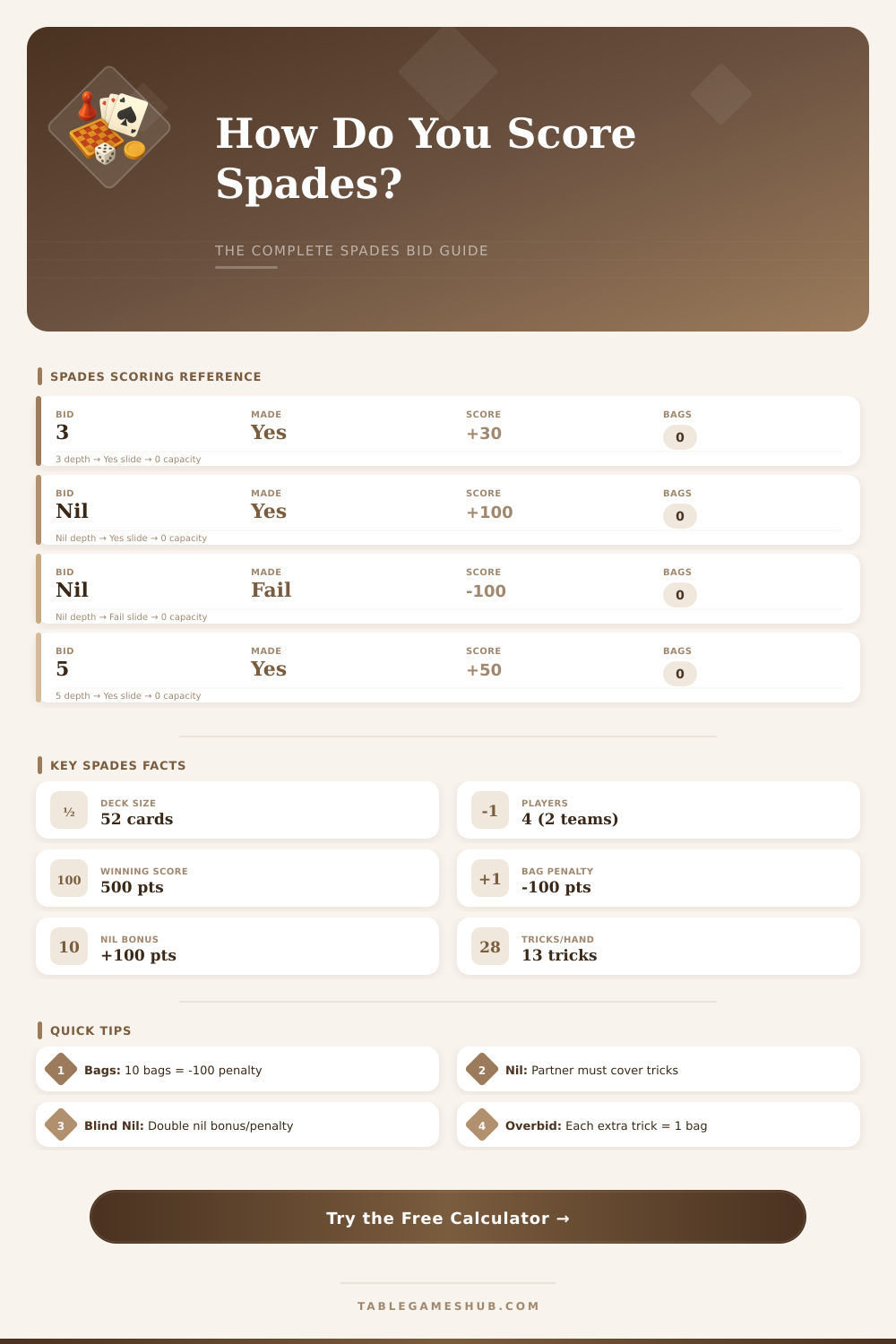
📋 Spades Key Stats
52
Cards in Deck
13
Tricks Per Hand
±100
Nil Bonus/Penalty
500
Standard Win Score
10
Bags = -100 Penalty
13
Spades in Deck
4
Players (Standard)
2x
Blind Nil Multiplier
📈 Spades Scoring Reference Table
| Bid Type | Bid Made? | Score Change | Bags Added | Notes |
|---|---|---|---|---|
| Numeric Bid (N) | Yes (exact) | +N x 10 pts | 0 | Perfect bid |
| Numeric Bid (N) | Yes (overtricks) | +N x 10 + bags | +1 per extra | Each overtrick = 1 bag |
| Numeric Bid (N) | No (set) | -N x 10 pts | 0 | Team is "set" |
| Nil Bid | Yes (0 tricks) | +100 pts | 0 | Partner bids normally |
| Nil Bid | No (took trick) | -100 pts | 0 | Partner score unaffected |
| Blind Nil | Yes (0 tricks) | +200 pts | 0 | Bid before seeing cards |
| Blind Nil | No (took trick) | -200 pts | 0 | Very high risk |
| Boston (13) | Yes (all 13) | +130 pts bonus | 0 | Rare, all tricks |
| 10 Bags | N/A | -100 pts | Reset 0 | Bag penalty applied |
🎯 Bid Strategy Reference
| Team Bid Total | Risk Level | If Made (Exact) | If Set | Bags if +1 Overtrick |
|---|---|---|---|---|
| 1 | Very Low | +10 pts | -10 pts | 1 bag |
| 3 | Low | +30 pts | -30 pts | 1 bag |
| 5 | Moderate | +50 pts | -50 pts | 1 bag |
| 7 | Moderate-High | +70 pts | -70 pts | 1 bag |
| 9 | High | +90 pts | -90 pts | 1 bag |
| 11 | Very High | +110 pts | -110 pts | 1 bag |
| 13 (Boston) | Extreme | +130 pts | -130 pts | 0 (must be exact) |
Card Distribution Per Hand
| Players | Cards Each | Tricks Available | Min Bid (each) | Mode |
|---|---|---|---|---|
| 2 | 13 each (26 used) | 13 | 1 | 2-Player Partnership |
| 3 | 17 each (1 removed) | 17 | 1 | Cutthroat |
| 4 | 13 each (all 52) | 13 | 0 (nil allowed) | Standard Partnership |
| 6 | 8 each (2 decks) | 16 | 1 | Extended (2 decks) |
💡 Strategy Tips
Bag Management: Every trick you win beyond your bid counts as a "bag" (sandbag). Once a team accumulates 10 bags, they lose 100 points and the bag count resets. Underbid slightly when you are close to 10 bags — avoid winning extra tricks to dodge the penalty.
Nil Bid Timing: A successful Nil bid earns +100 points (or +200 for Blind Nil), but failing costs the same amount. Only attempt Nil when you hold no Aces, no high Spades, and you have low cards in every suit. Your partner must bid aggressively (3–5) to cover the team’s share of the 13 tricks without relying on you.
Spades are a game for two pairs, where one takes tricks by means of cards, and the Spades always beat everything else. The 52 cards from a standard deck divide equally between the four players so that each receives thirteen cards in the hand. But what truly gives rhythm to the game, that does the phase of Bid, here strategies start to form before anyone even plays one card.
The player sitting to the right of the dealer starts with his Bid. Later, the Bid goes right around the table until the dealer ends his turn. Each says, how many tricks he thinks he can win.
How to Bid in Spades
There is only one round of Bid, no two chances, and one must Bid at least one trick, zero is not allowed. Because Spades already are fixed as trump, no one needs to mention what color is trump during the Bid.
When the Bid ends, the two partners of a team combine their own numbers to reach the target of the group. Here the main number… So many tricks one must reach exactly.
Whether one reaches it or beats it? The team receives 10 points for every trick that one intended. Beating it however does not help a lot.
Every extra tirck values only one point, and those extras belong to the bags. Here where it stings (one gets punished by bags), that indeed costs 10 points minus one for every bag. Beating it so mostly means losing spots without return.
Three main things help to Bid well: how many strong cards you keep, how many Spades are in your hand and how many cards you have for every color. Aces almost always value one trick. Kings can be one, if that color has only four or less cards.
If a color has five or more, king becomes risky, anyone can trump it away. Because of the Spades themselves, the rules four count: ace gives one trick, king helps if you have at least two Spades, and queen if three or more. Even low Spades have value; one can hope one extra trick for every Spades above three.
The best way is to stay with reality. If your hand truly can give three tricks, intend three. Playing too carefully hurts just as much as attacking too hard.
A Bid that you truly can reach beats failing always, so intend that, what you can really reach, instead of what you hope maybe will happen.
A nil Bid changes the game in a funny way. Some players skip it entirely, while others hunt it always. Winning nil is so fun, that whole parties adjust according to that, whether teams benefit from the nil chances.
When opponents intend nil, one must play low cards and force tricks to them, that is the plan. Grabbing their attention helps also quite a lot.
High Bid commonly gives bigger advantage, because they earn bonuses, but exactly hitting the target is the most important. Correctly reaching itremoves bags from the score and gives push to your team.