Snooker Handicap Calculator: Fair Match Setup Tool
🎱 Snooker Handicap Calculator
Calculate fair frame and points handicaps for any skill difference — club, league & tournament ready
⚡ Quick Presets
⚙️ Match Setup
📊 Handicap Calculation Results
📋 Snooker Ball & Table Quick Reference
147
Max Possible Break
22
Balls on Table
15
Red Balls
12 ft
Full Table Length
6 ft
Full Table Width
72 pts
Total Colour Value
75 pts
Total Red Value
2.125"
Ball Diameter
🎯 Ball Point Values & Colours
| Ball | Points Value | Quantity | Total Possible |
|---|---|---|---|
| Red | 1 pt each | 15 | 15 pts |
| Yellow | 2 pts | 1 | 2 pts |
| Green | 3 pts | 1 | 3 pts |
| Brown | 4 pts | 1 | 4 pts |
| Blue | 5 pts | 1 | 5 pts |
| Pink | 6 pts | 1 | 6 pts |
| Black | 7 pts | 1 | 7 pts |
| Total | — | 22 | 147 pts |
📐 Standard Handicap Reference Chart
| Avg Break Difference | Frame Handicap | Points Start | Recommended Level |
|---|---|---|---|
| 0 – 5 pts | 0 frames | 0 pts | Even match |
| 6 – 15 pts | 0 frames | 7 – 14 pts | Social |
| 16 – 25 pts | 1 frame | 14 – 21 pts | Club |
| 26 – 40 pts | 1 – 2 frames | 21 – 28 pts | Club / League |
| 41 – 60 pts | 2 frames | 28 – 42 pts | League |
| 61 – 80 pts | 2 – 3 frames | 42 – 56 pts | County |
| 81 – 100 pts | 3 frames | 56 – 70 pts | Regional |
| 100+ pts | 3+ frames | 70+ pts | Pro vs Amateur |
📏 Snooker Table Size Specifications
| Table Type | Length (Imperial) | Length (Metric) | Playing Surface |
|---|---|---|---|
| Full Size (Regulation) | 12 ft x 6 ft | 3.66 m x 1.83 m | 72 sq ft / 6.7 m² |
| 3/4 Size | 10 ft x 5 ft | 3.05 m x 1.52 m | 50 sq ft / 4.6 m² |
| Half Size | 6 ft x 3 ft | 1.83 m x 0.91 m | 18 sq ft / 1.7 m² |
| Mini / Pool | 4 ft x 2 ft | 1.22 m x 0.61 m | 8 sq ft / 0.74 m² |
🏆 Competition Level & Typical Break Ranges
| Level | Avg Break Range | Highest Break | Typical Format |
|---|---|---|---|
| Beginner | 0 – 15 pts | Under 30 pts | Best of 3 |
| Intermediate | 15 – 35 pts | 30 – 70 pts | Best of 5 |
| Club Player | 30 – 55 pts | 50 – 100 pts | Best of 5 / 7 |
| County / League | 50 – 75 pts | 80 – 130 pts | Best of 7 / 9 |
| Semi-Professional | 70 – 90 pts | 100 – 140 pts | Best of 9 / 11 |
| Professional | 80 – 110 pts | 100 – 147 pts | Best of 11+ |
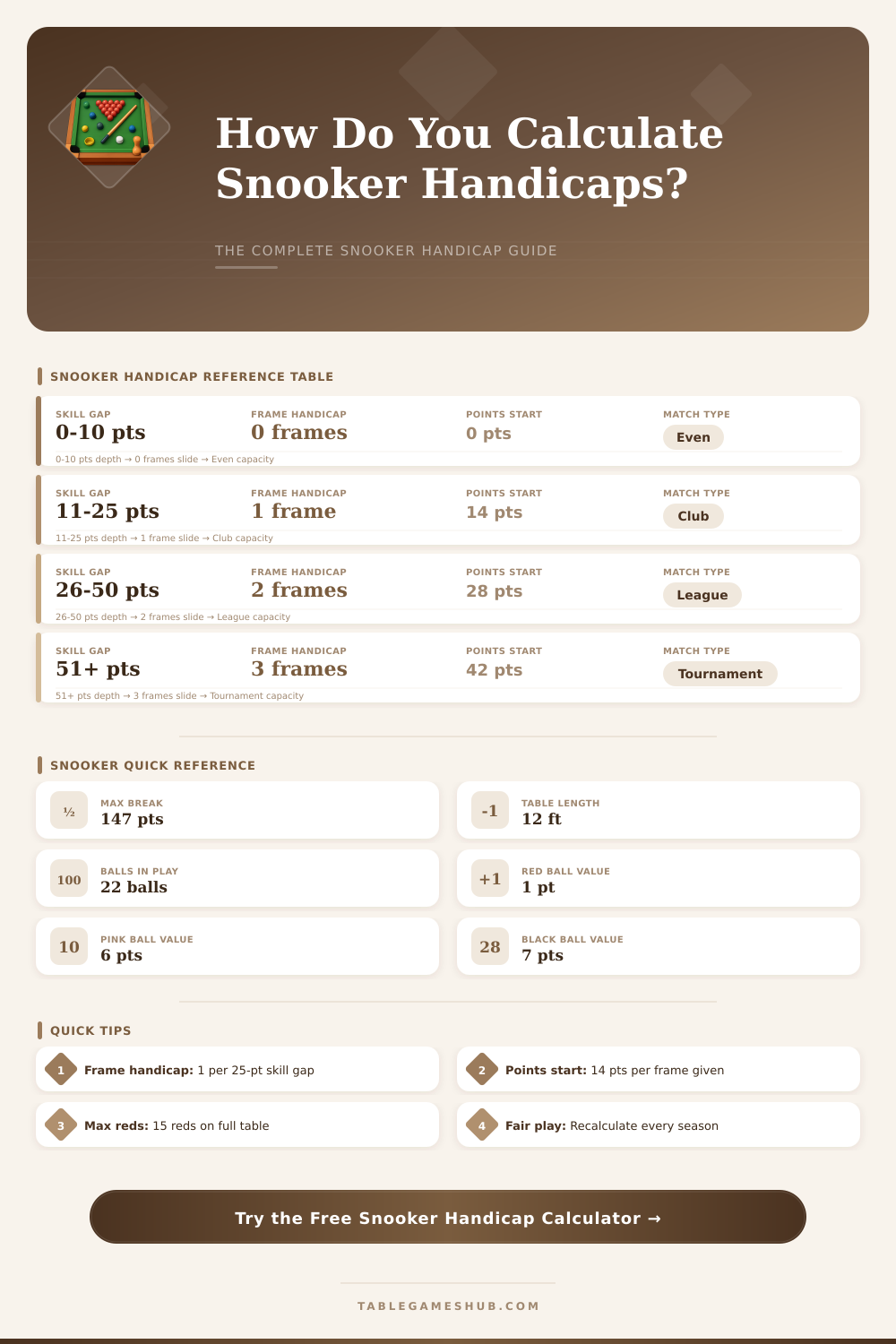
💡 Frame Handicap Rule: Give the weaker player a head start of 1 frame for every 25-point difference in average break scores. For example, a player averaging 20 vs a player averaging 70 has a 50-point gap = 2 frame handicap in a best-of-7 match.
💡 Points Start Tip: A points start handicap (e.g. Player 2 starts each frame at +21 pts) is often fairer for mixed ability social play than frame handicaps. Use approximately 7 points per 10-point difference in average break. Recalculate handicaps every 3 months as players improve.
Snooker handicap help to spot gaps between players of different skill. They can be hard to determine exactly, even so. Some night a player can play above his usual level which does the handicap seem unfair even if they are right.
Players with higher handicap are naturally less stable, so on some evening they can beat scratch-player or even better. That does not show that their handicap is wrong. It simply points that they have good day.
How Snooker Handicaps Work
The handicap ways range by ties. In one system, one counts them from results of league matches only. Matches in cups, single tournaments and breaks for points do not affect.
When a player wins a session, his handicap sinks by one spot for the victory plus the margin divided by 100. Players that play at least six sessions and win 90% or more, receive change of hand 14. Those that win 10% or less, get increase in hand 14.
Other mode is based on average points. If the average score of a player falls under 73.5, his handicap becomes positive. For instance, some with average 63.25 would recieve handicap of 10.25, because that is the difference to 73.5.
In snooker handicap usually are rounded in 7 or 8, which is worth to recall.
There are limits on how much total handicap can be. In some ties one limits them to hand 20 and plus hand 80. The biggest initial spot that a player can receive is 70 points.
If a match ends by means of penalty instead of game, it does not affect the handicap. One reviews handicap at the start and halfway of the season by difference between victories and defeats. The biggest handicap for one frame session is 50, even if the sum of two players goes past that.
Simple samples show how it works in practice. If player A has hand 10 and B plus hand 10, between them are 20 point difference. If one notes results on paper over time, one strips the past average and can set the handicap to that difference, changing it when players progress.
Without handicap many ties would limit too around 30 players, which would not suit any. To keep snooker alive, most ties need handicap systems. Some offer central record of players and their handicap, like the ELO system in other competitive games.
Bottom players benefit most, because handicap give to them feeling of tournament game and chance to beataccidentally, which keeps them engaged instead of being fully removed.