Small World Calculator – Find Your Network’s Six Degrees
🌐 Small World Network Calculator
Calculate average path length, clustering coefficient, and small-world sigma (σ) for any network
⚡ Quick Presets
⚙️ Network Parameters
✨ Small World Analysis Results
📊 Key Network Metrics at a Glance
σ > 1
Small World Threshold
3.57
Facebook Avg Path Length
0.61
Facebook Clustering (C)
6
Six Degrees of Separation
150
Dunbar's Number
4.74
LinkedIn Avg Path Length
ln(N)/ln(k)
Random Network L Formula
k/N
Random Network C Formula
🌐 Real-World Network Benchmarks
| Network | Nodes (N) | Avg Degree (k) | Avg Path Length (L) | Clustering (C) | σ (Sigma) |
|---|---|---|---|---|---|
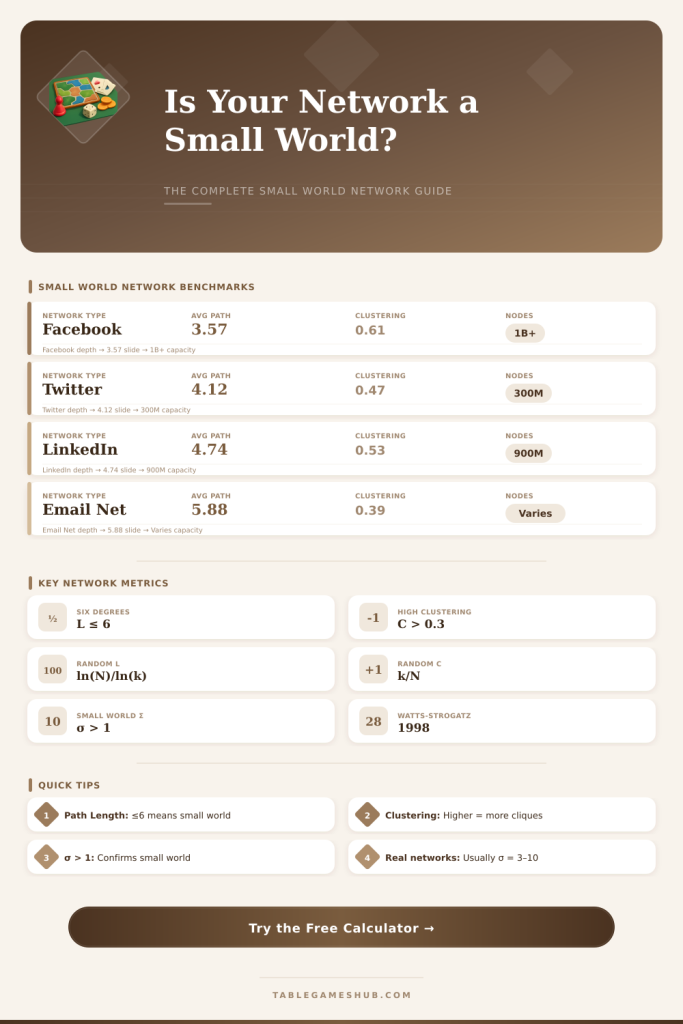
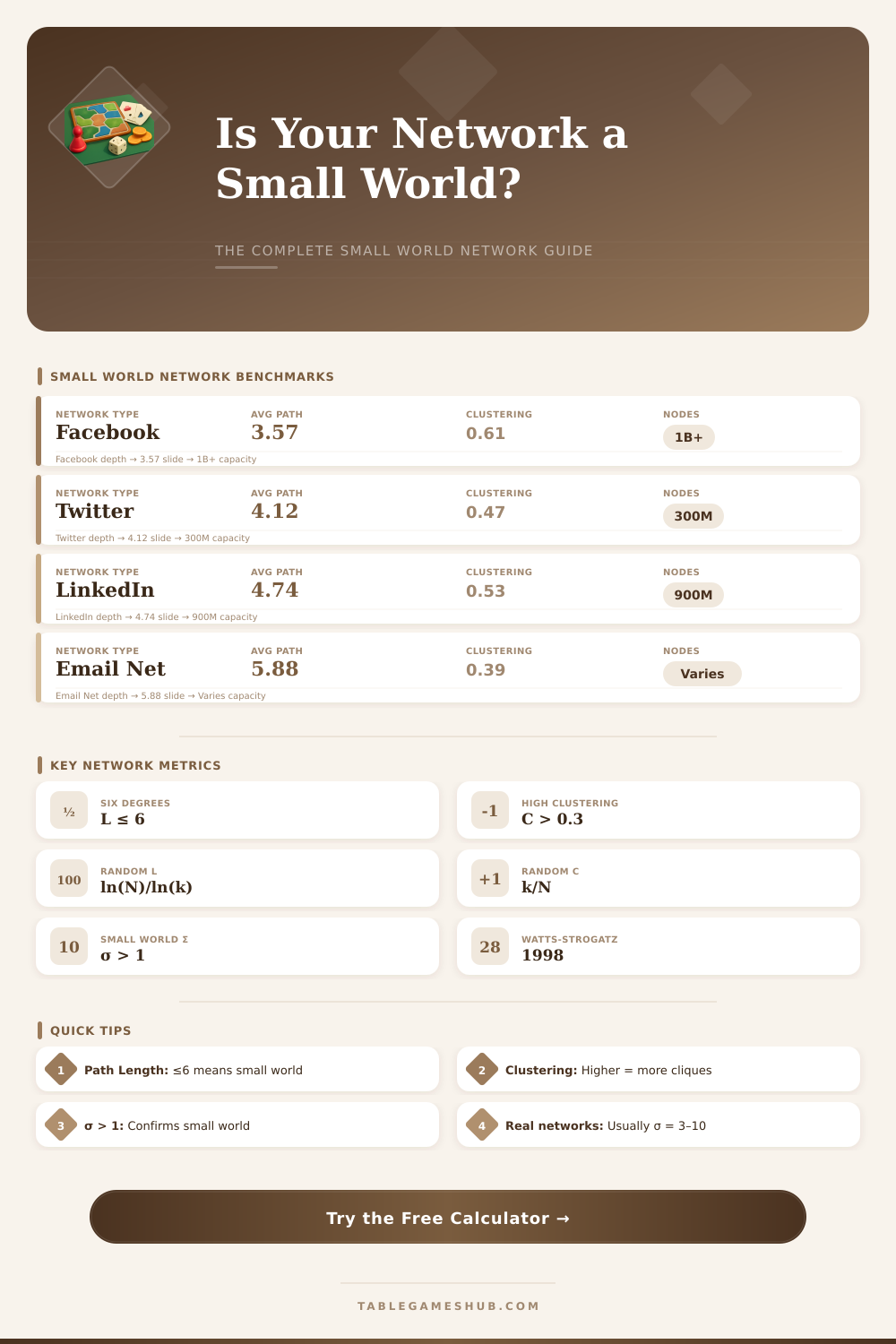
| Facebook (2016) | 1.6 billion | ~190 | 3.57 | 0.61 | ~14 |
| Twitter (2012) | 41.7M | ~28 | 4.12 | 0.47 | ~11 |
| ~500M | ~50 | 4.74 | 0.53 | ~10 | |
| Email Networks | ~59,000 | ~10 | 4.95 | 0.16 | ~6 |
| WWW (hyperlinks) | ~800M | ~8 | 18.59 | 0.24 | ~4 |
| Power Grid (US) | 4,941 | 2.67 | 18.99 | 0.08 | ~2 |
| C. Elegans Neural | 282 | 14 | 2.65 | 0.28 | ~5 |
| Protein Interactions | ~2,000 | ~6 | 6.80 | 0.12 | ~3 |
🧠 Small World Sigma (σ) Interpretation
| σ Value | Classification | Clustering Ratio (γ) | Path Ratio (λ) | Typical Network Examples |
|---|---|---|---|---|
| < 1.0 | Not Small World | < 1 | > 1 | Lattice graphs, grid networks |
| 1.0 – 2.0 | Borderline | ≈ 1 | ≈ 1 | Sparse transport, power grids |
| 2.0 – 5.0 | Weak Small World | 1–3 | ≈ 1 | Tech networks, protein nets |
| 5.0 – 10.0 | Moderate Small World | 3–6 | ≈ 1 | Email, co-authorship networks |
| 10.0 – 20.0 | Strong Small World | 6–15 | ≈ 1 | Social networks (Twitter, LinkedIn) |
| > 20.0 | Very Strong Small World | > 15 | ≈ 1 | Dense social graphs (Facebook) |
📌 Watts-Strogatz Rewiring Effects
| Rewiring Prob. (p) | Network Structure | Path Length | Clustering | Use Case |
|---|---|---|---|---|
| p = 0 | Pure Lattice | Very High | High (0.75) | Regular grid, nearest-neighbor |
| p = 0.01 | Near Lattice | High | High | Tightly clustered communities |
| p = 0.05 | Small World Zone | Low | High | Typical real-world networks |
| p = 0.10 | Small World Zone | Low | Moderate | Online social platforms |
| p = 0.50 | Near Random | Very Low | Low | Random connections dominant |
| p = 1.0 | Fully Random (Erdos-Renyi) | Minimum | Very Low (k/N) | Theoretical baseline |
💡 Tip 1: Understanding Sigma (σ) — The small world coefficient sigma = (C/C_random) / (L/L_random). A value greater than 1 confirms your network is a small world. Most real social networks have sigma between 3 and 20. The higher the sigma, the more pronounced the small-world effect.
💡 Tip 2: Path Length vs. Clustering Trade-off — A true small world network has BOTH short average path lengths (similar to a random network) AND high clustering (much higher than a random network). If only one condition is met, the network may not qualify. Use L_ratio close to 1 and C_ratio significantly greater than 1 as your benchmark.
Small World is funny, merry board game where all players try to control territories on a map, which actually is too narrow for all groups that fight about it. Philippe Keyaerts designed it, Miguel Coimbra created the pictures and Cyrille Daujean as the designer of the map, and Days of Wonder issued it in 2009. Everything started as a remake of the earlier creation of Keyaerts, Vinci, that appeared in 1999.
The basic idea is quite simple. Players choose wild races, that one matches with separate special skills, and later use them to take territories on the board. Here the tension, that moves everything: the map spaces do not have place for all races, that struggle about territory.
Simple Guide to the Small World Board Game
That restriction does the game work. Every race brings its own advantages to the table, and when one combines that with special skill, things become really attractive quickly. The number of possible combinations of races and skills ensure, that one never plays the same game tiwce.
Of two until five players can take part, and the game includes various maps made for different numbers of players. If one uses the wrong map, that can really hurt the experience, especially in a two-player game, where constant conflict should be usual. When the table seems weird peaceful, make sure too double check, whether one takes the right map for the play.
One trick separates good players from the rest: know exactly when to send a race in removal. From my experience, when one already lays half of his race tokens on the board, that usually signals, that is time to change and choose something new. This choice is really the heart of the deep thinking in the game.
The change from Vinci to Small World did everything smoother and easier. In the original version, any two skills could combine freely. Small World however limits those links, to escape entirely broken or useless pairs.
It keeps the balance, but some players think, that it removes the wild, dramatic moments.
Also, there are expansions. Small World: Heavenly Islands has seven new races and skills together with a bonus board of islands in the sky. While one uses it, the basic board works as if there is one player less at the table.
Later comes Ranges, that is more complete, it swaps the regular map with floor pieces, so one can build different tables always, andit includes between twelve and sixteen setups for play.
There is also a digital version, if one likes to not arrange all pieces yourself. The computer handles all heavy tasks, which honestly does the thing simpler. Some folks find, that the game sits a bit oddly between casual players and serious board gamers.
Others think, that it is much better than dusty classics like Risk or Monopoly, because it delivers exactly that, what it means, without dragging on too long.
Related Posts
Cribbage Discard Calculator: Find Your Best Discard Every Time
Connect Four Calculator: Win Probability & Strategy Tool
Bowling Calorie Calculator: How Many Calories Do You Burn?
Words With Friends Calculator – Score Any Word Instantly

