Shogi Calculator: Piece Values, Moves & Setup Guide
♟ Shogi Calculator
Analyze piece values, board setups, promotion zones & game configurations for Shogi (Japanese Chess)
⚡ Quick Presets
🔧 Configuration
🏆 Shogi Analysis Results
♟ Shogi Board Stats
40
Total Pieces
81
Board Squares
8
Piece Types
6
Promotable Types
27
Promotion Zone Sq.
18
Pawns (Total)
~80
Avg. Game Moves
~45min
Avg. Game Time
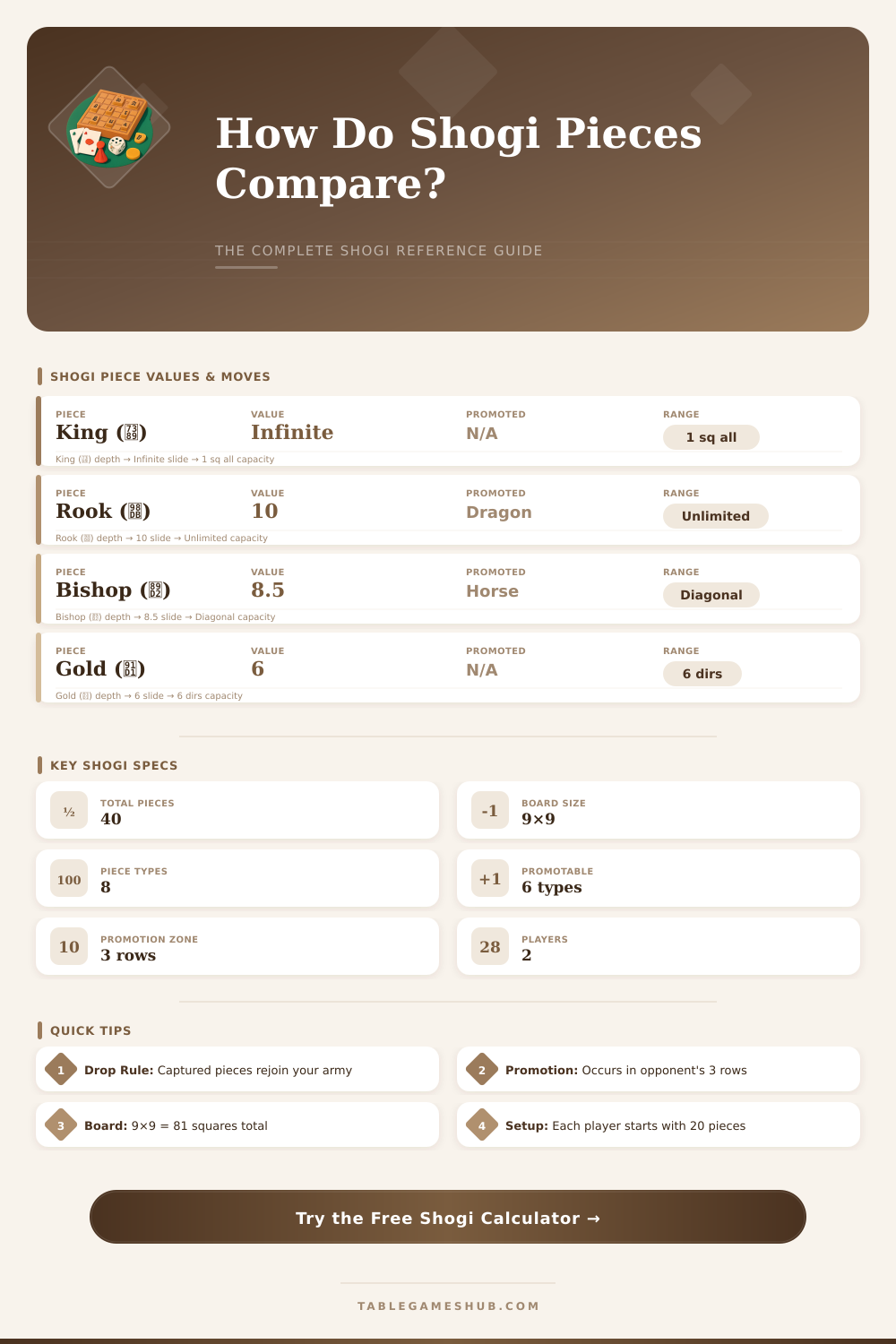
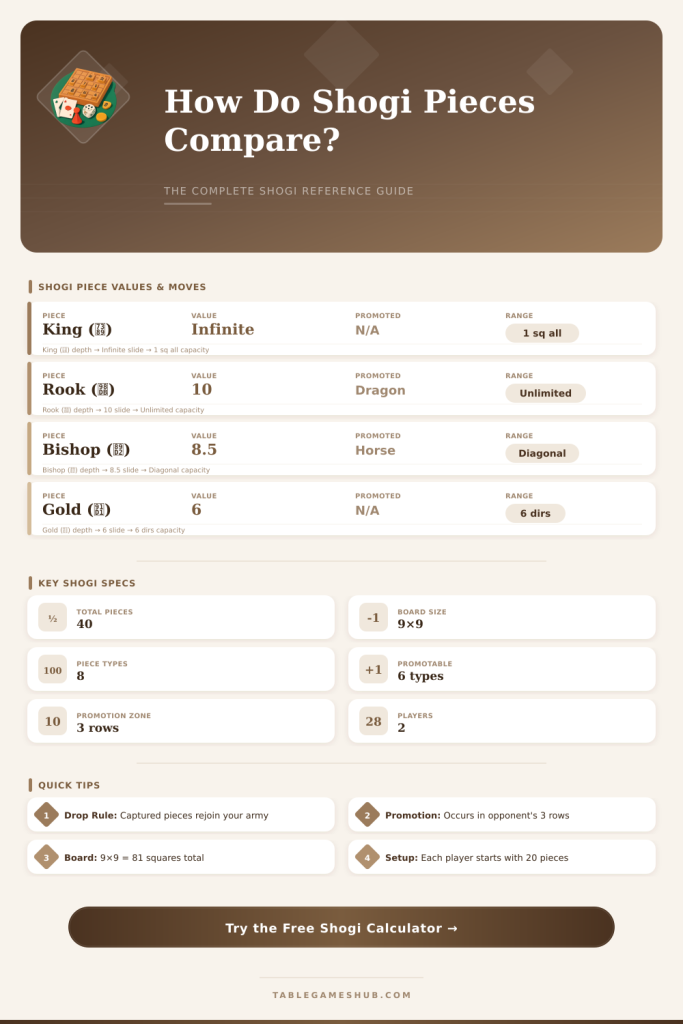
📊 Piece Values & Move Reference
| Piece (Kanji) | Relative Value | Promoted Name | Promoted Value | Count per Side | Movement Type |
|---|---|---|---|---|---|
| King (王/玉) | ∞ | N/A | N/A | 1 | 1 sq, all 8 dirs |
| Rook (飛車) | 10 | Dragon King (龍王) | 12 | 1 | Unlimited orthogonal |
| Bishop (角行) | 8.5 | Dragon Horse (龍馬) | 10 | 1 | Unlimited diagonal |
| Gold General (金将) | 6 | N/A (no promotion) | 6 | 2 | 1 sq, 6 dirs (no diag back) |
| Silver General (銀将) | 5 | Promoted Silver (成銀) | 6 | 2 | 1 sq diag + 1 forward |
| Knight (桂馬) | 3 | Promoted Knight (成桂) | 6 | 2 | 2 fwd + 1 side (jump) |
| Lance (香車) | 3 | Promoted Lance (成香) | 6 | 2 | Unlimited forward only |
| Pawn (歩兵) | 1 | Tokin (と) | 6 | 9 | 1 square forward only |
📐 Board Dimensions by Variant
| Variant | Board Grid | Total Squares | Pieces per Side | Std Board Size (in) | Std Board Size (cm) | Avg Game Time |
|---|---|---|---|---|---|---|
| Standard Shogi | 9×9 | 81 | 20 | 17.5 x 17.5 | 44.5 x 44.5 | 30–90 min |
| Chu Shogi | 12×12 | 144 | 46 | 23 x 23 | 58.5 x 58.5 | 2–4 hrs |
| Mini Shogi | 5×5 | 25 | 6 | 10 x 10 | 25.4 x 25.4 | 5–15 min |
| Sho Shogi | 9×9 | 81 | 21 | 17.5 x 17.5 | 44.5 x 44.5 | 30–60 min |
| Kyoto Shogi | 5×5 | 25 | 5 | 10 x 10 | 25.4 x 25.4 | 5–10 min |
| Dai Shogi | 15×15 | 225 | 65 | 29 x 29 | 73.7 x 73.7 | 4–8 hrs |
⚖ Handicap Reference Table
| Handicap Name | Pieces Removed | Value Deficit | Skill Diff. (Dan) | Remaining Pieces |
|---|---|---|---|---|
| Even Game | None | 0 | 0 | 20 |
| Rook Handicap | Rook only | −10 | ~1 Dan | 19 |
| Bishop Handicap | Bishop only | −8.5 | ~1 Dan | 19 |
| Rook+Bishop | Rook & Bishop | −18.5 | ~2 Dan | 18 |
| 4-Piece Handicap | R, B, 2 Lances | −24.5 | ~3 Dan | 16 |
| 6-Piece Handicap | R, B, 2L, 2Kn | −30.5 | ~4 Dan | 14 |
| 8-Piece Handicap | 6-piece + 2 Silvers | −40.5 | ~5 Dan | 12 |
| 10-Piece Handicap | 8-piece + 2 Golds | −52.5 | ~6 Dan | 10 |
💡 Calculation Tips
♟ Promotion Zone Rule: A piece can promote (or must promote if it can no longer move) upon entering, leaving, or moving within the opponent's three furthest ranks (rows 1–3 from opponent's side). The promotion zone covers 27 of 81 squares — exactly one-third of the board.
📐 Board Size Calculation: Total board outer dimensions = (grid squares × square size) + (2 × border width). A standard tournament board uses 1.5 inch squares with a 1-inch border, giving a 15.5 + 2 = 17.5 inch board. Always add 10% buffer for piece overhang during play.
⚖ Handicap Value Formula: Handicap deficit = sum of removed piece values. Use this to match players of different skill levels. A 1-Dan difference ≈ 8–10 point piece value deficit. Two players 2 Dans apart should use Rook+Bishop handicap (18.5 pts).
🎯 Move Probability: Available moves for a piece depend on its position on the board and blockers. A centrally placed Rook (row 5, col 5) has up to 16 possible squares it can reach. A corner Pawn has exactly 1 legal move. Use the calculator to find exact move counts per position.
Shogi-calculator works as a resource that researches positions and variations of shogi on a board with interaction. It researches the current situation of the board and identifies all allowed moves outside the pieces. That happens by means of rating of every possible step and removal of those that attacked own pieces.
The whole process uses computer algorithms together with deep knowledge of the rules of shogi for reaching accuracy.
Shogi calculators, apps, and websites
A popular website for such tools is kento-shogi.com. Here players can upload their games, and the page then computes and shows the best steps. There is a section about “candidates” where tap on options actually plays them on the board.
That gives a practical mode to control games and strip, where something failed or went well.
In many cases shogi hampers the computing compared to chess. Players can resubmit captive pieces on almost any field, and the board itself is vaster. Because of that the amount of possible steps in any moment beats that in chess.
On the other hand, forced sequences always calculate with a similar grade of challenge in both games. Computers project in raw force of calculation and commonly beat folks in finding paths to mate from a given position, because such results imply fewer alternatives.
Shogidroid is a free app, that includes the gpsfish engine, that one considers fit for shogi. Some players used it even to play shogi in video games, for instance in the Yakuza-series. One can load engines in programs like Shogi Browser Q, Shogidokoro or XBoard/WinBoard for more detailed research.
During mode of engine, one chooses that mainstream variation study, included of those at shallower levels or worse steps at same depth in multi-PV-rule.
Shogi Playground deserves mention as another platform. It works anywhere without need of installation and fits well to mobile devices. Players hear can control, research and exchange shogi-games together with problems for friends.
Between English speaking players Lishogi and 81dojo are the most commonly used websites for shogi, and both offer different sets of pieces, that show all possible moves of pieces.
Tanigawa and Satoh, two professional players of shogi, developed separate systems to estimate the value of pieces on the board. Knowing those values is useful for decisions about computing during a game. According to rumour, mainstream Japanese in professional shogi own wonderful skills of calculation, although their knowledge about openings, endgames or strategies in chess-style stays limited.
Knowledge about chess does not right away apply to shogi, but experts of chess compute more quickly and more deeply than a typical newcomer in shogi. One even says, that a game of shogi improves the skill in chess inatleast one grade. The fastest way to mate from the starting position in shogi requires only seven steps, rather than chess, and there exist several different modes to reach it.