Puzzle Edge Piece Calculator – Count Pieces Instantly
🧩 Puzzle Edge Piece Calculator
Calculate edge pieces, corner pieces, and interior pieces for any puzzle size
📏 Unit System
⚡ Quick Presets
⚙ Puzzle Configuration
📊 Puzzle Piece Breakdown Results
📋 Standard Puzzle Specifications
4
Corner Pieces (any puzzle)
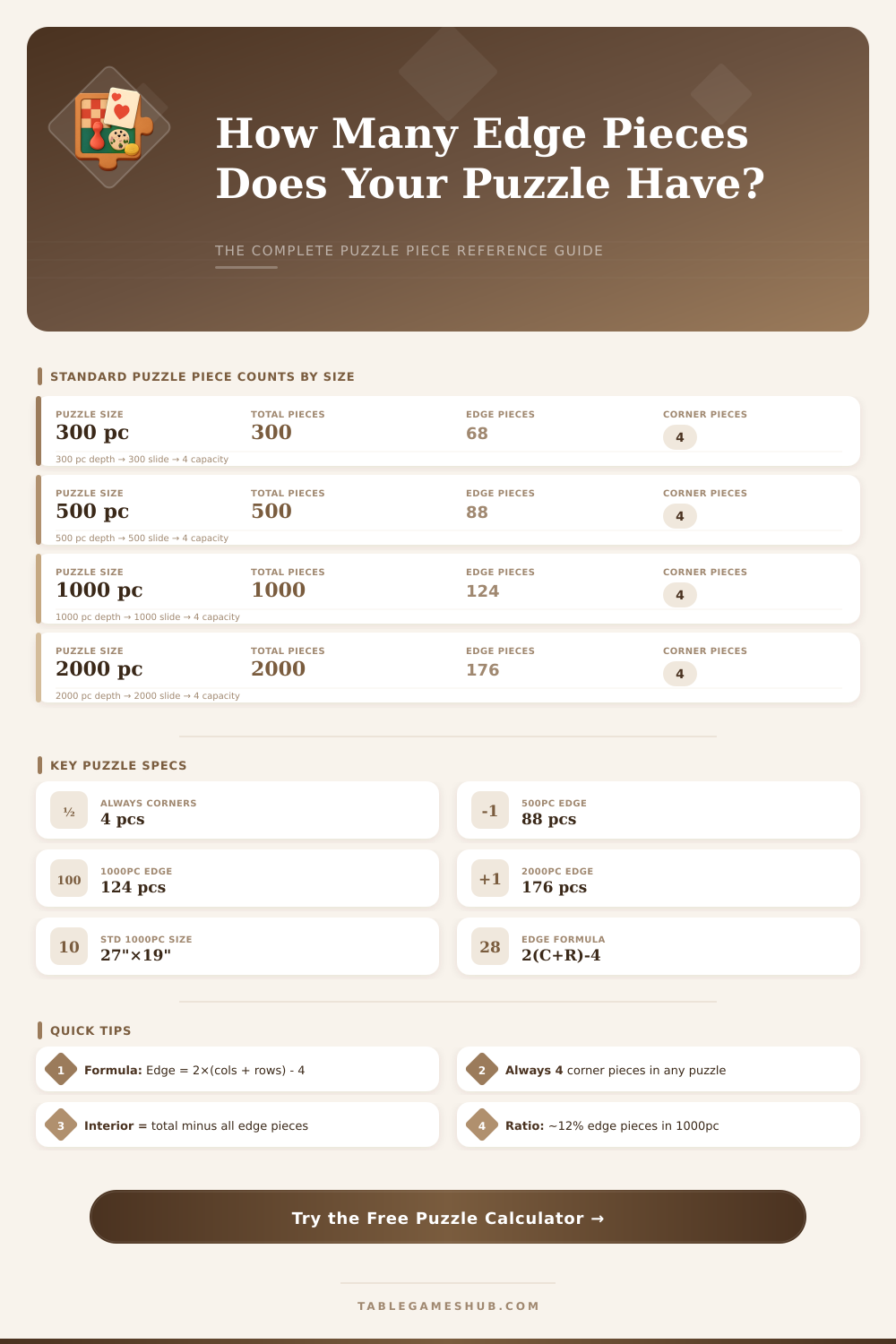
124
Edge Pieces (1000pc std)
872
Interior Pieces (1000pc std)
12.4%
Edge % of 1000pc
88
Edge Pieces (500pc std)
176
Edge Pieces (2000pc std)
0.71"
Avg Piece Size (1000pc)
27×19"
Standard 1000pc Dimensions
📐 Puzzle Piece Count Reference Table
| Puzzle Size | Typical Grid (Col×Row) | Edge Pieces | Corner Pieces | Interior Pieces | Edge % | Std Dimensions (in) |
|---|---|---|---|---|---|---|
| 24 pieces | 6×4 | 16 | 4 | 8 | 66.7% | 12×8 |
| 48 pieces | 8×6 | 24 | 4 | 24 | 50.0% | 14×10 |
| 100 pieces | 12×9 | 38 | 4 | 62 | 38.0% | 15×11 |
| 200 pieces | 20×10 | 56 | 4 | 144 | 28.0% | 19×13 |
| 300 pieces | 23×13 | 68 | 4 | 232 | 22.7% | 18×13 |
| 500 pieces | 29×18 | 90 | 4 | 410 | 18.0% | 21×15 |
| 750 pieces | 34×22 | 108 | 4 | 642 | 14.4% | 24×17 |
| 1000 pieces | 38×27 | 126 | 4 | 874 | 12.6% | 27×19 |
| 1500 pieces | 46×33 | 154 | 4 | 1346 | 10.3% | 33×23 |
| 2000 pieces | 56×36 | 180 | 4 | 1820 | 9.0% | 38×26 |
| 3000 pieces | 68×44 | 220 | 4 | 2780 | 7.3% | 45×32 |
| 5000 pieces | 89×56 | 286 | 4 | 4714 | 5.7% | 57×40 |
📏 Puzzle Dimensions & Assembly Reference
| Puzzle Size | Width (in) | Height (in) | Width (cm) | Height (cm) | Piece Size (in) | Est. Assembly Time |
|---|---|---|---|---|---|---|
| 100 pieces | 15 | 11 | 38.1 | 27.9 | 1.25 | 30–60 min |
| 300 pieces | 18 | 13 | 45.7 | 33.0 | 0.78 | 1–2 hours |
| 500 pieces | 21 | 15 | 53.3 | 38.1 | 0.72 | 2–4 hours |
| 1000 pieces | 27 | 19 | 68.6 | 48.3 | 0.71 | 5–10 hours |
| 1500 pieces | 33 | 23 | 83.8 | 58.4 | 0.72 | 8–15 hours |
| 2000 pieces | 38 | 26 | 96.5 | 66.0 | 0.68 | 12–20 hours |
| 3000 pieces | 45 | 32 | 114.3 | 81.3 | 0.66 | 20–35 hours |
| 5000 pieces | 57 | 40 | 144.8 | 101.6 | 0.64 | 40–80 hours |
🧱 Sorting Strategy by Puzzle Size
| Puzzle Size | Recommended Sections | Pieces per Section | Edge-First Strategy | Table Space Needed |
|---|---|---|---|---|
| 100–300 pieces | 2–3 | 50–100 | 5–10 min | 24×18 in |
| 500 pieces | 4 | ~125 | 10–15 min | 28×22 in |
| 1000 pieces | 4–6 | ~170 | 20–30 min | 36×28 in |
| 1500 pieces | 6 | ~250 | 30–40 min | 42×32 in |
| 2000 pieces | 6–8 | ~285 | 40–60 min | 48×36 in |
| 3000–5000 pieces | 8–12 | ~400 | 60–90 min | 60×48 in |
💡 Puzzle Assembly Tips
🧩 Edge Piece Formula: Edge pieces always = 2 × (columns + rows) – 4. There are always exactly 4 corner pieces regardless of puzzle size. Interior pieces = total – edge – 4. For a 1000pc puzzle with a 38×27 grid: 2(38+27)–4 = 126 edge pieces, 870 interior pieces.
📏 Table Space Rule: Allow at least 1.5× the finished puzzle dimensions for your working table space — you need room to sort pieces alongside the assembly area. A 27×19 inch puzzle (1000pc) needs a table at least 40×30 inches. For 2000pc+ puzzles, a dedicated folding table (48×36 inches) is strongly recommended.
The Puzzle Edge Piece ranks among the most discussed elements of puzzles. Sort them carefully helps in the whole sorting work. That helps quickly introduce yourself to the ranged tones and patterns of the image.
Many puzzlers firmly believe in the principle “edges before” and no approach changes that for them.
All About Edge Pieces
Puzzles sold as having smooth edges commonly include also curved corners or several parts. Some have unusual edges, and the real form of the edge surprisingly shows when one opens the box. There are also such without any clear edges entirely, what increases the whole challenge.
The bits commonly have different forms, what expands the trouble of the puzzle. Each of them locks with the rest, what results in a full image after combining. The puzzles come in different sizes and types of pieces.
Here is the spot, where everything becomes truly unusual. There exists a puzzle with 438 from 501 bits as Puzzle Edge Piece, what sounds entirely absurd but offers strong challenge for those puzzlers, that need something new, thanks to the wierd shape and form. By the way, a version called the Puzzle of the Majority of Edge Pieces stores 408 from 512 such bits.
It does not give a simple start, only striking challenge, where every bit equally tricky is as the last. Usually combining the Puzzle Edge Piece forms the joyful core of puzzles, so what happens, if almost everything is a Puzzle Edge Piece?
Some brands indeed offer puzzles, where every bit is a Puzzle Edge Piece. A sample from Yetch Studio is called Summer Day on the River and is maid up of 501 bits. One called it truly fun and attractive, although it seems difficult.
Some brands have troubles with their Puzzle Edge Piece bits. Springbok became known because of too smooth edges in the puzzle, also as bits, that touch the edge but do not lock with it. Because of that Puzzle Edge Piece bits can end in the wrong place, what truly upsets.
Bits and Bits cause alike confusion, that needs time to figure out. While sorting, commonly appear separate crowds of “false Puzzle Edge Piece bits”, because they are hardlyensure.
Buffalo Puzzles write 1000-piece puzzle in 38 by 28 inches, that stores 1026 bits entirely with 126 Puzzle Edge Piece. Some puzzlers panic, thinking that a bit lacks, until they find it ultimately. One or two Puzzle Edge Piece bits can stick through while sorting, what forces restarting the whole process.
After finishing a puzzle, some folks separate the edges from the other bits in a packet to preserve. Others simply mix everything together.