Pickleball Rating System Calculator – Find Your DUPR & UTPR Level
🏓 Pickleball Rating System Calculator
Estimate your DUPR, UTPR, or skill level rating based on match results and performance data
⚡ Quick Presets
⚙️ Calculator Settings
📊 Match Results Entry
🏋️ Player Profile
🏆 Your Pickleball Rating Results
📋 Pickleball Rating Scale Quick Reference
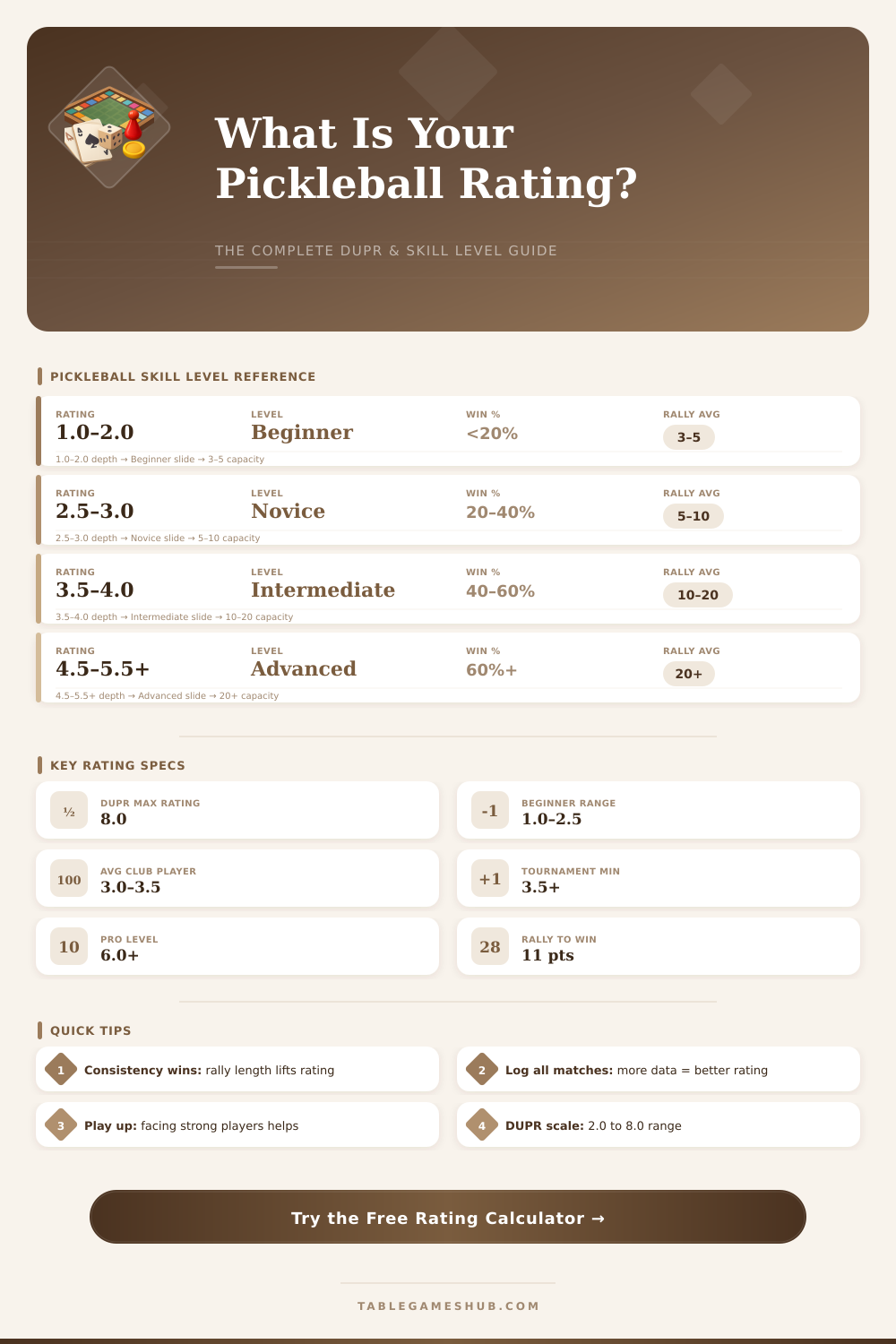
1.0–2.0
Beginner Range
2.5–3.0
Novice Range
3.5–4.0
Intermediate
4.5–5.5+
Advanced / Pro
6.0–8.0
DUPR Pro Range
11 pts
Standard Game Score
44 ft
Court Length
20 ft
Court Width
📈 DUPR Rating Level Breakdown
| Rating Range | Skill Level | Typical Win % vs 3.0 | Avg Rally (shots) | Recommended Play |
|---|---|---|---|---|
| 1.0 – 2.0 | Absolute Beginner | <10% | 2–4 | Lesson groups, open play |
| 2.0 – 2.5 | Beginner | 10–20% | 3–6 | Beginner clinic, social play |
| 2.5 – 3.0 | Novice | 20–35% | 5–10 | Club open play, beginner leagues |
| 3.0 – 3.5 | Low-Intermediate | 35–50% | 8–14 | Club leagues, local tournaments |
| 3.5 – 4.0 | Intermediate | 50–65% | 12–20 | Regional tournaments, leagues |
| 4.0 – 4.5 | Upper-Intermediate | 65–75% | 15–25 | State tournaments, open divisions |
| 4.5 – 5.0 | Advanced | 75–85% | 20–35 | National tournaments, 5.0 open |
| 5.0 – 5.5 | Expert | 85–95% | 25–45 | Pro-am events, top amateur |
| 6.0+ | Professional (DUPR) | 95%+ | 30+ | APP Tour, MLP, PPA Tour |
🏓 Standard Pickleball Court Dimensions
| Measurement | Imperial | Metric | Notes |
|---|---|---|---|
| Court Length (total) | 44 ft | 13.41 m | Including both kitchens |
| Court Width | 20 ft | 6.10 m | Singles and doubles same |
| Kitchen (NVZ) Depth | 7 ft | 2.13 m | Each side from net |
| Net Height (center) | 34 in | 86 cm | Regulation height |
| Net Height (sides) | 36 in | 91 cm | At sideline posts |
| Service Box Width | 10 ft | 3.05 m | Each half of court |
| Baseline to Net | 22 ft | 6.71 m | Each side |
| Recommended Play Area | 30 x 60 ft | 9.14 x 18.3 m | Including out-of-bounds |
🏅 Tournament Rating Categories & Rules
| Event Type | Min Rating | Max Rating | Format | Points to Win |
|---|---|---|---|---|
| Beginner Open | 1.0 | 2.5 | Doubles / Mixed | 11 (win by 2) |
| 3.0 Division | 2.5 | 3.249 | Doubles | 11 (win by 2) |
| 3.5 Division | 3.25 | 3.749 | Doubles | 11 (win by 2) |
| 4.0 Division | 3.75 | 4.249 | Doubles / Singles | 11 (win by 2) |
| 4.5 Division | 4.25 | 4.749 | Doubles / Singles | 11 (win by 2) |
| 5.0 Division | 4.75 | 5.249 | Doubles / Singles | 11 (win by 2) |
| Open / Pro | 5.25+ | No max | All formats | 15 or 21 (finals) |
| Age-Restricted (USAPA) | Varies | Varies | Age brackets | 11 or 15 |
📝 Rating System Comparison
| System | Scale | Method | Update Frequency | Best For |
|---|---|---|---|---|
| DUPR | 2.0 – 8.0 | Algorithm (results-based) | After each match | All players, global ranking |
| UTPR | 1.0 – 6.0+ | Tournament results only | After each tournament | USAPA tournament players |
| Skill Level (USAPA) | 1.0 – 5.5+ | Self-assessment / testing | Player-initiated | Recreational, local leagues |
| IPTPA | 1 – 10 | Instructor evaluation | Certification-based | Teaching professionals |
💡 DUPR Rating Tip: DUPR uses a sophisticated algorithm that weights recent match results more heavily. Playing against higher-rated opponents and winning gives a larger rating boost than beating lower-rated players. Log every match — recreational and tournament — for the most accurate DUPR rating.
🎾 Improve Your Rating Faster: The fastest way to move from 3.0 to 3.5 is to focus on third-shot drops and dinking consistency. Average rally length is a strong predictor of rating level — intermediates typically sustain 10–20 shot rallies, while beginners average 3–6 shots per point. Play up one level when possible.
Pickleball ratings may seem hard at first, but really they are simple when you strip the basics. Rating points show your current level of skill based on your play in official games. The most common methods use a scale that starts at 2.0 for newcomers and climbs to 8.0 for professionals.
Really useful is that ratings help to find proper opponents of same strength and allow you to track how far you progressed.
How Pickleball Ratings Work
Currently DUPR (Dynamic Universal Pickleball Rating), is the most commonly used rating system in the world. It reached global popularity and gets support from big clubs, contests, groups and players everywhere. Although it is still fairly young, it spread surprisingly quickly.
The best part? It is free and open for all players. New players start as NR (Not Rated), later they climb in the range of 2.000 to 8.000 as they win games and show their real place.
Here is what makes DUPR ratings dynamic: your rating adjusts automatically when a game result goes into the database. It takes info from various play types, contests, team games, casual parties… And recalculates your position based on your freshest results.
Also the difference in score matters. Beating someone by 11-0 raises your rating more then a narrow 11-9 victory. There are two easy ways to enter the system and receive your rating.
Various things decide how your rating will adjust after a game. The ranks of opponents matter. So does the kind of game, whether it is a casual party, team match, or official event.
Here is a clever cause: if your opponent lost before against a stronger player, the algorithm of DUPR could give you some points, because that person showed themselves more tough than you thought. The more long someone plays, the moreprecise their rating becomes.
UTR-P is another option that you must mention, it is the official rating system of United States Pickleball for events of APP. United States Pickleball created the first national rating in 2005. Those levels sort players based on their skills and help newcomers easily enter.
Most players start with self-rating, reaching values of 1.0 to 5.5 or more. Usually you commonly see ratings between 3.0 and 5.0. A player at 4.0 is skilled; they know the rules, play smart and can guess what the opponent will do.
Time spent playing does not always rush you. Each learns at their own pace, and rating must reflect stable skill, not only one good session or bad day.
Today many pickleball clubs run seeded games, sorting folks in groups like 2.X, 3.X, 4.X and 5.X. Each ends up with games against similar players, which keeps the game fun and just hard enough.