Multiple Dice Roll Probability Calculator – Get Exact Odds
🎲 Multiple Dice Roll Probability Calculator
Calculate exact probabilities for any combination of dice — sums, targets, advantage rolls, and full distributions
⚡ Quick Presets
Display Mode:
🧮 Dice Configuration
✅ Probability Results
📊 Key Dice Probability Stats
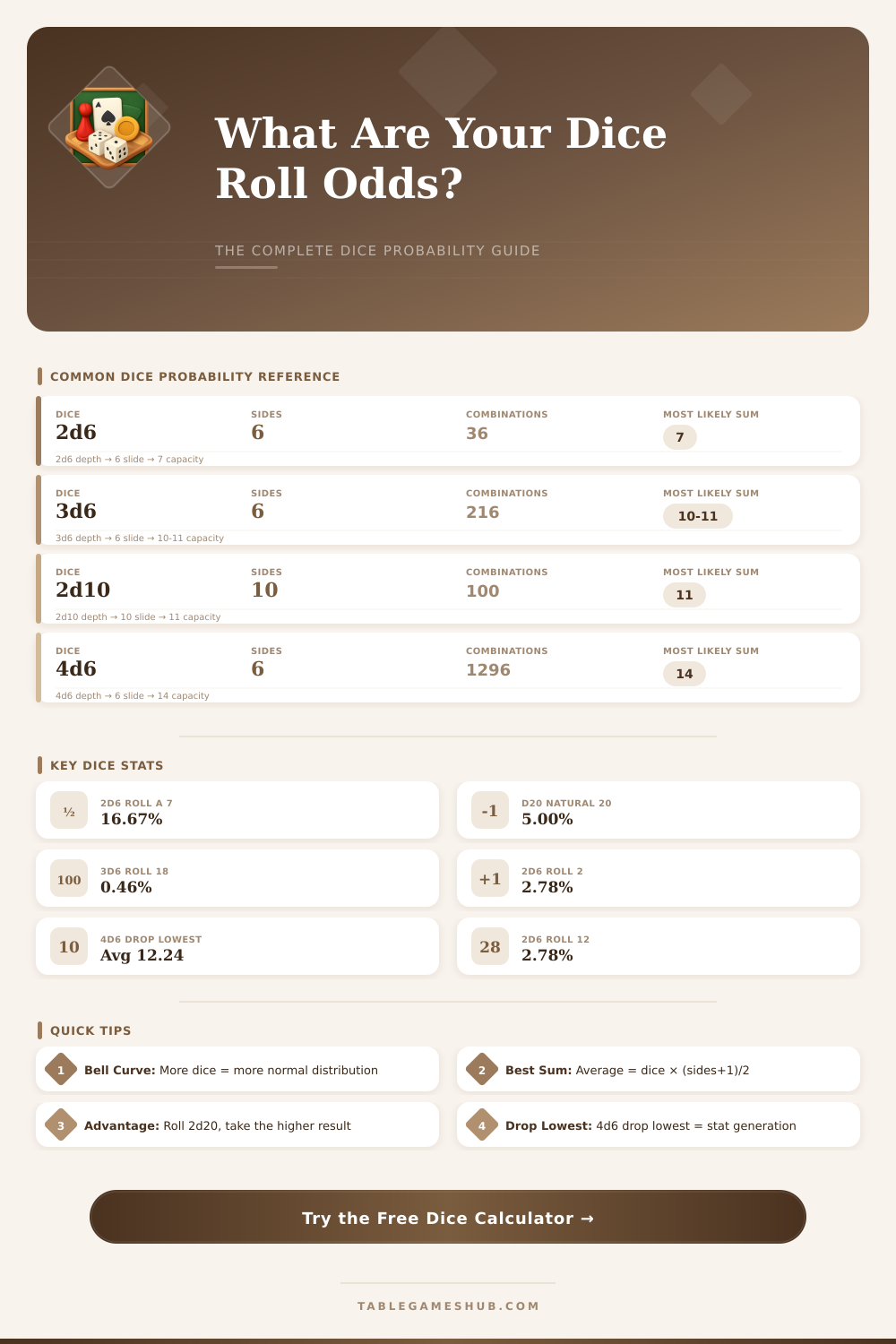
16.67%
2d6 Roll a 7
5.00%
d20 Natural 20
0.46%
3d6 Roll 18
2.78%
2d6 Roll a 2
26.26%
4d6 Drop Low Avg 12+
8.33%
2d6 Roll 6 or 8
50.00%
d20 Adv. Roll 11+
12.35%
3d6 Roll 10 Exactly
🎲 2d6 Complete Probability Distribution
| Sum | Combinations | Probability | Cumulative (sum or less) | Roll in 36 games |
|---|---|---|---|---|
| 2 | 1 | 2.78% | 2.78% | 1.0 |
| 3 | 2 | 5.56% | 8.33% | 2.0 |
| 4 | 3 | 8.33% | 16.67% | 3.0 |
| 5 | 4 | 11.11% | 27.78% | 4.0 |
| 6 | 5 | 13.89% | 41.67% | 5.0 |
| 7 | 6 | 16.67% | 58.33% | 6.0 |
| 8 | 5 | 13.89% | 72.22% | 5.0 |
| 9 | 4 | 11.11% | 83.33% | 4.0 |
| 10 | 3 | 8.33% | 91.67% | 3.0 |
| 11 | 2 | 5.56% | 97.22% | 2.0 |
| 12 | 1 | 2.78% | 100.00% | 1.0 |
⚔️ Dice Type Reference — Standard Probability Data
| Die Type | Min Roll | Max Roll | Mean (Avg) | Std Dev | Common Use |
|---|---|---|---|---|---|
| d4 | 1 | 4 | 2.5 | 1.12 | Damage (dagger, magic missile) |
| d6 | 1 | 6 | 3.5 | 1.71 | Board games, craps, poker dice |
| d8 | 1 | 8 | 4.5 | 2.29 | RPG damage (longsword) |
| d10 | 1 | 10 | 5.5 | 2.87 | Percentile, WoD system |
| d12 | 1 | 12 | 6.5 | 3.45 | Greataxe damage, calendar |
| d20 | 1 | 20 | 10.5 | 5.77 | D&D attack rolls, skill checks |
| d100 | 1 | 100 | 50.5 | 28.87 | Percentile checks, loot tables |
🏆 Common Multi-Dice Pool Probabilities
| Dice Pool | Total Combos | Most Likely Sum | Peak Probability | Avg Sum | Game Use |
|---|---|---|---|---|---|
| 2d6 | 36 | 7 | 16.67% | 7.0 | Monopoly, Craps, Catan |
| 3d6 | 216 | 10, 11 | 12.50% | 10.5 | Classic RPG stats |
| 4d6 drop 1 | 1296 | 13 | ~9.3% | 12.24 | D&D ability scores |
| 5d6 | 7776 | 17, 18 | ~9.3% | 17.5 | Yahtzee |
| 2d10 | 100 | 11 | 10.00% | 11.0 | WoD, Shadowrun |
| 2d20 adv. | 400 | 14 | ~9.75% | 13.83 | D&D 5e advantage |
| 2d20 disadv. | 400 | 7 | ~9.75% | 7.17 | D&D 5e disadvantage |
| 3d8 | 512 | 13, 14 | ~9.6% | 13.5 | RPG area damage |
💡 Tips for Dice Probability Calculations
📐 Bell Curve Principle: The more dice you roll, the more the distribution clusters toward the mean. Rolling 10d6 gives a much narrower spread around 35 than rolling 1d60. This is the Central Limit Theorem in action — very useful for understanding game balance.
➕ Calculating the Mean: For any number of identical dice, the expected average sum equals: Number of Dice × (Sides + 1) / 2. For 3d6: 3 × 7/2 = 10.5. This formula works for any die type and is the foundation of all dice probability calculations.
🎯 Advantage Mechanics: Rolling 2d20 and keeping the highest (advantage in D&D 5e) raises your effective average roll from 10.5 to approximately 13.83. The probability of rolling 20 or higher doubles from 5% to 9.75% with advantage.
💥 Independent Probability: Each die roll is statistically independent. The probability of rolling a specific face on each die is always 1/sides, regardless of previous rolls. The “gambler's fallacy” — believing past results affect future rolls — does not apply to fair dice.
You roll a fair six-sided die and get a number from 1 to 6. Each of those numbers has the same chance to come up, so 1 in 6 probability for any result. Because all sides of a fair die are the same, each has exactly 1/6 probability.
All this depends on one basic rule: the dice are not weighted or rigged. Most importantly recall that every single dice roll is independent of the others. One result does not affect the next.
Basic Dice Probability
Here is where many folks go wrong. Dice do not have memory. Say that someone rolled only four 6s during a game.
The next roll? Still 1 in 6 chance for a new 6. This is not like pulling cards from a shrinking deck.
With dice, the chances stay the same, what happened before does not change anything.
When we use two dice, things become more interesting. Now we have 36 different possible combinations, simply 6 times 6. The order really matters, which confuses some folks.
Rolling 1 then 2 is entirely different than 2 then 1. Think about one die red and the otehr blue, with red always first, that image helps to understand. Every particular pair has probability 1/36.
Some totals happen only one way. For 2: both dice show 1. For 12: both show 6.
Only that. But four the sum of 7 there are more ways (six different pairs work). So expert players of board games know that 7 is the most common result when rolling two dice.
The easiest way to solve such questions is to list your sample space. It means writing down every possible result. For dice, that means to note all possible rolls.
After you have that list, counting probability is easy: divide the number of ways to get your target total by the whole number of possible combinations.
Everything gets harder when you add more dice. The formula for probability raises the single die chance to a power equal to the number of dice, so P = p^n. Luckily, online tools like AnyDice do that work.
They are made specially for board games. Some of them give exact fractions (for instance 1/6) instead of awkward decimals.
If you want the probability of at least one success in several rolls, use the method of reverse calculation. Do not count direct success, but the failure and subtract it from 1. For instance, the chance to not roll a 6 in one dice roll is 5/6.
Multiply that by itself ten times for ten rolls, then subtract from 1 to get the real chance of at least one 6.
Dice are the heart of board games. They decide every success or failure, andeverything in between. The real challenge is to balance probability with gameplay, so that everything stays fair and fun for the players.