Mahjong Tile Efficiency Calculator – Optimize Your Hand
🀄 Mahjong Tile Efficiency Calculator
Calculate shanten number, tenpai probability, uke-ire count & hand efficiency for any mahjong style
⚡ Quick Presets
🔧 Hand Configuration
✨ Efficiency Analysis Results
🀄 Mahjong Set Composition by Style
136
Riichi Standard Tiles
144
HK/MCR Full Set
152
American Set (Jokers)
148
Taiwanese Set
34
Unique Tile Types
13
Hand Size (Standard)
4
Copies Per Tile
~70
Starting Wall Tiles
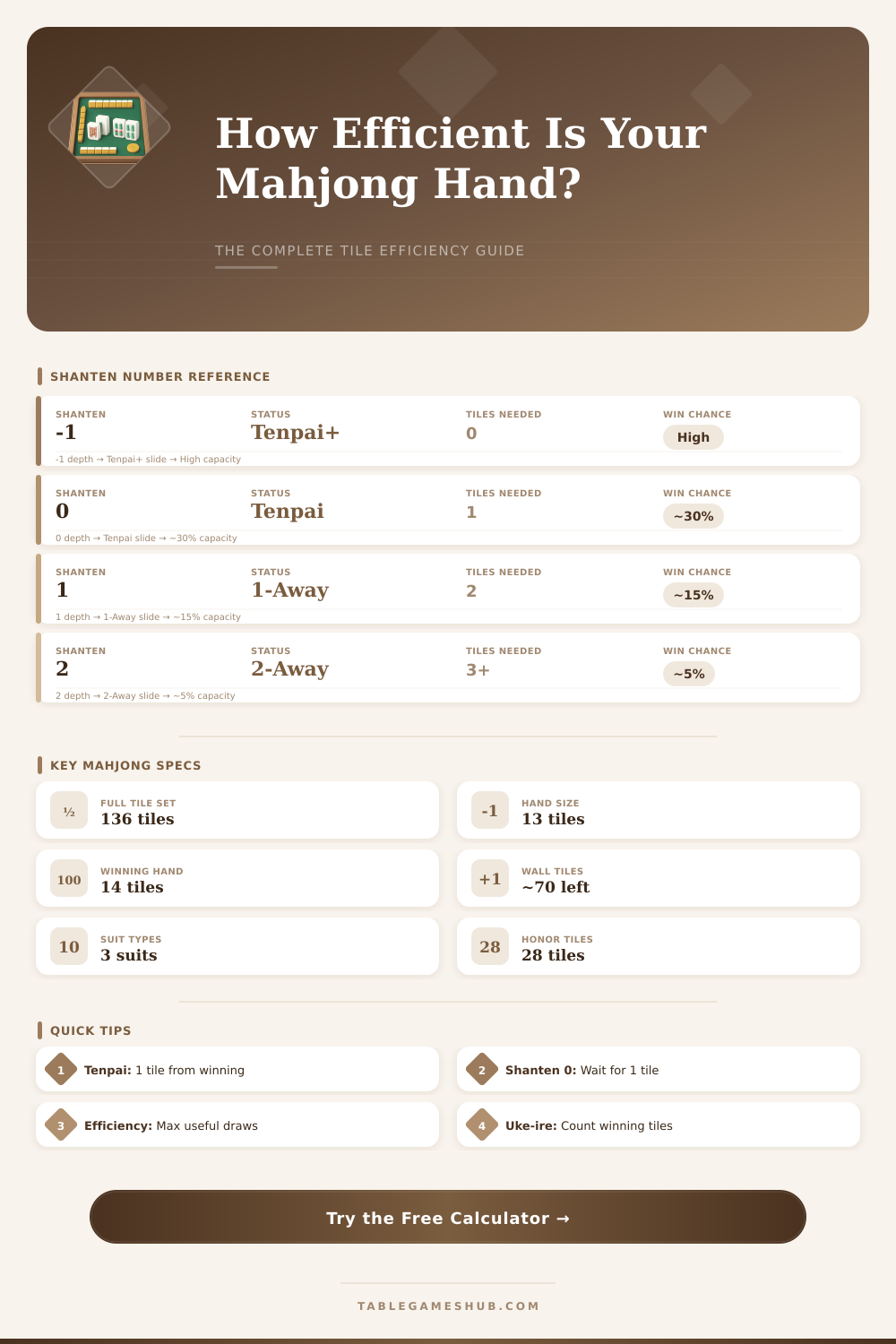
📊 Shanten Number Reference Table
| Shanten # | Status | Tiles to Tenpai | Est. Win Probability | Recommended Action |
|---|---|---|---|---|
| -1 | Winning Hand (Agari) | 0 | 100% (Won) | Declare win |
| 0 | Tenpai (Waiting) | 1 draw | ~25–40% | Declare riichi or wait |
| 1 | 1-Away (Iishanten) | 2 draws | ~12–20% | Draw toward tenpai |
| 2 | 2-Away (Ryanshanten) | 3 draws | ~5–10% | Build sets, improve blocks |
| 3 | 3-Away | 4+ draws | ~2–5% | Restructure hand |
| 4+ | Far from Tenpai | 5+ draws | <2% | Consider defense / fold |
🎯 Tile Set Dimensions & Table Specs
| Mahjong Style | Total Tiles | Table Size (in) | Table Size (cm) | Players | Avg. Game Time |
|---|---|---|---|---|---|
| Riichi (Japanese) | 136 | 34–36 in | 86–91 cm | 4 | 60–90 min |
| Hong Kong | 144 | 34–36 in | 86–91 cm | 4 | 60–120 min |
| MCR (Chinese Official) | 144 | 34–40 in | 86–102 cm | 4 | 90–150 min |
| American | 152 | 36–40 in | 91–102 cm | 4 | 60–90 min |
| Taiwanese | 148 | 34–38 in | 86–97 cm | 4 | 60–120 min |
| 3-Player Riichi | 108 | 30–34 in | 76–86 cm | 3 | 45–75 min |
🧮 Standard Tile Group Counts
| Tile Category | Tile Names | Count (Riichi) | Count (MCR/HK) | Notes |
|---|---|---|---|---|
| Man (Characters) | 1–9 Man | 36 | 36 | 4 copies each |
| Pin (Circles) | 1–9 Pin | 36 | 36 | 4 copies each |
| Sou (Bamboo) | 1–9 Sou | 36 | 36 | 4 copies each |
| Winds | East, South, West, North | 16 | 16 | 4 copies each |
| Dragons | Haku, Hatsu, Chun | 12 | 12 | 4 copies each |
| Flowers / Seasons | Flower 1–4, Season 1–4 | 0 | 8 | Optional bonus tiles |
| Jokers | Joker tiles | 0 | 0 (8 in American) | American only |
📋 Common Setup Configurations
| Players | Hand Size | Wall Size | Starting Draws (East) | Typical Duration |
|---|---|---|---|---|
| 4 (Standard) | 13 tiles | 136 tiles | 14 tiles | 60–90 min/round |
| 3 (Sanma) | 13 tiles | 108 tiles | 14 tiles | 45–75 min/round |
| 4 (MCR) | 16 tiles | 144 tiles | 16 tiles | 90–150 min/round |
| 4 (American) | 13 tiles | 152 tiles | 14 tiles | 60–90 min/round |
💡 Shanten Formula: For a standard hand, shanten = (4 – mentsu_count) × 2 + (1 – pair_count) – taatsu_count – 1. A result of 0 means tenpai; –1 means complete winning hand. The lower the shanten, the closer you are to winning.
🎯 Uke-ire (Acceptance Count): Count how many unique tiles can improve your hand to one lower shanten. More uke-ire tiles = higher efficiency. With 70 tiles in the wall and 4 copies of each tile type, a single uke-ire tile type gives approximately a 1/17.5 draw probability per draw.
🀄 Table Setup Tip: A standard square mahjong table is 34–36 inches (86–91 cm) per side for 4 players. Each player needs approximately 9–10 inches of wall length for their dealt tiles and draws. Automatic shuffling tables add ~4 inches per side.
🎲 Tile Draw Probability: If you are tenpai waiting on N tile types, your win probability per draw = (N × remaining_copies) / tiles_left. With 1 tile type remaining (4 copies, 70 tiles in wall), win chance per draw ≈ 4/70 = 5.7%. Multiple waits multiply your chances accordingly.
Mahjong, in its most basic form, is a game where four players race to be the fastest to form four sets of three tiles plus one pair. Hence the choice of tiles to dump, based on its impact is like this natural and decisive. Without knowledge about that, like picking the right tile to remove, the way to victory becomes much harder.
The base of Mahjong Tile Efficiency is something called the theory of five blocks. A full hand normally is made up of five blocks: four sets of three tiles, plus one pair. The secret lies in that one mentally splits the hand into such blocks before they are fully ready.
How Mahjong Tile Efficiency Works
That helps much more easily compare possibilities and estimate what to dump. Splitting the hand into possible blocks, one can identify spots where there are too many or too few useful bits.
The mainstream goal is having exatcly five blocks. Neither more, neither less. On the other hand, six blocks still beat five blocks with two fully useless loose tiles, that simply sit here.
The sixth block is extra, but it adds deadly burden. When one draws a strong single tile, that is a good chance to give up the extra block.
Two mainstream words appear commonly when one talks about Mahjong Tile Efficiency. Shan-ten shows the amount of draws needed to reach tenpai, which is the state where the hand only needs one more tile too win. Lower shan-ten are better, and zero shows that the hand already is in tenpai.
The other term is uke-ire, that measures the total number of tiles that could be drawn to lower the shan-ten. Bigger uke-ire gives more chances to improve the hand.
Here is where things become interesting though. Pure Mahjong Tile Efficiency suggests to remove loose honor tiles first, because they connect with fewer others. But sometimes players knowingly keep those honors and dump deadly tiles instead.
Because of what? Because drawing that same honor later can help, and keeping honors near the end does more easily defend, if the situation turns bad.
Practice Mahjong Tile Efficiency counts across various styles of mahjong. There are trainers for Mahjong Tile Efficiency, made specially for Japanese Riichi Mahjong, and also tile calculators are available. Practice things like quickly tracking expected tiles and reading the discards of opponents are helpful.
One simple way is use only one set of tiles andplay with limited calls, only Kan, Ron or Tsumo are allowed.
Speed does not matter, when the hand leads to winning. Reaching victory directly stops opponents from reaching theirs and can even reduce their points. Hence learning Mahjong Tile Efficiency is not optional…
It is what all players need to play well.