Dominoes All Fives Calculator – Score Every Hand Fast
🧮 Dominoes All Fives Calculator
Calculate scores, open-end sums, hand totals, and game stats for All Fives (Muggins) dominoes
⚡Quick Presets
🎮Game Configuration
📊Score This Play
🃏Hand & Boneyard
📏Tile Dimensions
🏆 Results
📐Domino Set Quick Reference
28
Double-6 Tiles
55
Double-9 Tiles
91
Double-12 Tiles
168
Double-6 Total Pips
495
Double-9 Total Pips
1092
Double-12 Total Pips
250
Standard Win Score
5
Min Scoring Sum
📋All Fives Scoring Table
| Open End Sum | Points Scored | Multiple of 5? | Example Ends |
|---|---|---|---|
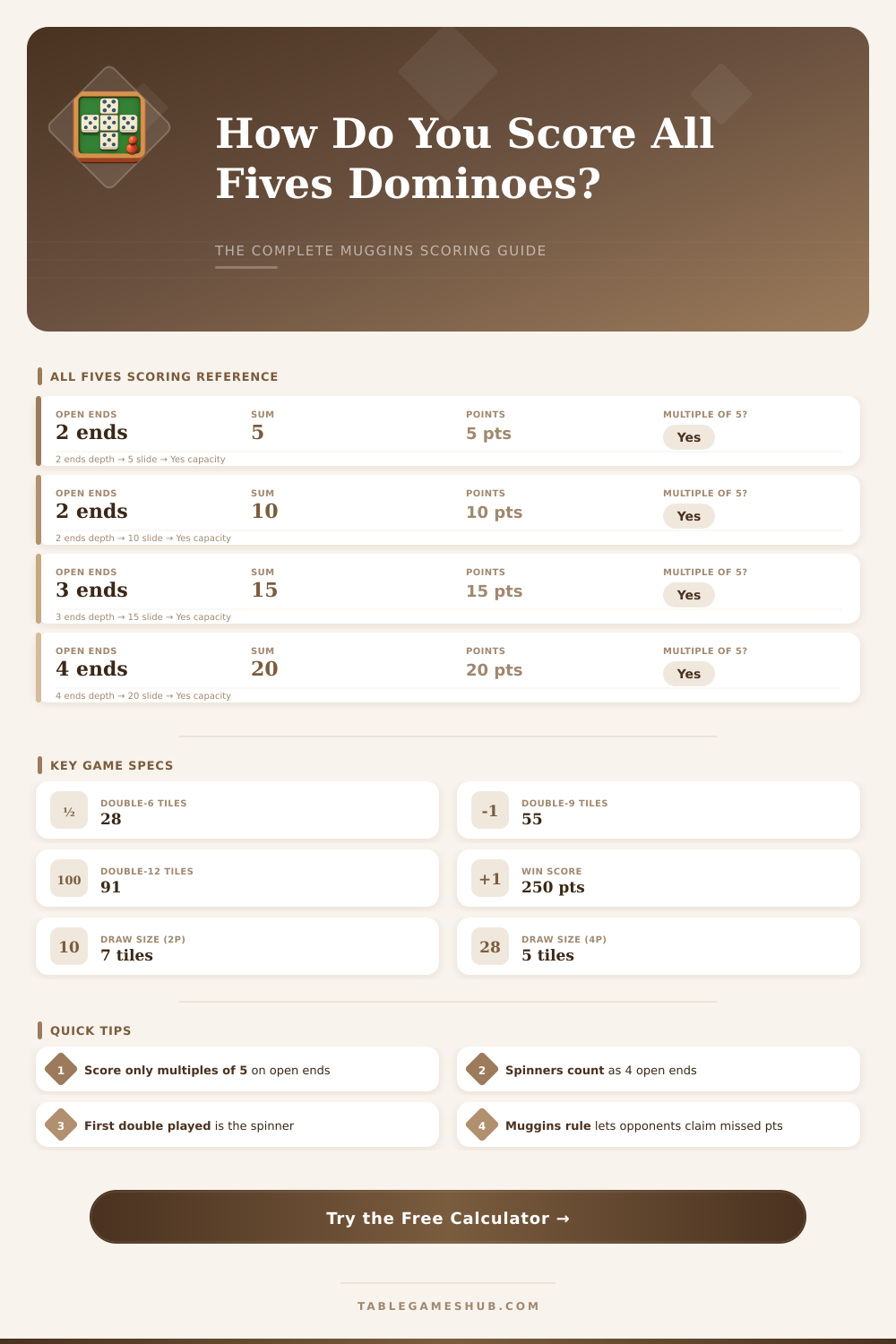
| 5 | 5 | Yes | 0 + 5, 2 + 3 |
| 10 | 10 | Yes | 5 + 5, 4 + 6 |
| 15 | 15 | Yes | 6 + 9, 5 + 10 |
| 20 | 20 | Yes | 10 + 10, 5 + 15 |
| 25 | 25 | Yes | 5 + 5 + 5 + 10 |
| 30 | 30 | Yes | 5 + 10 + 5 + 10 |
| 35 | 35 | Yes | 6 + 4 + 12 + 13 |
| 3 | 0 | No | 1 + 2 |
| 7 | 0 | No | 3 + 4 |
| 11 | 0 | No | 5 + 6 |
🃏Standard Draw Sizes by Set & Players
| Players | Double-6 Draw | Double-9 Draw | Double-12 Draw |
|---|---|---|---|
| 2 | 7 tiles | 7 tiles | 9 tiles |
| 3 | 6 tiles | 7 tiles | 9 tiles |
| 4 | 5 tiles | 7 tiles | 9 tiles |
| 5 | 5 tiles | 6 tiles | 8 tiles |
| 6 | 4 tiles | 6 tiles | 8 tiles |
🎲Tile Distribution — Double-6 Set
| Tile | Pip Total | Scores Points? | Points if Scored |
|---|---|---|---|
| 0-0 (blank-blank) | 0 | No | 0 |
| 0-5 | 5 | Yes | 5 |
| 5-5 (double 5) | 10 | Yes | 10 |
| 0-0 (spinner base) | 0 | No | 0 |
| 5-0 | 5 | Yes | 5 |
| 5-5 | 10 | Yes | 10 |
| 6-4 | 10 | Yes | 10 |
| 6-9 (D9 set) | 15 | Yes | 15 |
⏱Estimated Game Duration & Setup
| Set / Players | Tiles Per Player | Boneyard Size | Avg. Game Time |
|---|---|---|---|
| Double-6 / 2P | 7 | 14 | 20–30 min |
| Double-6 / 4P | 5 | 8 | 30–45 min |
| Double-9 / 2P | 7 | 41 | 25–40 min |
| Double-9 / 4P | 7 | 27 | 40–60 min |
| Double-12 / 4P | 9 | 55 | 60–90 min |
| Double-12 / 6P | 8 | 43 | 75–120 min |
💡 Scoring Rule: In All Fives (Muggins), you score points only when the sum of all open ends is a multiple of 5. The score equals that sum exactly — e.g. if open ends total 15, you score 15 points.
⚠ Muggins Call: If a player fails to claim their scored points and an opponent calls “Muggins”, the opponent takes those points instead. Always double-check your open-end sum before passing!
All Fives, occasionally called Muggins, takes the basic idea of Dominoes and raises the challenge. Instead of simply matching equal tiles one after another the players must reach a clear target: that the open ends of the chain add up to five or a multiple of it. Whether you reach 5, 10, 15 or 20?
Then you mark those points right away. This creates the thrilling rhythm of the game, the points score during the action itself, not only at the end of everything.
How to Play All Fives Dominoes
One can play that with a regular double-six set, that works for the most folks, or extend it to double-nine if you prefer a bigger challenge. The charm of the game is that it works surprisingly well for two players, but easily adapts to four without losing its essence. All Fives belong to that kind that one calls “point games” (and truly), that label fits perfectly, because the main driving force is reaching points during the whole process.
Starting the game is easy. Every player draws one tile, and the one that receives the heaviest starts first. Mix the tiles in the pile, and everything is ready.
Some groups like to start with the highest double. Usually the double-six, that goes on the table and serves as the starting point for building the chains. Others favour a more open start, where the first player simply chooses any tile they want, and the starting point appears naturally during the game progress.
Here is the moment when the thinking effort starts: before every turn, you count all pips on the open ends of the chain. If you find a tile that adds up too reach a multiple of five? Then play it and get the points on the spot.
If your turn does not reach such a multiple, you win nothing for that occasion. Speed plays a role in the strategy, but you need to think some steps forward and plan, what tiles could prepare you for points later.
Blocking the opponent becomes an important part, especially when four players join and all Dominoes already move around. Even in a two player game, clever blocking can force the opponent to take from the reserve at least one time. It is also smart to remove the heavy tiles early, the most ignored reason would be that your opponent scores a big amount from the pipes in your hand.
The game lasts until some player empties their hand or the table closes like this, that none can play. The winner then marks points from the staying pipes in the hands of the others, rounded to the nearest five. Seven pipes stay?
That becomes five points. Eight pipes? That jumps to ten.
The rounds last untilsome player passes the target that all agreed before.
Digital versions exist, if you want to play alone or with online players. It truly is fun, it turns the regular Dominoes game into something with deep tactical strategy.