D&D Encounter Calculator: Balance Any Combat Encounter
⚔️ D&D Encounter Calculator
Balance combat encounters for any party size and level — get XP thresholds, difficulty ratings, and adjusted encounter XP instantly
⚡ Quick Presets
📋 Party Configuration
💀 Monster Group(s)
📊 Encounter Analysis Results
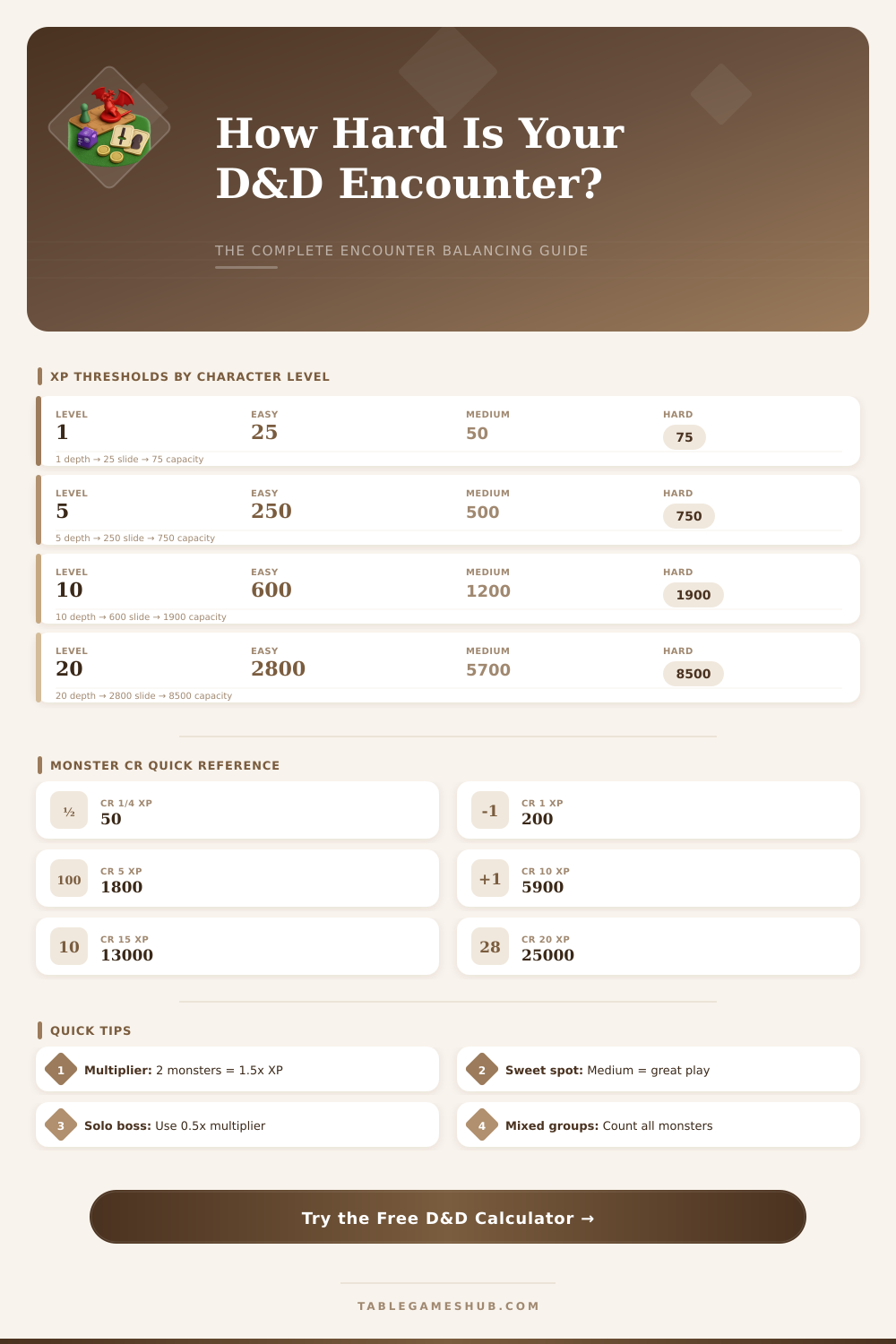
📖 CR & XP Quick Reference
CR 1
200 XP
CR 5
1,800 XP
CR 10
5,900 XP
CR 15
13,000 XP
CR 20
25,000 XP
1.5x
2 Monsters Mult.
2.0x
3–6 Monsters
2.5x
7–10 Monsters
📊 XP Thresholds by Character Level
| Level | Easy XP | Medium XP | Hard XP | Deadly XP | Daily XP Budget |
|---|---|---|---|---|---|
| 1 | 25 | 50 | 75 | 100 | 300 |
| 2 | 50 | 100 | 150 | 200 | 600 |
| 3 | 75 | 150 | 225 | 400 | 1,200 |
| 4 | 125 | 250 | 375 | 500 | 1,700 |
| 5 | 250 | 500 | 750 | 1,100 | 3,500 |
| 6 | 300 | 600 | 900 | 1,400 | 4,000 |
| 7 | 350 | 750 | 1,100 | 1,700 | 5,000 |
| 8 | 450 | 900 | 1,400 | 2,100 | 6,000 |
| 9 | 550 | 1,100 | 1,600 | 2,400 | 7,500 |
| 10 | 600 | 1,200 | 1,900 | 2,800 | 9,000 |
| 11 | 800 | 1,600 | 2,400 | 3,600 | 10,500 |
| 12 | 1,000 | 2,000 | 3,000 | 4,500 | 11,500 |
| 13 | 1,100 | 2,200 | 3,400 | 5,100 | 13,500 |
| 14 | 1,250 | 2,500 | 3,800 | 5,700 | 15,000 |
| 15 | 1,400 | 2,800 | 4,300 | 6,400 | 18,000 |
| 16 | 1,600 | 3,200 | 4,800 | 7,200 | 20,000 |
| 17 | 2,000 | 3,900 | 5,900 | 8,800 | 25,000 |
| 18 | 2,100 | 4,200 | 6,300 | 9,500 | 27,000 |
| 19 | 2,400 | 4,900 | 7,300 | 10,900 | 30,000 |
| 20 | 2,800 | 5,700 | 8,500 | 12,700 | 40,000 |
🔀 Monster Count Multiplier Table
| Total Monsters | Multiplier | Effect on Encounter | DM Note |
|---|---|---|---|
| 1 (solo) | x0.5 | Much easier than XP suggests | Lone monsters lose action economy |
| 2 | x1.5 | Moderate action advantage | Good for paired threats |
| 3 – 6 | x2.0 | Strong action economy | Standard group encounter |
| 7 – 10 | x2.5 | Very strong action advantage | May overwhelm unprepared parties |
| 11 – 14 | x3.0 | Extreme action advantage | Use for dramatic set-pieces |
| 15+ | x4.0 | Overwhelming swarm | AoE abilities become critical |
🎮 Common Encounter Configurations
| Encounter Type | Typical Setup | Difficulty | Avg. Duration |
|---|---|---|---|
| Goblin Ambush | 6–8 x CR 1/4 | Medium (Lvl 1–3) | 20–30 min |
| Bandit Encounter | 4 x CR 1/8 + 1 x CR 2 | Medium (Lvl 2–4) | 25–40 min |
| Troll Bridge | 2 x CR 5 | Hard (Lvl 5–7) | 30–45 min |
| Dragon Lair | 1 x CR 13 + 2 x CR 4 | Deadly (Lvl 9–12) | 60–90 min |
| Undead Legion | 12 x CR 1/2 | Hard (Lvl 4–6) | 40–60 min |
| Lich Boss | 1 x CR 21 | Deadly (Lvl 15+) | 90–120 min |
| Orc War Band | 8 x CR 1/2 + 1 x CR 4 | Hard (Lvl 4–6) | 35–55 min |
| Mind Flayer | 2 x CR 7 | Hard (Lvl 6–9) | 45–60 min |
💡 DM Tips for Encounter Balancing
⚔️ Action Economy is Everything: The number of monsters matters more than their CR. Two CR 5 monsters with a x1.5 multiplier create an adjusted XP of 5,400 — dramatically harder than a single CR 5 at 1,800 XP. Always apply the monster count multiplier before judging difficulty.
🎯 Daily XP Budget Rule: A standard adventuring day should not exceed the party’s daily XP budget. Use 6–8 medium or hard encounters, or 2–3 hard/deadly ones. One deadly encounter alone may exhaust all resources, so plan short-rest recovery opportunities between fights accordingly.
💀 Solo Monsters Use 0.5x: A single monster fighting the whole party suffers a severe action economy disadvantage. The DMG recommends applying a 0.5x multiplier to solo creature XP when judging difficulty. Legendary actions and lair actions help compensate for this imbalance.
🧙 Tier of Play Guidance: Levels 1–4 = Local Hero (CR 1/4 – CR 3). Levels 5–10 = Paragon (CR 2 – CR 10). Levels 11–16 = Master (CR 5 – CR 18). Levels 17–20 = Epic (CR 10–CR 25). Match CR to tier for best play experience.
In Dungeons and Dragons, an Encounter is simply a situation where the players must use a bit of their resources to beat it. The whole game turns around the management of those resources, however different classes handle that according to their mode. For instance some classes work in big moments, like the wizard, while others, like the warlock, almost do not need rest at all.
D&D Beyond offers interactive tools for building encounters, that simplifies things. The players can arrange encounters by means of group tools and adding monsters. After one finished the build, one can save them and bring them up at need.
How Encounters Work in Dungeons and Dragons
Redcap Press also released an Encounter builder for the 2024 version of D&D 5e, that stores all monsters from the 2024 Monster Manual.
Even so, creating a balanced Encounter requires fine skill. The game is too complex to simplify it to something used by a computer, which usually is the system of CR. This system does have a lot of mistakes.
To make good encounters, you truly need long experience with the game and good understanding of how one designed it.
The rules store a mode for guessing the trouble of an Encounter. First, one counts the limits of experience points for every character in the group. There is a table with four limits of XP for every level of character, one for every category of trouble.
Later, one adds the number of characters and there level. When characters have different levels, one groups them according to level in separate groups. Then one can guess the limits of XP for the whole Encounter of the party.
The guidelines for building encounters in the Guide of the Dungeon Master are quite precise, but not too precise. They help to well guess the trouble, even so there is no perfect mode for fights entirely balanced.
Not every Encounter needs to be a fight. Time during travel can bore, so encounters on the way help to make the way to the next city more fun. An idea for something new is meeting a travelling vendor, that offers unique magic objects, but the chance is, that those objects all be flawed, causing quirks unexpected or curses.
Encounters do not even need to involve monsters. One great Encounter happened entirely by means of players themselves. The group sat at the main dining table of their balloon, only discussing where to go next.
During the conversation, they lost themselves in their broken adventures. Sometimes the best moments are born from such calm scenes.
Not balancing encounters also can be an excellent idea. If fights are not balanced, the players find other modes to settle the challenge. Killing everything is only one of the ways to address problems.
Now players can also play fast andtactical fights right on maps, which helps to keep everything in motion fast.