Connect Four Calculator: Win Probability & Strategy Tool
🔴 Connect Four Calculator
Analyze win probabilities, board positions, piece distributions & game configurations
⚡ Quick Presets
⚙️ Game Configuration
✅ Connect Four Analysis Results
📊 Key Game Stats
42
Total Cells (Standard)
21
Pieces Per Player
~56%
P1 Win Rate (optimal)
4.5T
Possible Game States
69
Possible Win Lines
7
Column Count (Standard)
6
Row Count (Standard)
4
Win Directions
📏 Board Configurations & Dimensions
| Board Type | Columns x Rows | Total Cells | Board Size (in) | Board Size (cm) | Pieces/Player |
|---|---|---|---|---|---|
| Mini / Travel | 5 x 4 | 20 | ~7.5 x 6 | ~19 x 15 | 10 |
| Standard | 7 x 6 | 42 | ~10.5 x 9 | ~26.7 x 22.9 | 21 |
| Large | 8 x 7 | 56 | ~12 x 10.5 | ~30.5 x 26.7 | 28 |
| Extra Large | 9 x 7 | 63 | ~13.5 x 10.5 | ~34.3 x 26.7 | 32 |
| Giant Outdoor | 7 x 6 | 42 | ~36 x 30 | ~91.4 x 76.2 | 21 |
🎯 Win Line Counts by Board Size
| Board Size | Horizontal Lines | Vertical Lines | Diagonal Lines | Total Win Lines |
|---|---|---|---|---|
| 5 x 4 (Mini) | 8 | 5 | 4 | 17 |
| 7 x 6 (Standard) | 24 | 21 | 24 | 69 |
| 8 x 7 | 35 | 32 | 40 | 107 |
| 9 x 7 | 42 | 36 | 48 | 126 |
🔄 Game Variants Reference
| Variant | Board | Special Rules | Pieces/Player | Avg Duration |
|---|---|---|---|---|
| Standard | 7 x 6 | Drop only, bottom-up | 21 | 5–10 min |
| Pop Out | 7 x 6 | Remove bottom discs | 21 | 8–15 min |
| Power Up | 7 x 6 | Special power discs | 21 + 4 power | 10–20 min |
| Five in a Row | 7 x 6 | Need 5 in a row | 21 | 10–20 min |
| Giant Outdoor | 7 x 6 | Large freestanding | 21 | 5–15 min |
| 3D Connect Four | 4 x 4 x 4 | 3D grid, any line | 32 | 10–25 min |
📈 Column Strategy Probabilities
| Column | Position | Win Line Involvement | Strategic Value | Recommended Priority |
|---|---|---|---|---|
| Column 4 | Center | Highest (all 4 directions) | Very High | 1st |
| Columns 3 & 5 | Inner | High | High | 2nd |
| Columns 2 & 6 | Outer | Medium | Medium | 3rd |
| Columns 1 & 7 | Edge | Low (3 directions) | Low | 4th |
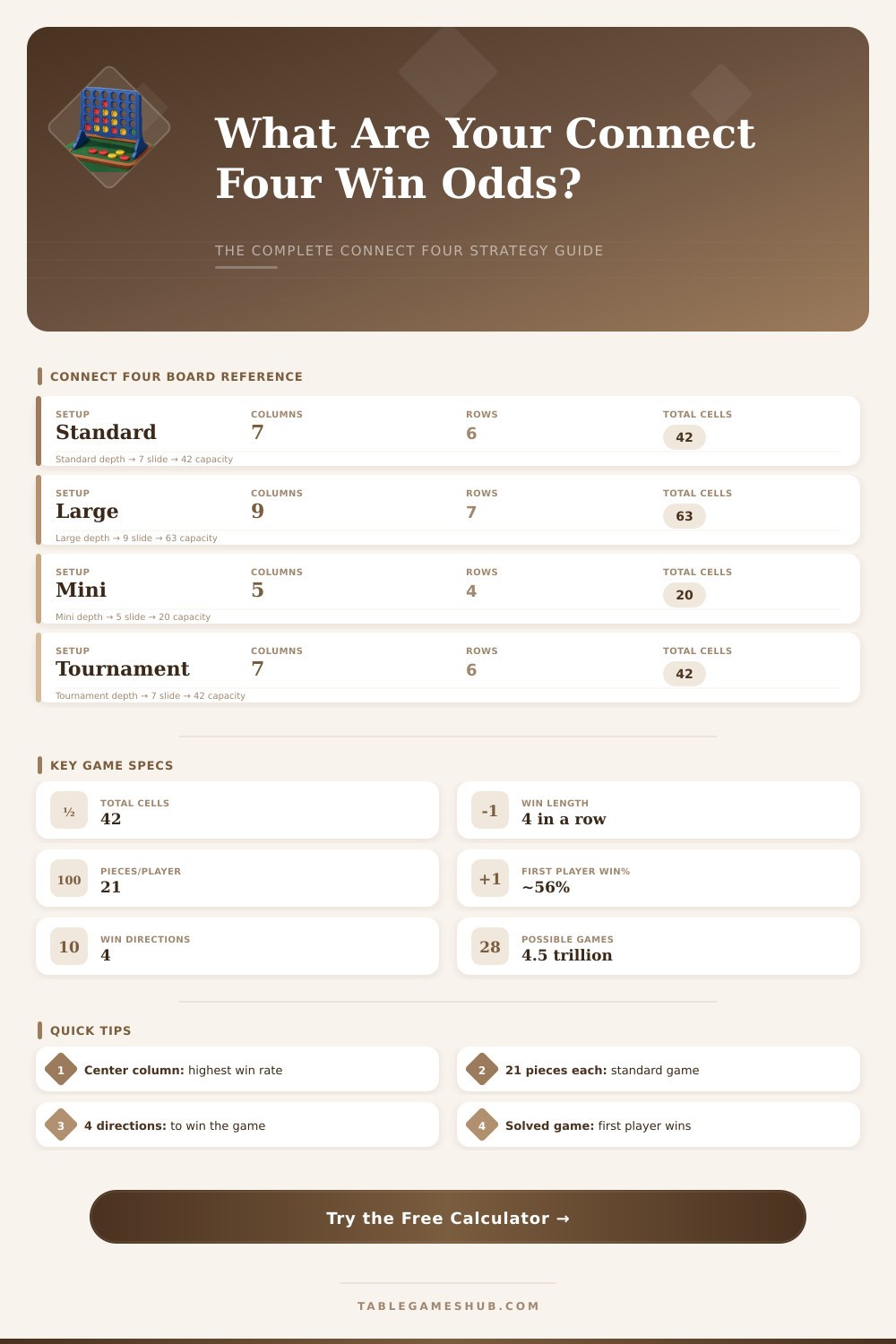
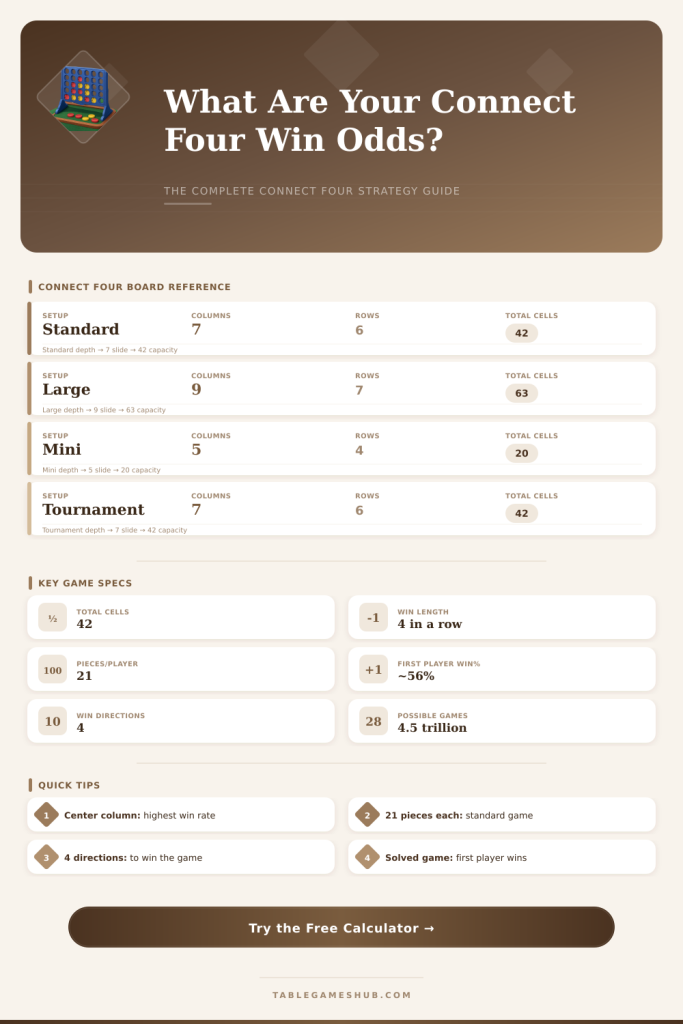
💡 Strategy Tip: The center column (column 4 in a 7-column board) is involved in more potential win lines than any other column. Research shows the first player wins with optimal play by starting in the center column — this is a mathematically solved fact proven in 1988 by James Dow Allen.
📏 Setup Tip: A standard Connect Four board has exactly 69 possible winning lines of 4. With 42 total cells, each player gets exactly 21 pieces. The board is 7 columns wide and 6 rows tall. Giant outdoor sets typically use 3-inch diameter discs on a board measuring ~36 x 30 inches.
Connect Four has been around for a long time, almost forever, and you probably already played it at least once. The game could not be easier, you simply let colored pieces fall in the gate and try to arrange four of your own before your opponent does that. Over the years, it received many different names: Four Up, Plot Four, Find Four, the Master of Four, Four in Conflict, Fall Four.
Even in the Soviet Union they called it Gravitrips.
How to Play Connect Four and Win
The game itself works really simply, six rows rise one on the other vertically, with seven columns stretching through everything. Players take turns laying their colored pieces in the column that they want, and gravity takes care of the rest, pulling every piece down until the most bottom free space. You win by connecting four own pieces in any direction: horizontally, vertically or diagonally.
In the classic version by Hasbro, many prefer the red or the golden pieces. Ned Strongin and Howard Wexler created it many years ago and it is meant for age six and up, with games that usually ends in around ten minutes.
Here it becomes really thrilling. Connect Four is what mathematicians call a “solved game“; that means that the result is totally fixed with perfect play. The first player always will win, if he knows what he does.
Scientists proved that already in 1988. The winning strategy is made up of starting in the central column and later controlling the center, creating threats and pushing your opponent into bad positions. Interesting detail: if the first player chooses one of the four edge columns, the second player can turn the situation and win.
And those two columns at the centre? They lead to a draw, if one defends well from both sides.
The secret to winning depends on creating double threats (that is), building two different ways to tie four pieces at the same time. Your opponent can only block one of them, so the other will win. Horizontal and vertical links are easily visible and blocked, so diagonal victories happen more commonly in real games.
Connect Four has some new variations that go around now. There is a card version with wild colors, special moves with extra powers and secret tasks to stop the routine. You also can try the cube version, three inches in size with rounded edges, made from the same blue plastic as the original.
For big groups their are huge outdoor versions made of wood, and homemade copies are so simple that you can build them in one afternoon, if you want.
Now you can maybe play it online. Join matches against artificial intelligent opponents or with real folks directly in your browser. Many websites let you jump in fast games without needing to install a program.
It really helps to train your logic and strategic skills. Discord servers andgaming groups commonly run weekly tournaments and share tips to get better.