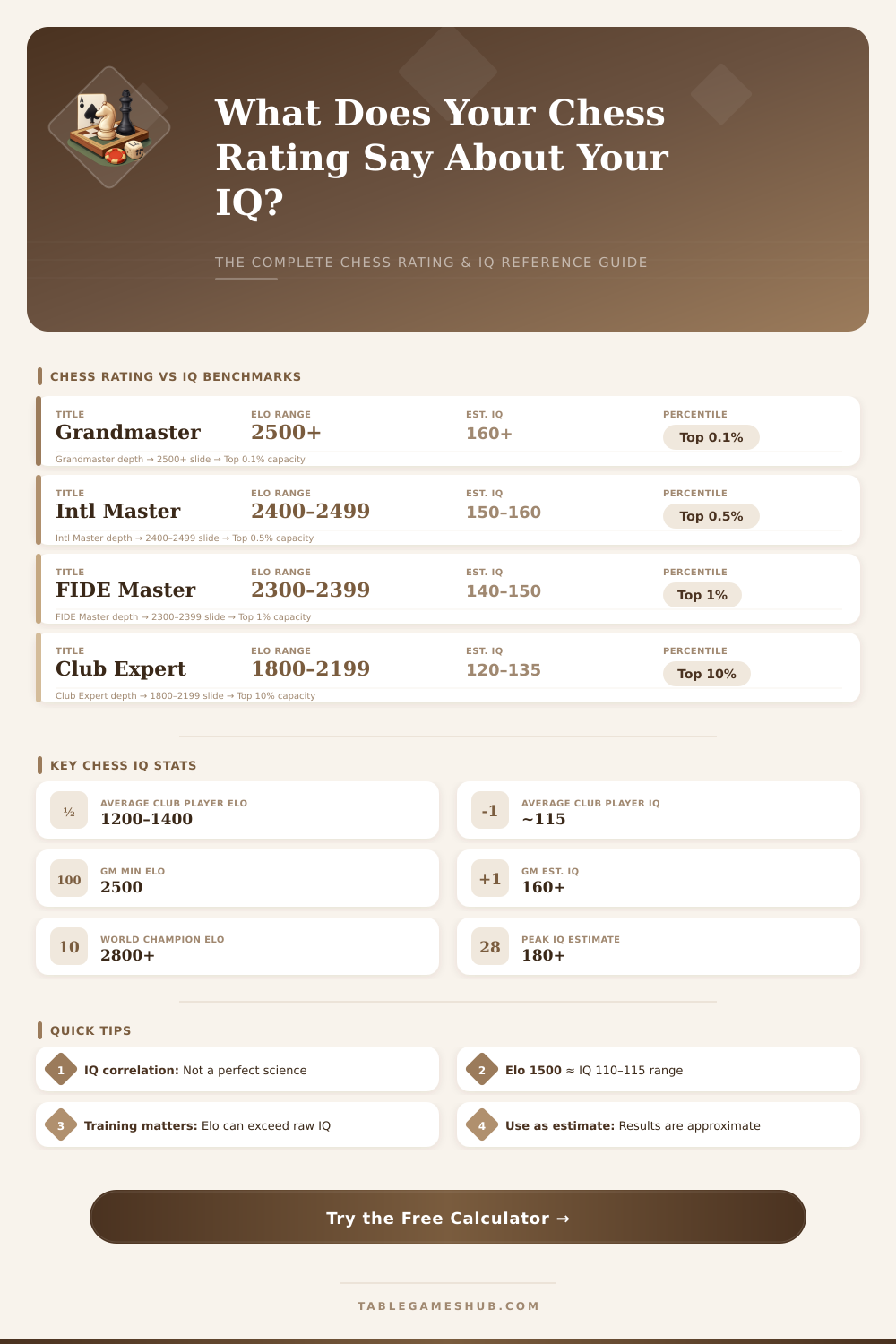
Chess Rating to IQ Calculator – Estimate Your Score
♞ Chess Rating to IQ Calculator
Estimate IQ from Elo rating — explore GM, IM, club player & beginner benchmarks
⚡ Quick Presets
🔧 Calculator Inputs
📊 Your Chess IQ Profile
📊 Chess IQ Key Stats
2500+
GM Min Elo
160+
Est. GM IQ
1200
Avg Club Elo
~115
Avg Club IQ Est.
800
Beginner Elo
~100
Avg IQ Baseline
2830
Carlsen Peak Elo
180+
World Champ IQ Est.
🏅 Chess Rating vs IQ Benchmark Table
| Chess Title / Level | Elo Range (FIDE) | Estimated IQ | Population Percentile | Std Dev Above Mean |
|---|---|---|---|---|
| World Champion | 2800+ | 175–190 | Top 0.01% | +5.0 |
| Super Grandmaster | 2700–2799 | 165–175 | Top 0.05% | +4.3 |
| Grandmaster (GM) | 2500–2699 | 155–165 | Top 0.1% | +3.7 |
| International Master (IM) | 2400–2499 | 148–157 | Top 0.5% | +3.2 |
| FIDE Master (FM) | 2300–2399 | 140–150 | Top 1% | +2.7 |
| Candidate Master (CM) | 2200–2299 | 133–142 | Top 2% | +2.2 |
| Expert / Category A | 2000–2199 | 125–135 | Top 5% | +1.7 |
| Advanced Club Player | 1800–1999 | 118–128 | Top 10% | +1.2 |
| Intermediate Club | 1600–1799 | 112–122 | Top 20% | +0.8 |
| Casual Club Player | 1400–1599 | 108–117 | Top 30% | +0.5 |
| Social / Recreational | 1200–1399 | 103–113 | Top 45% | +0.2 |
| Beginner / Learner | 800–1199 | 95–108 | Average | 0.0 |
| Complete Novice | Below 800 | 85–100 | Below Avg | –0.5 |
📋 Rating System Comparison Table
| Skill Level | FIDE Elo | USCF Rating | Lichess Rating | Chess.com Rating |
|---|---|---|---|---|
| Grandmaster | 2500+ | 2500+ | 2700+ | 2400+ |
| Intl Master | 2400–2499 | 2400–2499 | 2600–2699 | 2300–2399 |
| Expert | 2000–2199 | 2000–2199 | 2200–2399 | 1900–2099 |
| Advanced Club | 1800–1999 | 1800–1999 | 2000–2199 | 1700–1899 |
| Intermediate | 1500–1799 | 1500–1799 | 1700–1999 | 1400–1699 |
| Beginner | 800–1200 | 800–1200 | 1000–1400 | 800–1200 |
🧠 IQ Score Reference Table
| IQ Score Range | Classification | Population % | Std Dev | Chess Tier Equivalent |
|---|---|---|---|---|
| 160+ | Profoundly Gifted | 0.003% | +4.0 | Grandmaster |
| 145–159 | Highly Gifted | 0.1% | +3.0 | IM / FM Level |
| 130–144 | Gifted | 2% | +2.0 | Candidate Master |
| 120–129 | Superior | 8% | +1.33 | Expert / Cat A |
| 110–119 | High Average | 16% | +0.67 | Advanced Club |
| 90–109 | Average | 50% | 0 | Social/Beginner |
| 80–89 | Low Average | 16% | –0.67 | Novice |
| Below 80 | Below Average | 9% | –1.33 | Complete Beginner |
💡 Tips & Notes
🧠 IQ vs Chess Skill: Chess rating and IQ are correlated but not identical. High Elo requires both raw intelligence AND accumulated pattern recognition from thousands of hours of study. A dedicated player can exceed the IQ-predicted rating through training.
📈 Online vs OTB Ratings: Online ratings (Lichess, Chess.com) are typically 150–300 points higher than OTB (over-the-board) FIDE ratings. A 1700 Lichess rating is approximately equivalent to a 1400–1500 FIDE rating. Always compare within the same system.
⚠ Estimation Disclaimer: This calculator provides statistical estimates based on research correlations. IQ is a complex construct and cannot be precisely determined by chess rating alone. Use results as a rough benchmark, not a definitive IQ test.
💪 Training Effect: Studies show that Elo improvement correlates more strongly with hours of deliberate practice than raw IQ. Players with 10,000+ hours of study often perform 200–400 Elo points above their raw cognitive baseline.
Chess and IQ are two hardly comparable things. IQ measures general skill to settle problems, spot patterns and logically reason. Rating in Chess is a very different type of that problem-settling skill.
Whether they truly are linked? The answer is not simple.
Does a High IQ Make You Good at Chess?
Many studies point to a small connection between IQ and Chess skill, usually between 0.2 and 0.4. That shows a bit of tie, but not very strong. IQ and Chess Rating must have some link but it is not almost one-to-one.
Basically, high IQ does not promise high Rating in Chess.
Some folks mention a certain formula out there. According to it, after years of hard work, the Chess Rating will get close to something around 10 times the IQ minus 1000. For normal IQ of 100 that would give Rating of 2000.
Even so, the majority of Chess players spend their whole life playing and never reach even 1700. Such facts show, that the formula does not always count in realty.
Other formula one often hears: Rating matches to IQ times 200 minus 800. For IQ of 100 that would result in 1200 Rating. It also fits the idea, that Bobby Fischer had IQ of 180, what would give 2800 in Rating.
But those rules quickly fail. Folk can win 500 to 600 spots in one year, withotu their IQ changing slightly.
You do not need genius to play Chess well. In this game, early preparation and tactical knowledge gives huge advantage. Bright folk learns a bit more quickly at first, but one that is well prepared, will beat one that trusts only in natural feel.
Children with higher IQ learns more quickly, but when all keep playing, the IQ gap does not matter that much.
Brilliant grandmasters usually have very high IQ. Research shows, that top young Chess players beat the average by one standard gap in the performance part of smart tests. Stronger players reach higher results than weaker.
Many reckon, that Magnus Carlsen has IQ around 180. One studied Garry Kasparov and found his IQ around 135, although the used test probably was old.
Folk with IQ of 120 can stay at Rating of around 1100 for months. On the other hand, Chess depends truly on the desire to win, serious learning and attention. It never hurts to start early, as Capablanca did at five years old.
IQ helps in every brainwork, but it forms only asmall part of the whole picture in Chess.