Bridge Scoring Calculator: Score Any Contract Instantly
🂡 Bridge Scoring Calculator
Calculate scores for any contract, vulnerability, and result — including doubled & redoubled contracts, slam bonuses, and penalties
⚡ Quick Presets
📋 Contract Details
🏆 Bridge Score Results
📊 Key Scoring Values at a Glance
Minor Suits
20
pts per trick (♣/♦)
Major Suits
30
pts per trick (♥/♠)
Notrump
40+30
1st + each extra trick
Game Threshold
100
trick pts needed for game
Game Bonus (NV)
300
rubber/chicago bonus
Game Bonus (Vul)
500
rubber/chicago bonus
Small Slam (NV)
500
slam bonus (6-level)
Grand Slam (Vul)
1500
grand slam bonus (7-level)
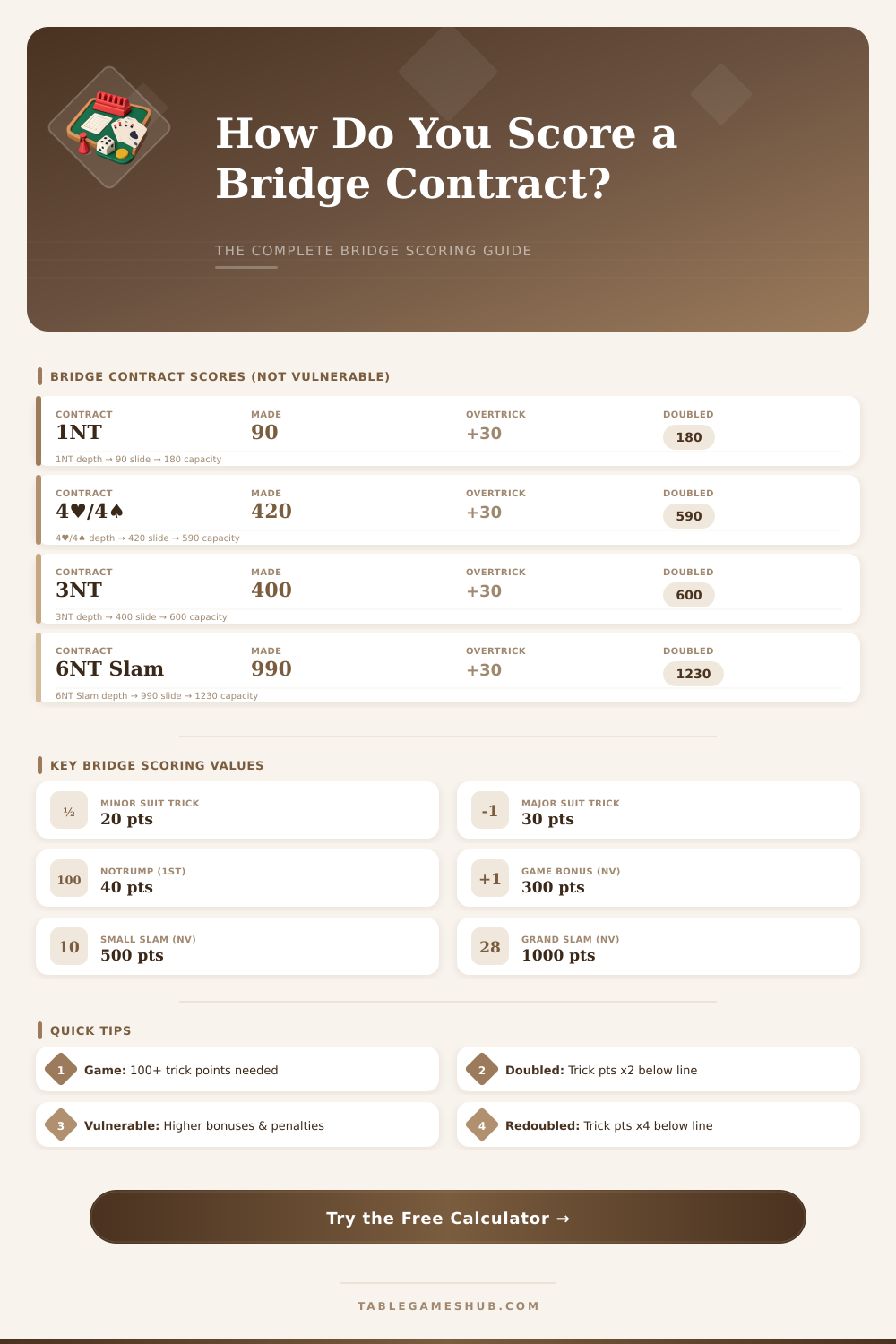
📋 Contract Scores — Not Vulnerable, Undoubled (Made Exactly)
| Contract | Trick Score | Game? | Bonus | Total Score | Tricks Needed |
|---|---|---|---|---|---|
| 1♣ | 20 | No | 50 (partial) | 70 | 7 |
| 1♥ | 30 | No | 50 (partial) | 80 | 7 |
| 1NT | 40 | No | 50 (partial) | 90 | 7 |
| 2♣ | 40 | No | 50 (partial) | 90 | 8 |
| 2NT | 70 | No | 50 (partial) | 120 | 8 |
| 3♣ | 60 | No | 50 (partial) | 110 | 9 |
| 3NT | 100 | Yes | 300 (game) | 400 | 9 |
| 4♥ | 120 | Yes | 300 (game) | 420 | 10 |
| 4♠ | 120 | Yes | 300 (game) | 420 | 10 |
| 5♣ | 100 | Yes | 300 (game) | 400 | 11 |
| 5♦ | 100 | Yes | 300 (game) | 400 | 11 |
| 6NT | 190 | Yes | 300+500 (slam) | 990 | 12 |
| 6♥ | 180 | Yes | 300+500 (slam) | 980 | 12 |
| 7NT | 220 | Yes | 300+1000 (grand) | 1520 | 13 |
| 7♥ | 210 | Yes | 300+1000 (grand) | 1510 | 13 |
❌ Undertrick Penalties Table
| Down | NV Undbl | Vul Undbl | NV Doubled | Vul Doubled | NV Redbl | Vul Redbl |
|---|---|---|---|---|---|---|
| 1 | -50 | -100 | -100 | -200 | -200 | -400 |
| 2 | -100 | -200 | -300 | -500 | -600 | -1000 |
| 3 | -150 | -300 | -500 | -800 | -1000 | -1600 |
| 4 | -200 | -400 | -800 | -1100 | -1600 | -2200 |
| 5 | -250 | -500 | -1100 | -1400 | -2200 | -2800 |
| 6 | -300 | -600 | -1400 | -1700 | -2800 | -3400 |
| 7 | -350 | -700 | -1700 | -2000 | -3400 | -4000 |
🃏 Doubled / Redoubled Made Contracts (NV)
| Contract | Base Tricks | Doubled Tricks | Insult Bonus | Total (Doubled) | Total (Redbl) |
|---|---|---|---|---|---|
| 1♠ (NV) | 30 | 60 | 50 | 160 | 230 |
| 2♥ (NV) | 60 | 120 | 50 | 220 | 290 |
| 3NT (NV) | 100 | 200 | 50 | 550 | 650 |
| 4♥ (NV) | 120 | 240 | 50 | 590 | 690 |
| 5♣ (NV) | 100 | 200 | 50 | 550 | 650 |
| 6NT (NV) | 190 | 380 | 50 | 1230 | 1430 |
💡 Scoring Tips
Game Threshold: You need at least 100 trick points to earn a game bonus. That means 3NT (100 pts), 4♥/4♠ (120 pts), or 5♣/5♦ (100 pts). Partial scores below 100 only earn a 50-point part-score bonus.
Doubled Insult Bonus: When you make a doubled contract, you earn an extra 50-point "insult bonus" (100 for redoubled). This is in addition to doubled trick points. Overtricks on doubled contracts score 100 (NV) or 200 (Vul) each — not the suit rate.
Slam Bonuses: Small slam (6-level) earns 500 (NV) or 750 (Vul) bonus on top of game bonus and trick score. Grand slam (7-level) earns 1000 (NV) or 1500 (Vul) bonus. These stack with the game bonus.
Vulnerability Matters: Vulnerable penalties are double non-vulnerable for undoubled contracts. For doubled contracts: Down 1 costs 100 (NV) vs 200 (Vul). This makes doubled penalties especially painful when vulnerable. Always consider vulnerability before doubling.
🏆 IMP (International Match Points) Scale
| Score Difference | IMPs Awarded | Score Difference | IMPs Awarded |
|---|---|---|---|
| 0 – 10 | 0 | 750 – 890 | 13 |
| 20 – 40 | 1 | 900 – 1090 | 14 |
| 50 – 80 | 2 | 1100 – 1290 | 15 |
| 90 – 120 | 3 | 1300 – 1490 | 16 |
| 130 – 160 | 4 | 1500 – 1740 | 17 |
| 170 – 210 | 5 | 1750 – 1990 | 18 |
| 220 – 260 | 6 | 2000 – 2240 | 19 |
| 270 – 310 | 7 | 2250 – 2490 | 20 |
| 320 – 360 | 8 | 2500 – 2990 | 21 |
| 370 – 420 | 9 | 3000 – 3490 | 22 |
| 430 – 490 | 10 | 3500 – 3990 | 23 |
| 500 – 590 | 11 | 4000+ | 24 |
| 600 – 740 | 12 | — | — |
Attacking in bridge can seem a bit difficult at first, but it follows strict rules after which the main ideas well feed. One reaches game, when the scores of a side reach 100 contract spots. Everything between 10 and 90 such spots is called partial score or half of game.
When some side succeeds in game, the partial scores of both teams reset to zero for the next part although those prior spots still add to the total score of the whole match.
Scoring in Bridge
Scores for every trick range according to the suit of the trump. Clubs and diamonds give 20 spots each trick. Hearts and spades value 30 spots for trick.
No trump works otherwise, the first trick counts 40 spots, and each following 30. Those values can double or even quadruple, if the contract doubles or redoubles.
Here something nice about the way the Scoring works. If the contract succeeds, the points are counted only according to the amount of tricks, that one took, and not according to that, what one planned. Like this planning one level of suit and taking three tricks, one reaches the same as planning three levels and doing them.
Both cases would give 140 spots.
Bonuses play a big role. They add spots for games and slams, what drives the players to aim for the highest possible targets. The team, that first wins two games, gets the rubber.
When a risky side manages too win it, it receives 700 bonus points. This drops to 500, if the opponents also are risky. Slams in the sixth or seventh level give even bigger bonuses on top of that.
All scores in bridge are multiples of 10. Some folks save time, dropping the final zeros while they write the points. In bridge one uses a special sheet for Scoring, where the tricks mark under the line and the bonuses up.
This same system shows in some other games with cards.
Rubber Bridge is good, but often hard to guess, how much time a full rubber needs. Because of that many prefer Chicago Bridge, also called four-deal Bridge. Every round is made up of four deals, one for every player.
If a deal passes, it does not count, and the same person deals again. During the first hand none is at risk. At the second and third hands the side of the dealer risks.
In the fourth hand both teams are at risk. Partial Bridge works the same, with sets of four deals, so that players can switch tables each thirty minutes.
In duplicate Bridge each hand compares with the results of other pairs using the same cards. To reach game in duplicate, the 100 spots must come from one single hand. That includes contracts like three no trump, four major or five minor.
Also partial scores compare. To finish a two-level major contract gives 110 spots in duplicate, whatstores 50 for the part plus the trick spots.