Bowling Game Time Calculator – How Long Will It Take?
🎳 Bowling Game Time Calculator
Calculate exactly how long your bowling session will take for any group size, skill level, and number of games
⚡Quick Presets
⚙️Calculator Settings
📊 Your Bowling Time Estimate
📋Bowling Quick Reference
10
Frames per Game
300
Perfect Score
10
Pins per Frame
60 ft
Lane Length
~10
Min/Player (avg)
12
Balls in Perfect Game
42 in
Lane Width
36 ft
Approach Length
⏱️Time Estimates by Player Count
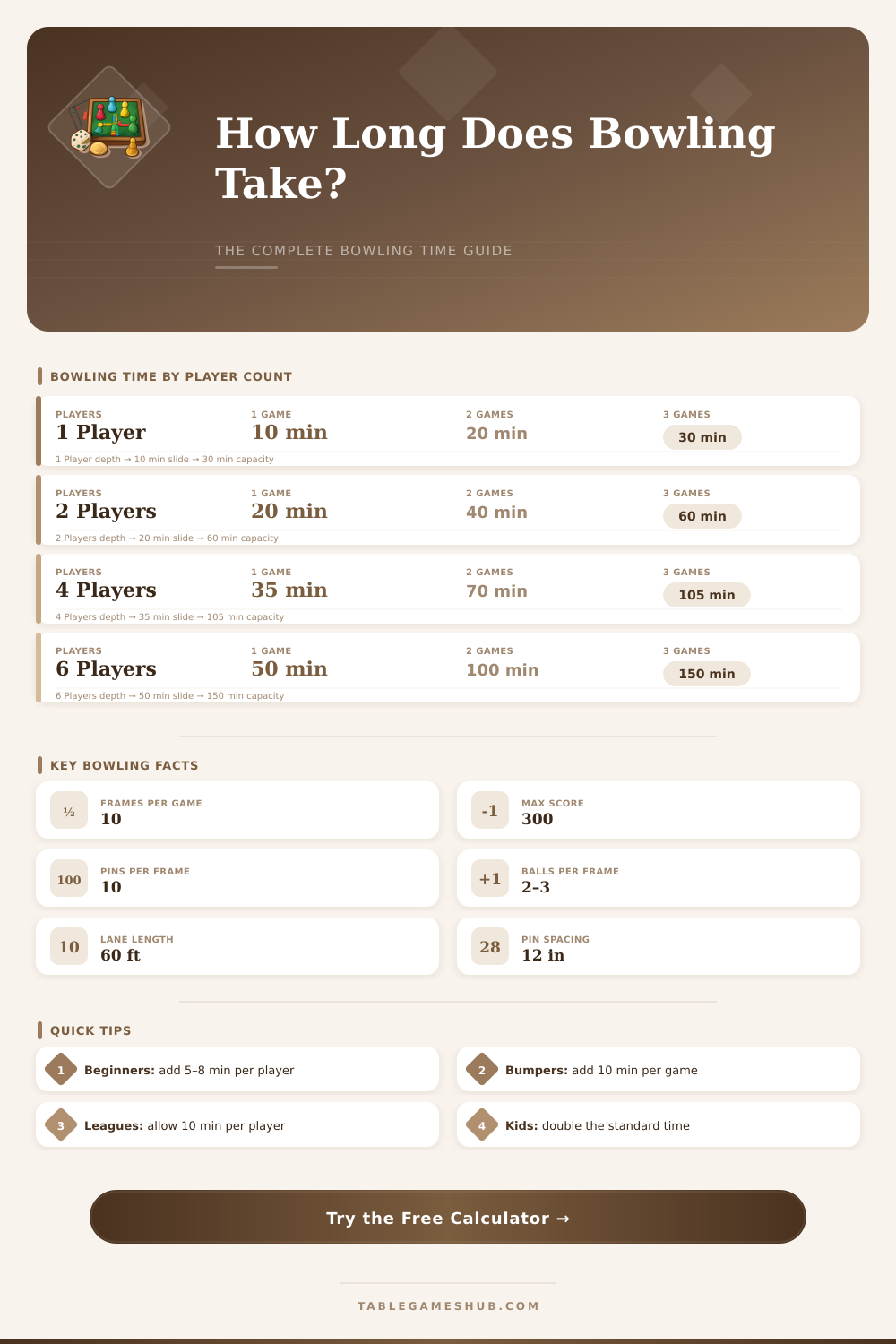
| Players | 1 Game (Avg) | 2 Games | 3 Games | Skill Assumed |
|---|---|---|---|---|
| 1 Player | 10 min | 20 min | 30 min | Average |
| 2 Players | 20 min | 40 min | 60 min | Average |
| 3 Players | 27 min | 54 min | 81 min | Average |
| 4 Players | 35 min | 70 min | 105 min | Average |
| 5 Players | 42 min | 84 min | 126 min | Average |
| 6 Players | 50 min | 100 min | 150 min | Average |
| 8 Players | 65 min | 130 min | 195 min | Average |
| 10 Players | 80 min | 160 min | 240 min | Average |
🎯Time per Frame by Skill Level
| Skill Level | Sec/Frame (1 Ball) | Sec/Frame (2 Balls) | Avg Frames w/Strike | Approx Min/Game (Solo) |
|---|---|---|---|---|
| Beginner | 45 sec | 75 sec | 0–1 | 12–15 min |
| Average | 35 sec | 55 sec | 2–3 | 9–11 min |
| Experienced | 28 sec | 45 sec | 4–6 | 7–9 min |
| Pro / League | 22 sec | 38 sec | 7–10 | 5–8 min |
📐Lane & Facility Dimensions
| Measurement | Imperial | Metric | Notes |
|---|---|---|---|
| Lane Length (foul to pin) | 60 ft | 18.29 m | Regulation USBC |
| Lane Width | 41.5 in | 105.4 cm | Regulation USBC |
| Approach Length | 15 ft min | 4.57 m | Min required |
| Pin Spacing (center-to-center) | 12 in | 30.5 cm | Equilateral triangle |
| Ball Diameter (max) | 8.595 in | 21.83 cm | USBC regulation max |
| Ball Weight (max) | 16 lb | 7.26 kg | USBC regulation max |
| Pin Height | 15 in | 38.1 cm | Standard pin |
| Pin Weight | 3 lb 6 oz | 1.53 kg | USBC regulation |
🏆Session Types & Typical Durations
| Session Type | Typical Games | Players/Lane | Est. Total Time | Notes |
|---|---|---|---|---|
| Casual Open Play | 1–2 | 2–6 | 30–90 min | Includes socializing time |
| League Night | 3 | 4–5 | 2–2.5 hrs | Organized, faster pace |
| Tournament | 3–6 | 2–4 | 3–6 hrs | Multiple rounds |
| Kids / Youth | 1–2 | 4–6 | 45–120 min | Add 50–80% time |
| Birthday Party | 1 | 5–8 | 60–90 min | Includes bumper setup |
💡 Lane Capacity Tip: Standard bowling alleys recommend no more than 6 players per lane for comfortable play. With more than 6 players, consider booking 2 lanes to keep the session under 90 minutes per game.
⏰ Strike & Spare Timing: A strike or spare in the 10th frame adds extra balls—up to 3 balls total in the final frame. For experienced bowlers, budget an extra 2–4 minutes per game to account for bonus 10th-frame deliveries.
The length of a game in Bowling depends on several factors. Whether it is solo or group, the number of players, their skill level and the type of match, friendly or tournament, everything affects the total time. Generally one game for one person lasts around 10 minutes.
So, with four players, one must count about 40 minutes. Even so, the actual time commonly varies a lot.
How Long Does a Bowling Game Take
One solo bowler can end one game in about 8 to 12 minutes. During regular times where one pays by the hour, one game commonly ends in around ten minutes. Using a second ball helps to cut the wait time, during the ball return.
Like this, one solo player can finish 6 to 7 games during one hour. For example, some other solo player ended four games in 30 minutes in a comfrotable rhythm, without hurry.
Obviously, groups need more time. Four bowlers can take between 40 and 50 minutes. For six players, it could extend to around one hour and 15 minutes.
In a group of five or six folks, a typical game lasts from 45 minutes to one hour. When lanes are split so that five people use one lane every 15 minutes, the whole session will come too around one and a quarter of hours.
Expert bowlers move more quickly, because they spend little time to aim shots. Newcomers and party groups should plan at least 60 minutes for one game. During a tournament, everything happens at high speed so that the flow stays smooth and fast.
But in a friendly game, folks pause between turns to chat and enjoy themselves. Theplayers decide about the rhythm of the whole thing.
Bowling in a league lasts even longer. With 10 players on two lanes, one needs around two and a half hours. In teams of five people, sometimes one warms up at 6:20, starts the game at 6:30 and ends around the 9th.
It can extend to the 10th, if the other team plays a bit slowly. About two and a half to three hours is enough for a league session, if the players stay focused.
When booking time in a Bowling hall, two hours work for a group that wants to play without feeling rushed. If only two folks play, one hour is plenty. Bowling shoes are required, and some places offer one hour of play for up to six visitors each lane.
Paying per game suits those that do not want time pressure or risk stopping in the middle of a game. Hourly payment works, if one plans to stay for a set amount of time.