Bowling Ball Speed Calculator – Find Your Perfect Delivery Speed
🎳 Bowling Ball Speed Calculator
Calculate your delivery speed in mph & km/h using time, distance, or pin impact methods
⚡ Quick Presets
⚙️ Calculator Settings
📊 Speed Calculation Results
📋 Bowling Speed Quick Reference
17 mph
PBA Average Speed
60 ft
Regulation Lane Length
16 lb
Max Ball Weight
8.5 in
Ball Circumference Max
2.5 sec
Avg. Foul-to-Pin Time
250 rpm
Average Rev Rate
10 pins
Standard Pin Count
42 ft
Oiled Lane Section
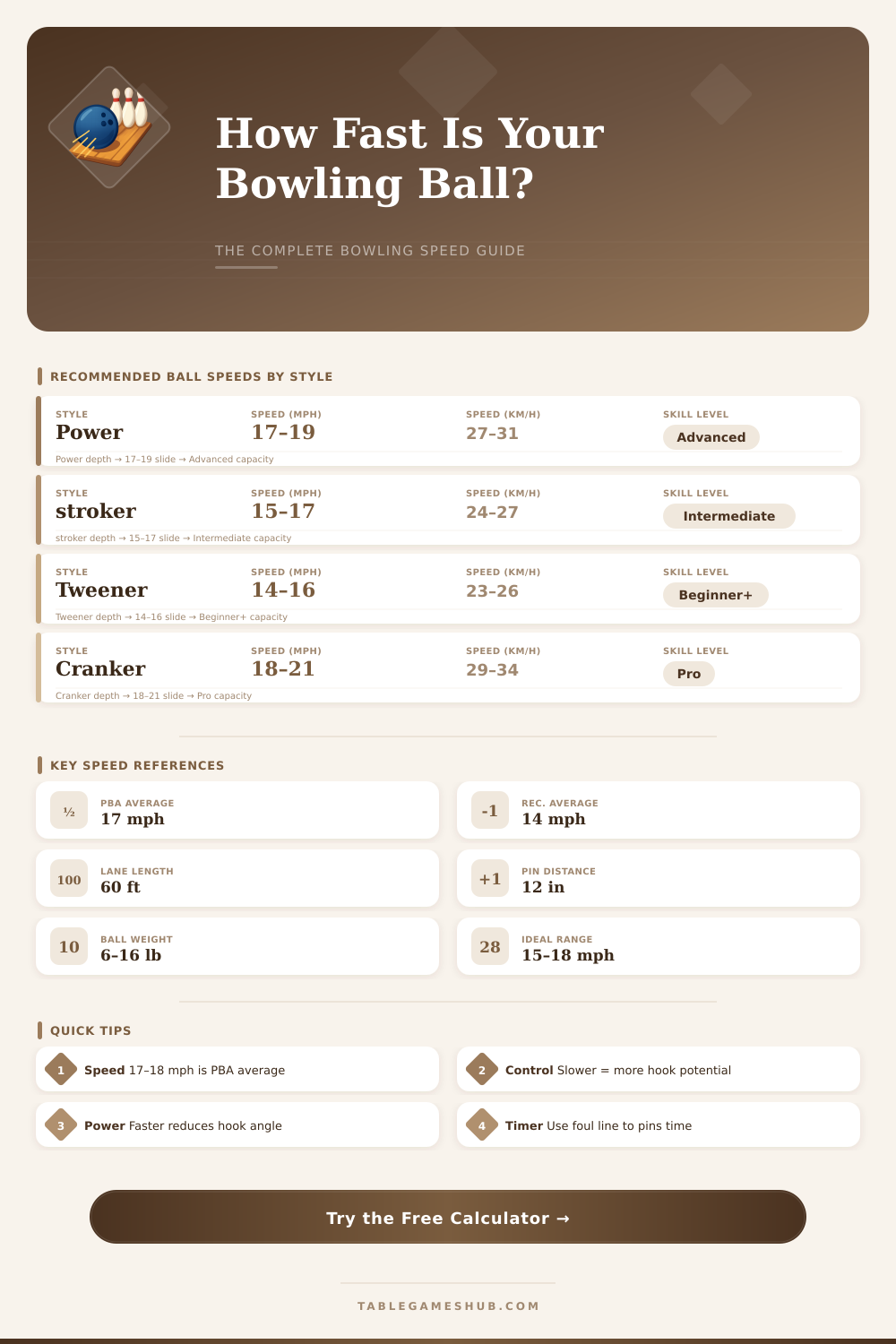
🏆 Speed by Bowler Style & Skill Level
| Style / Skill Level | Speed Range (mph) | Speed Range (km/h) | Rev Rate (rpm) | Recommended Ball Wt. |
|---|---|---|---|---|
| Youth / Beginner | 9 – 12 mph | 14 – 19 km/h | 100 – 150 rpm | 6 – 10 lb |
| Senior Bowler | 10 – 14 mph | 16 – 23 km/h | 130 – 200 rpm | 10 – 14 lb |
| Recreational Straight | 12 – 15 mph | 19 – 24 km/h | 150 – 200 rpm | 12 – 15 lb |
| Recreational Stroker | 14 – 17 mph | 23 – 27 km/h | 200 – 280 rpm | 14 – 15 lb |
| Intermediate Tweener | 15 – 18 mph | 24 – 29 km/h | 250 – 350 rpm | 14 – 16 lb |
| Advanced Stroker | 16 – 19 mph | 26 – 31 km/h | 280 – 380 rpm | 15 – 16 lb |
| Power Cranker | 17 – 21 mph | 27 – 34 km/h | 350 – 500 rpm | 15 – 16 lb |
| PBA Professional Avg. | 17 – 19 mph | 27 – 31 km/h | 300 – 450 rpm | 15 – 16 lb |
📐 Lane Distances & Timing Reference
| Measurement Point | Distance (ft) | Distance (m) | Notes |
|---|---|---|---|
| Foul Line to Head Pin | 60.0 ft | 18.29 m | USBC Regulation distance |
| Approach Length | 15.0 ft | 4.57 m | Minimum approach area |
| Total Lane Length | 62.8 ft | 19.14 m | Includes pin deck |
| Oiled Section | ~42.0 ft | ~12.8 m | Standard house shot oil |
| Dry Back End | ~18.0 ft | ~5.5 m | Hook zone for reactive balls |
| Pin Deck Depth | 2.56 ft | 0.78 m | From head pin to back edge |
| Lane Width | 3.5 ft | 1.07 m | Standard 42-inch lane width |
⏱ Time-to-Speed Conversion Table (60 ft Lane)
| Travel Time (sec) | Speed (mph) | Speed (km/h) | Category |
|---|---|---|---|
| 4.0 sec | 10.2 mph | 16.4 km/h | Slow / Youth |
| 3.5 sec | 11.7 mph | 18.8 km/h | Slow / Youth |
| 3.0 sec | 13.6 mph | 21.9 km/h | Recreational |
| 2.7 sec | 15.2 mph | 24.4 km/h | Recreational |
| 2.5 sec | 16.4 mph | 26.4 km/h | Intermediate |
| 2.3 sec | 17.8 mph | 28.6 km/h | Advanced |
| 2.1 sec | 19.5 mph | 31.4 km/h | Power / Pro |
| 2.0 sec | 20.5 mph | 33.0 km/h | PBA Maximum |
💡 Pro Tip: Optimal Speed Range — USBC research shows that 16–18 mph at the foul line produces the best pin carry percentage. Speeds above 20 mph reduce hook angle and deflection, while speeds below 12 mph reduce pin action energy. Measure your speed at the foul line, not at the arrows.
💡 Timing Your Ball: Use a stopwatch from the moment the ball crosses the foul line to the moment it contacts the head pin. Divide 60 ft (18.29 m) by your time in seconds, then multiply by 0.6818 to convert ft/s to mph (or multiply by 1.097 for km/h). Most bowling center ball speed displays measure speed at the arrows (15 ft) — actual pin impact speed is typically 1–2 mph slower.
Rolling the Bowling Ball at good speed matters more than many folks believe. Good Bowling Ball speed is around 16 to 17 miles per hour, if one measures at the pins. During the release, the Bowling Ball should reach around 20 to 21 miles per hour.
A difference of around one mile per hour in any direction is fine. The average speed during the whole way comes to around 18 miles per hour, although roughly.
How Fast a Bowling Ball Should Roll
Professional bowlers usually throw the Bowling Ball between 20 and 22 miles per hour. The typical speed for a professional is widely around 19 to 20 miles per hour. Some local bowlers were measured at 22 miles per hour in bowling centers.
The average amateur bowler probably throws around 15 miles per hour, but that depends on the skill and wiehgt of the Bowling Ball.
The perfect speed at the pins is around 15 to 18 miles per hour. In that range, the pins fall one on the other and roll into the rest, which helps to knock them more down. If it goes too slowly, the Bowling Ball does not carry quite a lot.
If too quickly, the pins fly away instead of falling together. When the Bowling Ball has too much energy, it does not role well in the pocket, which causes it to slide and leave some pins standing.
The speed of the Bowling Ball comes mostly from the legs. The more quickly the bowler moves during the approach, the more quickly the Bowling Ball goes. Simply throwing with more force is not the good way to boost speed.
Instead, placing the Bowling Ball three to four inches more highly in the start position helps. Because the Bowling Ball starts from a higher place, the swing of the arm makes a bigger arch, which naturally adds speed. Another option is to start a bit further back on the approach and boost the footwork.
That way works well, but requires practice because of the changes in timing.
Speed and revolutions must match well. Very high revolutions with low speed do not work. High revolutions need high speed to push through the pins.
Control of speed is what separates good bowlers from the best. Balancing the swing of the arm with footwork is key to making changes inspeed during the game.
Measuring the speed of the Bowling Ball at home is pretty easy. Ask a friend to use a stopwatch, starting it during the release and stopping when the Bowling Ball strikes the pins. The standard lane is 60 feet long.
Then, divide the distance by the time. Speed equals distance divided by time. Many bowling lanes also measure speed automatically with sensors in the gutter area.
The time that the Bowling Ball needs to pass through light beams is how the system figures the speed. Such readings can be a bit different depending on the hook of the Bowling Ball.
The weight of the Bowling Ball also matters. A Bowling Ball of 15 pounds should roll at least at 15 miles per hour. Otherwise, dropping to 14 pounds could be more helpful.
A heavier Bowling Ball with more speed widely gives more strikes, but it will not be useful a lot without a precise hit in the pocket.