Backgammon Calculator: Probabilities, Pip Count & Game Setup
🎲 Backgammon Calculator
Calculate pip counts, hit probabilities, checker distributions & board setups
⚡ Quick Presets
⚙️ Calculator Settings
📊 Calculation Results
📋 Key Backgammon Stats
36
Dice Combinations
167
Starting Pip Count
30
Total Checkers
24
Points on Board
16.7%
Any Doublet Chance
5.83
Average Dice Sum
8.17
Avg Pips/Roll (w/Doubles)
2.78%
Specific Double Chance
🎯 Hit Probability by Distance
| Distance (Pips) | Ways to Hit | Probability | Odds Against | Notes |
|---|---|---|---|---|
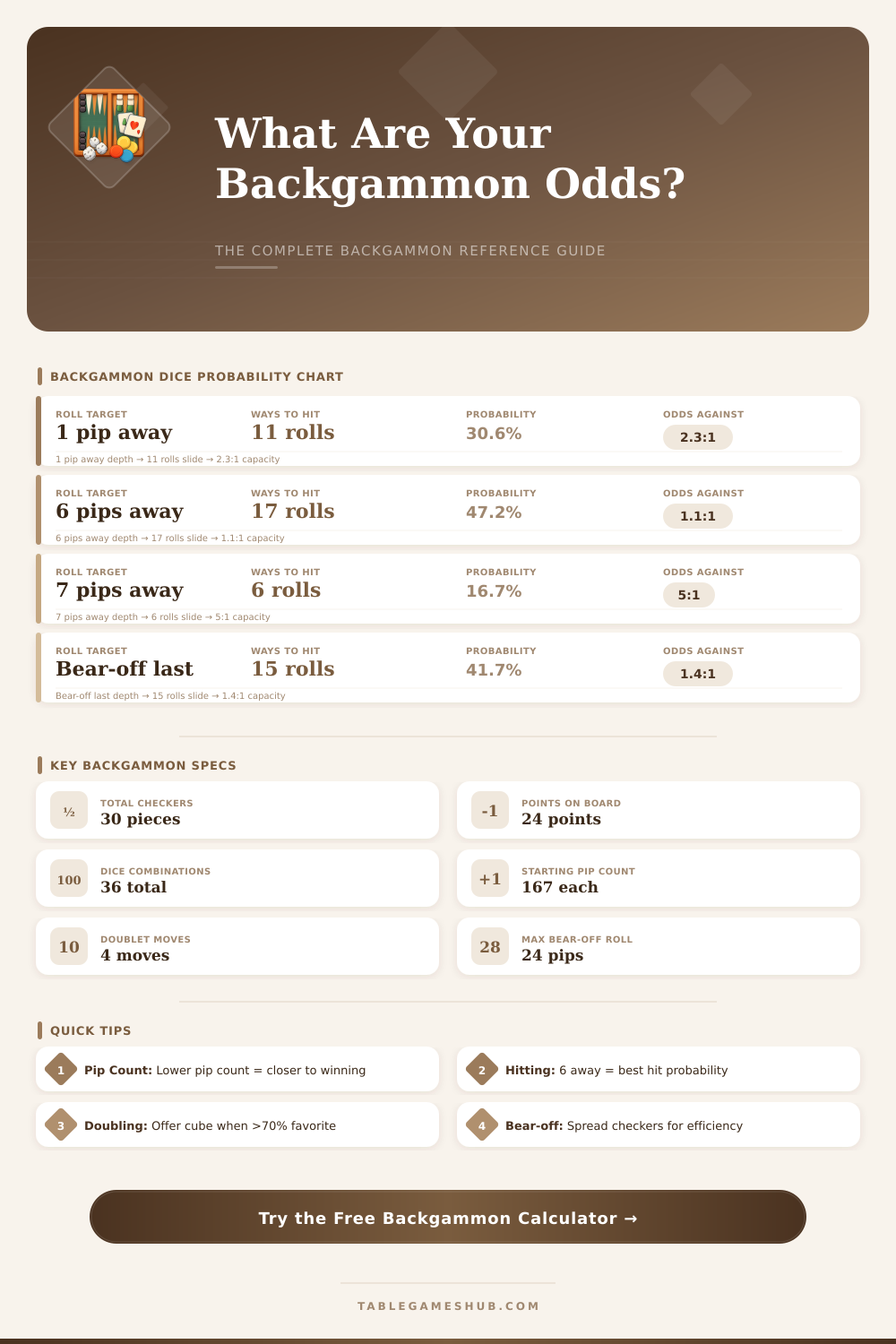
| 1 | 11 | 30.6% | 2.27:1 | All singles + all doubles |
| 2 | 12 | 33.3% | 2.0:1 | 1-1, 2-X, X-2 combos |
| 3 | 14 | 38.9% | 1.57:1 | 3-X, X-3, 1-2, 2-1, 1-1-1 |
| 4 | 15 | 41.7% | 1.4:1 | 4-X, X-4, 2-2, 1-3, 3-1 |
| 5 | 15 | 41.7% | 1.4:1 | 5-X, X-5, 1-4, 4-1, 2-3 |
| 6 | 17 | 47.2% | 1.12:1 | 6-X, X-6, all splits + 3-3 |
| 7 | 6 | 16.7% | 5.0:1 | 1-6, 6-1, 2-5, 5-2, 3-4, 4-3 |
| 8 | 6 | 16.7% | 5.0:1 | 2-6, 6-2, 3-5, 5-3, 4-4 |
| 9 | 5 | 13.9% | 6.2:1 | 3-6, 6-3, 4-5, 5-4, 3-3 |
| 10 | 3 | 8.3% | 11.0:1 | 4-6, 6-4, 5-5 |
| 11 | 2 | 5.6% | 17.0:1 | 5-6, 6-5 |
| 12 | 3 | 8.3% | 11.0:1 | 6-6, and combos |
| 16+ | 1 | 2.8% | 35.0:1 | Doublet only (e.g. 4-4 for 16) |
| 20 | 1 | 2.8% | 35.0:1 | 5-5 only |
| 24 | 1 | 2.8% | 35.0:1 | 6-6 only |
📐 Board & Equipment Reference
| Board Type | Size (Imperial) | Size (Metric) | Checkers Each | Players |
|---|---|---|---|---|
| Tournament Standard | 24 x 12 in | 61 x 30 cm | 15 | 2 |
| Travel Size | 14 x 7 in | 36 x 18 cm | 15 | 2 |
| Deluxe/Luxury | 30 x 15 in | 76 x 38 cm | 15 | 2 |
| Club Size | 21 x 11 in | 53 x 28 cm | 15 | 2 |
| Mini/Pocket | 10 x 5 in | 25 x 13 cm | 15 | 2 |
| Hypergammon | 24 x 12 in | 61 x 30 cm | 3 | 2 |
| Nackgammon | 24 x 12 in | 61 x 30 cm | 15 | 2 |
| Team/4-Player | 30 x 15 in | 76 x 38 cm | 15 | 4 |
🏆 Standard Setup Configurations
| Game Variant | Checker Distribution | Starting Pip Count | Avg Game Duration |
|---|---|---|---|
| Standard Backgammon | 2-0-0-0-0-5 / 0-3-0-0-0-5 | 167 pips each | 20-30 min |
| Nackgammon | 3-0-0-0-0-4 / 0-3-0-0-0-5 | 172 pips each | 25-40 min |
| Hypergammon | 1-1-1-0-0-0 per player | 39 pips each | 5-10 min |
| Acey-Deucey | All off board (entering) | 0 (bar) | 15-25 min |
| Long Gammon | Reversed home board | 240+ pips | 45-60 min |
| Tournament 5pt | Standard | 167 pips each | 45-90 min |
| Tournament 11pt | Standard | 167 pips each | 90-180 min |
| Money Game | Standard | 167 pips each | 20-30 min |
🎲 Doublet Probabilities
| Doublet | Pips Moved | Prob. (1 roll) | Prob. (3 rolls) | Strategic Value |
|---|---|---|---|---|
| 1-1 | 4 pips | 2.78% | 8.0% | Bar escape / builder |
| 2-2 | 8 pips | 2.78% | 8.0% | Builder / anchor |
| 3-3 | 12 pips | 2.78% | 8.0% | Strong mid-game |
| 4-4 | 16 pips | 2.78% | 8.0% | Racing powerhouse |
| 5-5 | 20 pips | 2.78% | 8.0% | Best racing roll |
| 6-6 | 24 pips | 2.78% | 8.0% | Best possible roll |
| Any Doublet | Varies | 16.67% | 42.1% | 4 moves instead of 2 |
💡 Pip Count Tip: The standard starting pip count is 167 for each player. To calculate your pip count, multiply each checker's position number by the number of checkers on that point and sum all values. A pip advantage of 10+ is a significant race lead. Use the doubling cube when your pip count is 10% or more better than your opponent's.
💡 Hit Probability Tip: Distance 6 has the highest hit probability (47.2%) because it can be reached by 17 of 36 dice combinations. Blots at distance 7 drop sharply to just 16.7% (6 combinations). When leaving blots, prefer distances of 7+ to minimize risk. Remember: each blocked point on the opponent's board reduces your effective hitting rolls.
Backgammon calculator helps players estimate probabilities, values and ideal steps during the game. Such programs appear in various forms and do different tasks, so it matters to know what each of them really does.
Common kind of those tools can be used to compile probabilities about particular dice results. Knowing the chances for rolling certain values forms a key part for improving play in Backgammon. For instance, one can count the amount of possible rolls that reach a blot when it is exposed, which is good practice.
What Backgammon Calculators Do
Non-doubles count twice while doubles only once. There exist 15 non-doubles and 6 doubles. In a given situation one simply counts the rolls that do not reach, and subtracts them from the total.
There are also rating calculators. This kind allows players to enter their initial match value, after which the tool itself computes the rest. One chooses between various options according to the used platform, for instance Galaxy, Heroes or FIBS.
It is useful to note that Backgammon Galaxy shows the final match ratings on its result screen, so players must enter their starting values the other way around. The rating formula of Galaxy received its last update in 2023, but soon later a mistake was discovered that afected matches, where players were within 100 spots of each other. The system used wrong expected prize in its computation.
Some of those calculators deal with equity, which outlines the value of a position. In a match the computer determines equity by means of a particular match method instead of the usual for endless games. Cubeful rating considers the risk of doubling.
Sometimes several moves have the same negative equity of one, because the program assumes that the opponent will double and the best rest is pass. The level of depth in programs like GNU Backgammon is shown by means of n-ply.
Error rate, or PR, forms another element that those tools handle. They build PR-level from total lost equity, shared according too decisive moments, although some think that this approach is not always fair.
Pip-calculations also matter in those tools. They help a player judge whether to offer or receive a double in non-contact positions. Two models form the base for such cube decision calculations, and both ignore the influence of gammons and backgammons.
However most Backgammon choices are not only mathematical. The randomness of dice rolls makes it too hard to compute everything by hand. Rather than in chess, where one can expect several steps, Backgammon requires a mix of strategy and flexible thought.
Resources like printed tables, calculators or simple pencil and page can help, but they do not replace solid instinct. Programs like GNU and XG are rated the two most useful for improving in the game, and serioustournament players use at least one of them. Backgammon Galaxy can be used to analyse games after they end.