Inventions Score Calculator
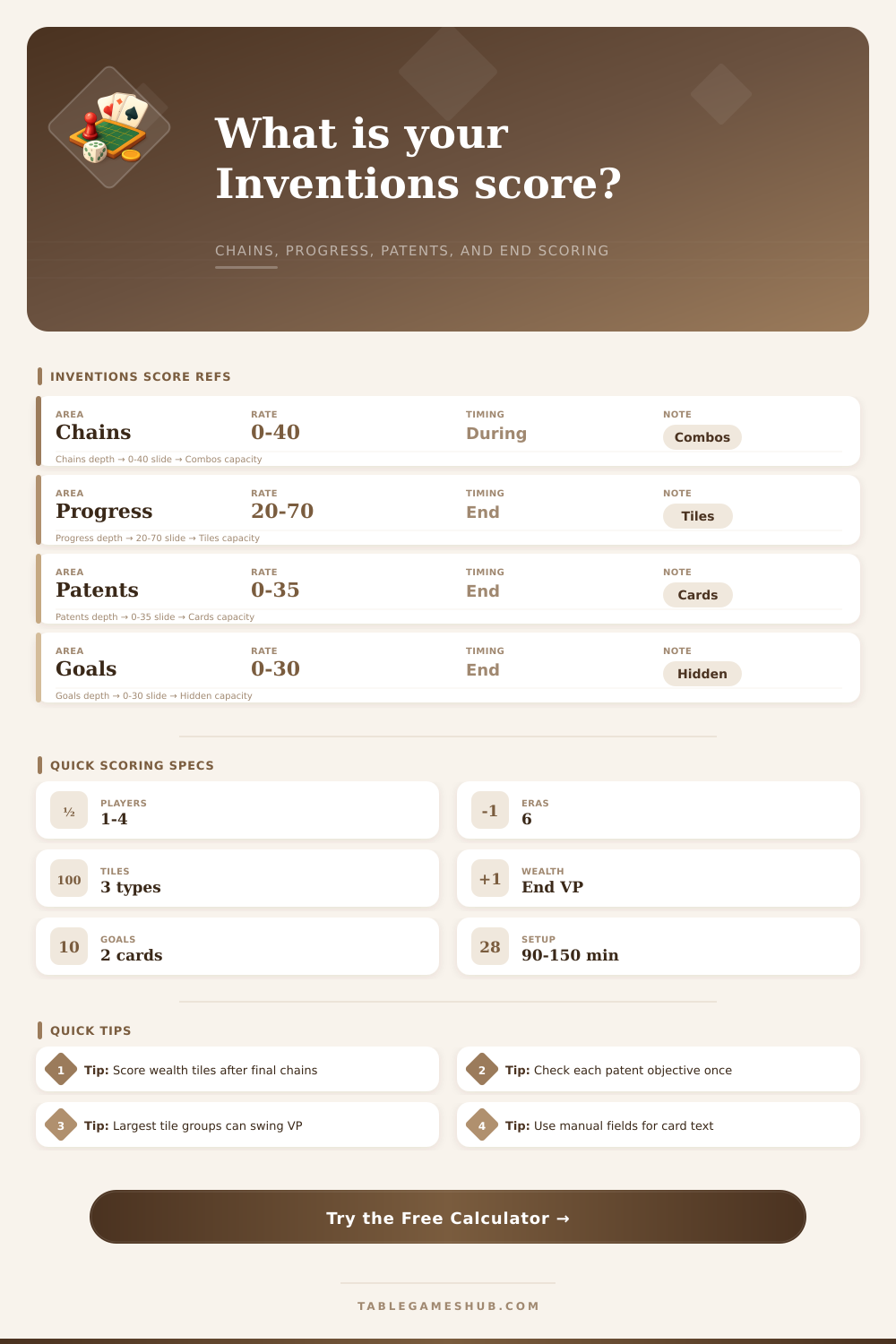
Total a final Inventions score from invention chains, progress and wealth tiles, patent cards, engineers, workshops, objectives, influence, citizens, and manual end scoring.
Use a preset as a realistic end-game board state, then adjust the patent, progress, and objective fields to match the exact cards and tiles in your play.
| Category | Calculator fields | How to count it | Common miss |
|---|---|---|---|
| Invention chains | Chain VP, chain links, unfinished links | Enter points already awarded during idea presentation, sharing, and linked action turns. | Counting unfinished links as final VP in final mode |
| Progress tiles | Technology, economy, culture, largest group | Count placed tiles on the society board by type and record the largest connected group. | Missing tiles gained late in the final era |
| Wealth tiles | Wealth tile VP, citizen rate, citizens out | Resolve each wealth tile condition, then enter the total plus any visible citizen scoring. | Scoring a conditional tile before final citizens are placed |
| Patents and idea cards | Completed patents, patent VP, manual VP | Score printed or card-text patent values once after all prerequisites are settled. | Double-counting a card in both patent VP and manual VP |
| Engineers and workshops | Engineer count, workshops, pair rate, workshop VP | Use the pair-rate selector only when a card or objective rewards balanced support pieces. | Adding support pieces that are not part of a scoring condition |
| Objectives and influence | Private goals, public VP, influence VP | Add private objective cards, public milestones, and region or influence track scoring. | Forgetting tie-break information after the VP total |
| Tile focus | Typical score driver | Calculator support | Audit question |
|---|---|---|---|
| Technology progress | Action chains and one-time acceleration | Technology tile count, chain VP, projected links | Did every earned tile get placed or scored? |
| Economy progress | Era-based engines and recurring conversion | Economy tile count, workshop bonus VP | Were final era economy triggers resolved? |
| Culture progress | Permanent improvements and broad support | Culture tile count, objective scoring | Does a wealth tile care about culture count? |
| Largest group wealth | Connected progress clusters on society board | Largest connected progress group | Is the group orthogonally connected and final? |
| Citizen wealth | Citizens moved out of supply or onto regions | Citizens placed outside supply, citizen rate | Were returned citizens removed before scoring? |
| Objective type | Input to use | Recommended timing | Scoring note |
|---|---|---|---|
| Private goal cards | Completed private objectives and VP per objective | After final tile placement and card cleanup | Use the printed value on each card when it differs from the selector. |
| Public milestones | Public objective and milestone VP | After final era milestone awards | Enter actual awarded VP, not the number of milestone tokens. |
| Patent portfolio | Completed patents and patent card VP | After checking prerequisites | Count each card once even if it supports multiple notes. |
| Engineer workshop set | Engineers, workshops, pair rate | Only if a scoring card rewards the pair | The calculator scores the smaller count as balanced pairs. |
| Influence majority | Influence and region VP, tie-breaker strength | After region and track scoring | Keep tie-breaker notes even when VP is already locked. |
| Score band | Typical profile | Progress board sign | What to recheck |
|---|---|---|---|
| Under 90 | Learning game or missed scoring source | Fewer than 10 total progress tiles | Progress tile gains, private objectives, wealth tiles |
| 90 to 120 | Solid first finish with some end scoring | 10 to 14 total progress tiles | Patent text and citizen-based wealth scoring |
| 121 to 150 | Competitive full game score | 15 to 18 total progress tiles | Largest group wealth and public milestones |
| 151 plus | Strong chain and end-board conversion | 18 or more progress tiles | Double-counted manual VP or unresolved objectives |
Wealth timing: score wealth tiles after final citizens, ideas, and progress tiles are settled so conditional end scoring sees the real board.
Manual VP check: use other card or board VP only for bonuses not already included in patents, objectives, workshops, or influence.
By the end of each Inventions game, things can get crazy at tax time. Tokens is everywhere, strewn about regions, piled up on your board, and held in your hand. You have cards in your hand, tiles on your board, and tokens scatterd across regions. It is tense. But the arithmetic sucks.
That’s when a systematic point system come to your rescue. It prevents you from tallying incorrect points that might cost you victory. Rather than wasting time calculating each Patent card and Chain link while everyone watches, you can retreat and let this calculator do all the number crunching. A cluttered conclusion turns into a clean-cut scorecard of your strategic skill.
Why Use an Inventions Score Calculator?
Invention chains are where the meat of your score lie. They’re the momentum you’ve generated over the course of the game. By proposing ideas and linking them to other idea, you’ve earned points. And the tool asks how many VP you earned via those inventions during gameplay. But it’ll also account for any unfinished links… Which is important. Potential doesn’t count as victory points until you project it out.
When you’re estimating your position at the end of game (prior to the last era’s turn), that projected buffer will be your best friend. It can help show you whether it is better to spend an action to push for another link in a chain or to pivot towards securing wealth tiles instead.
But if we look at your progress tiles, that tells another tale: What was your plan? Were you focused on culture, or the economy, or technology? Chances are there’s a bunch of one color clustered around your board. This is where the calculator splits it out into categories. Which engine did you ride? Economy tiles tend to keep things flowing well in the end game; tech tiles can help jump-start an action chain earlier on. Culture tiles will give you a more balanced flow throughout. Comparing them individually will show you where you’re strong and weak. For example, if you have a lot of tech tiles but not many culture, you may have raced ahead but failed to take advantage of more points elsewhere.
It’s also worth considering what the biggest connected set is. There are a lot of wealth conditions that score based off proximity. So a loose spread out board won’t score as much than a compact one. And the numbers themselves sometimes fail to reflect that spatial understanding.
Wildcards include patents and other private goals. These variables create some volatility because they rely on underlying text on a card (its text) and/or secret intentions (hidden goals). The tool gives you places to put those in so you won’t count a bonus twice, once for being a great way to get wealthy and again for being on a quest for something else. A patent is one example. You could easily overlook it since it may appear in both your objective score and your wealth score, depending on the situation. Separate out the two and leave your audit tidy.
Finally we have workshops and engineers which act as support structures here. They don’t always score items themselves, but instead help the pair or set that does. Check whether a particular condition was fulfilled before counting that. Use the tool to walk through that logic tree and make fewer mistakes due to honest errors when time is tight.
The last piece to this is citizen placement and influence. Citizen placement is something that can be overlooked as you play since it seems vague. However, placing citizens on certain tiles or moving them from the supply affects your citizen wealth scoring, while influence and majority control can swing totals in different regions. Finally, having majority control in regions can swing your final total significantly. It might not seem like much but when scores are close it does make a difference.
All of those factors is taken into account by the calculator and give you a complete picture of where you stand. After using it once, you’ll never approach another game the same way. Clustering tiles and completing chains suddenly become valuable. You discover that ignoring influence isn’t always cost free, no matter how powerful your engine may be. It turns the after-the-fact game analysis into something real, not just point keeping.
The next time you’re at the table, use this as a mental checklist. Pay attention to growth of your chains. Track how well your tiles cluster together. And realize that each patent costs something, and there is a price for everything. Understanding what the numbers mean is often the separation between a casual gamer and a serious competitor. Once you learn the worth behind each piece on the board, you stop your guesses and begin constructing. But only if you know where these points are coming from does math provide a clear path to victory.