Nucleum Score Calculator
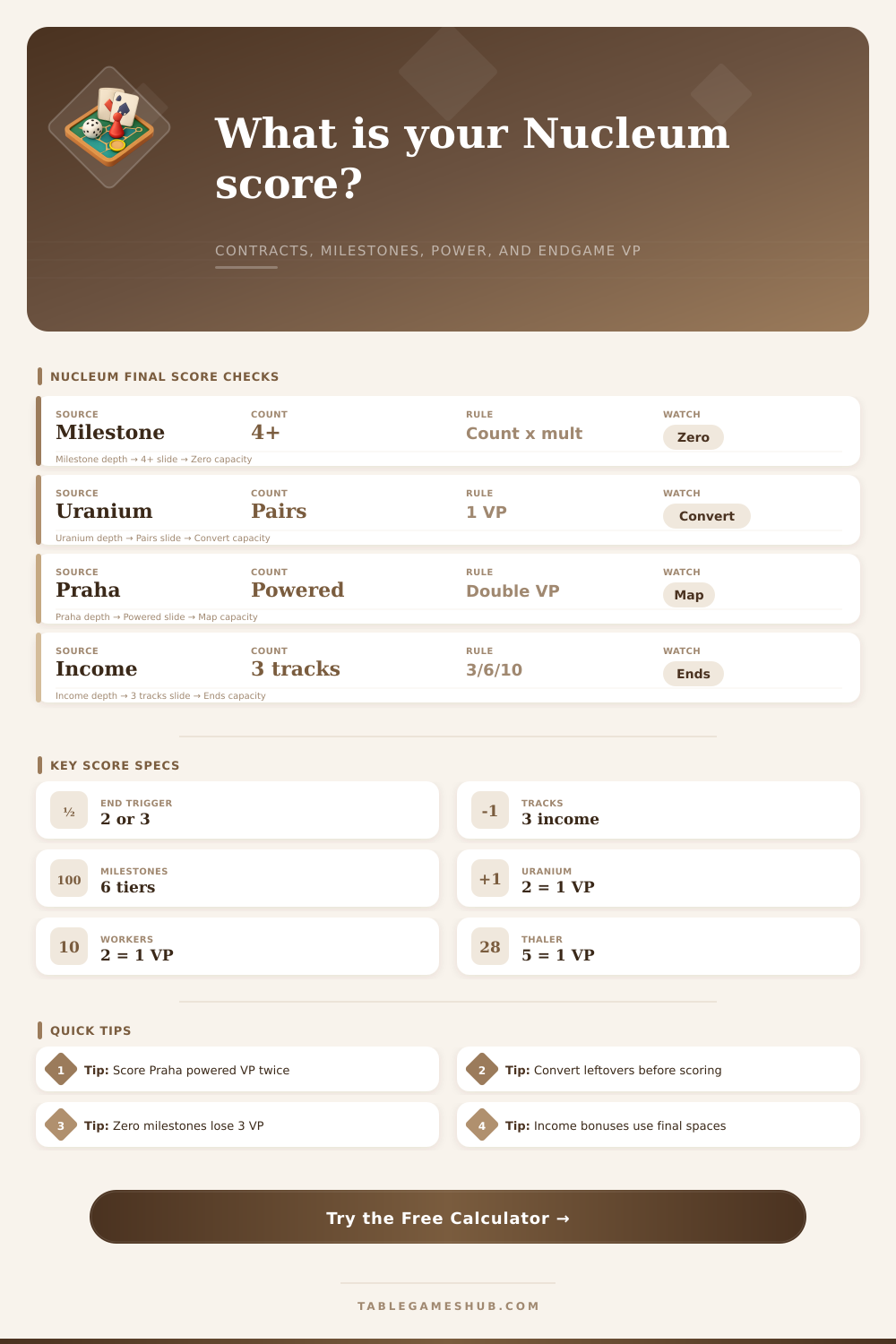
Total your Nucleum VP from contracts, milestone multipliers, powered buildings, income tracks, experiments, network growth, workers, uranium, and final scoring.
Presets fill the form with plausible endgame positions. Adjust the fields to match your board before scoring.
Marker 1
Marker 2
Marker 3
Marker 4
Score Breakdown
| Step | What to score | Calculator field | Common audit |
|---|---|---|---|
| 1 | Place final achievement marker if possible | Milestone count and multiplier | Respect one marker per tier |
| 2 | Score milestone markers | Marker rows | Zero markers lose 3 VP each |
| 3 | Score ultimate technology | Final tech VP | Only if 8th technology is unlocked |
| 4 | Score resources after conversions | Uranium, workers, thaler | Try uranium to workers to thaler |
| 5 | Score energized buildings and income bonuses | Power and income sections | Praha powered buildings score double |
| Contract family | Typical requirement | Score effect | Calculator use |
|---|---|---|---|
| Initial | 2 pieces in a city color | Low VP or early technology | Add VP already earned to track total |
| Silver | 2 buildings, 2 turbines, 5 rails, or 2 mines | Small VP plus resources or level 1 tech | Use fulfilled count to judge C35/C49 pace |
| Gold | 3 buildings, 7 rails, 3 mines, or network 7 | Medium VP plus level 2 tech | Check network and map fields |
| Purple | 4 turbines, 8 uranium, 8 contracts, or 9 rails | Large VP or level 3 tech | Compare final board to target thresholds |
| Milestone type | Board count to enter | Network link check | Scoring note |
|---|---|---|---|
| Every 2nd urban building | Floor(total urban buildings / 2) | Buildings can be in separate networks | Dual-icon buildings still count once |
| Every 2nd railway tile | Floor(railway tiles / 2) | Only tiles you placed count | Useful with rail-heavy Experiment B |
| Energized city | Each city with your powered building | Completed lines matter for power reach | Praha counts as a city here |
| Mines or turbines | Each matching piece on the map | Must be in or extend your network when built | Pairs well with uranium and power scoring |
| Experiment | Score lens | Strong inputs | Endgame watch |
|---|---|---|---|
| A | Turbine and mine tempo | Turbines, mines, uranium | Convert excess uranium only after power checks |
| B | Railway spread and action flexibility | Railway tiles, completed links, network size | Every 2nd railway milestone can swing late VP |
| C | Energize reach and powered buildings | Energized cities, printed building VP, Praha | Praha doubling and government networks need review |
| D | Contracts and achievement tokens | Fulfilled contracts, achievement marker value | Last marker placement may change milestone VP |
The surprise in Nucleum is that it all comes to an abrupt end, which will spook first-time players unless they get used to it. Yes, you lay down your tiles cautiously, but then somebody reaches a limit, or the market depletes its stock, and the game halts. No slow burn; there are points accumulating right away. That’s when good players set themselves apart from lucky ones who is merely hoping.
Before the final count is made, you must know exactly where you stand. The calculator (above) adds everything: left-over resources, tech points, bonuses on the income track, buildings powered-up with energizers, contract values, and milestones times their multipliers. It takes a jumble of token bits and transforms them into one reliable figure.
How to use the Nucleum Calculator
The milestones are tricky, though. There is one key number to know for milestones: you must know how many matching items are on the board, not just in your personal area. For example, if the milestone is for mines, your base count would be the number of mine you’ve placed on the board. From there you multiply by the multiplier from your position on the marker. Having a higher-level marker but zero progress there is bad news. You lose three victory points without gaining anything. Ouch. That’s a big hit if you skipped checking the board and went for income instead.
The tool will do that math for you so you know whether or not it was worth risking going for a higher spot. It shows if playing safe and sticking to your guns would of led to a safer number overall.
Late-game: Power reach matter more than raw power generation. Buildings that have been powered up adds their printed points to the total. Cities in Prague double those points. This is something players frequently ignore; they tend to view all cities equally. Those points add up fast if you’ve linked your network to Prague. This distinction shifts calculation a lot. Hence why the calculator requests different values for Prague versus other cities. You may believe you’re within striking distance of an opponent, but they get double their base (yours does not), so the gap is actualy larger than it appears at the board.
Your leftover resources must be converted into points. Workers convert 2 for one into thaler. Uranium converts 2 for one into workers. Every 5 leftover thaler coins is worth 1 point. Sounds easy, but when should you convert? Holding onto uranium until it increases mine production can result in strange amounts you cannot easily sell. How do you know which way gets you most points? This calculator will test them all for you. It figures out whether it’s better to convert your uranium into workers or to keep your uranium to get a mine multiplier. Guesswork about what’s best isn’t required. The system run through the possibilities and tell you how much you’ll get from each option.
The other reward structure is by income tracks. Large amounts of victory points are given when reaching the last spots on VP, worker, and thaler tracks. These are large enough to swing a close game but are independent of network or building achievements. You can build an awesome power grid but still lose because someone else got their income slider going while you didn’t get yours up. There is also a big difference in the end-of-track bonuses: three, six, or ten points depending on how far along you are. If you’ve not checked those inputs, then make sure you credit yourself with those passively-earned points during the game.
The short term benefits of contracts come from the points they deliver right away. But the real benefit is long term as you receive technology upgrades. Finally getting that eighth technology delivers a large end game bonus. This means pursuing contracts is not only an income stream early on, but a strategic move to make sure you’re in contention at the end. The calculator has spaces for both current points and total points with ultimate technology bonuses so it’s accounting for this late-game surge appropriately. Plug in what you’ve got and find out how far behind you are to overtake a leader who picked up their last tech upgrade.
The choice of experiment also determines what will be relevant on the scoreboard at the end. Turbine count and mine count is key for Experiment A, while railway network flexibility and spread are important for Experiment B. These are the milestones whose weights will contribute most heavily to the overall result. In the tool, players can choose from their set of experiment presets. This changes scoring fields so they reflect the corresponding rules for each variation. Therefore, the benchmark suggestions and reference tables match the mechanics as actualy experienced during a play-through.
So how should you use this calculator? While it can help calculate points, that’s not its greatest use. To audit your strategy, run your projected score against a competitor’s score and see where the difference arise. Maybe you’re undervaluing some doubles in Praha? Perhaps you’re lacking points from income tracks? Knowing what’s causing you to lag behind will allow you to better plan during your next game. It reveals what engines are worth pursuing and what pitfalls to steer clear of. Ultimately, it makes scoring a bit less mysterious and a little more diagnostic.
This is an improvement to your game.