Carcassonne Farmer Calculator
Score fields by completed adjacent cities, farmer majority, shared control, pig bonuses, barn timing, and expansion scoring mode.
Load a common endgame field shape, then adjust each city count and meeple majority to match the exact farm area on your board.
Farmer Scoring Result
| Scoring item | What to count | Typical value | Calculator treatment |
|---|---|---|---|
| Completed adjacent city | Each finished city touching the field | 3 points | Multiplies by scoring mode and field count |
| Incomplete adjacent city | Unfinished city segments by the field | 0 points | Shown in breakdown as missed potential only |
| Farmer majority | Most farmer meeples on that exact field | Full field | Your score is zero if an opponent has more |
| Shared majority | Two or more players tied for most farmers | Full each | Table points multiply by tied player count |
| Duplicate city count | Same completed city touched twice by one field | Count once | Correction subtracts accidental duplicates |
| Expansion or variant | When it matters | Field value | Calculator option |
|---|---|---|---|
| Base game or modern edition | Final scoring farmers | 3 per completed city | Modern farmer scoring |
| Classic table variant | Older local scoring reference | 4 per completed city | Classic variant |
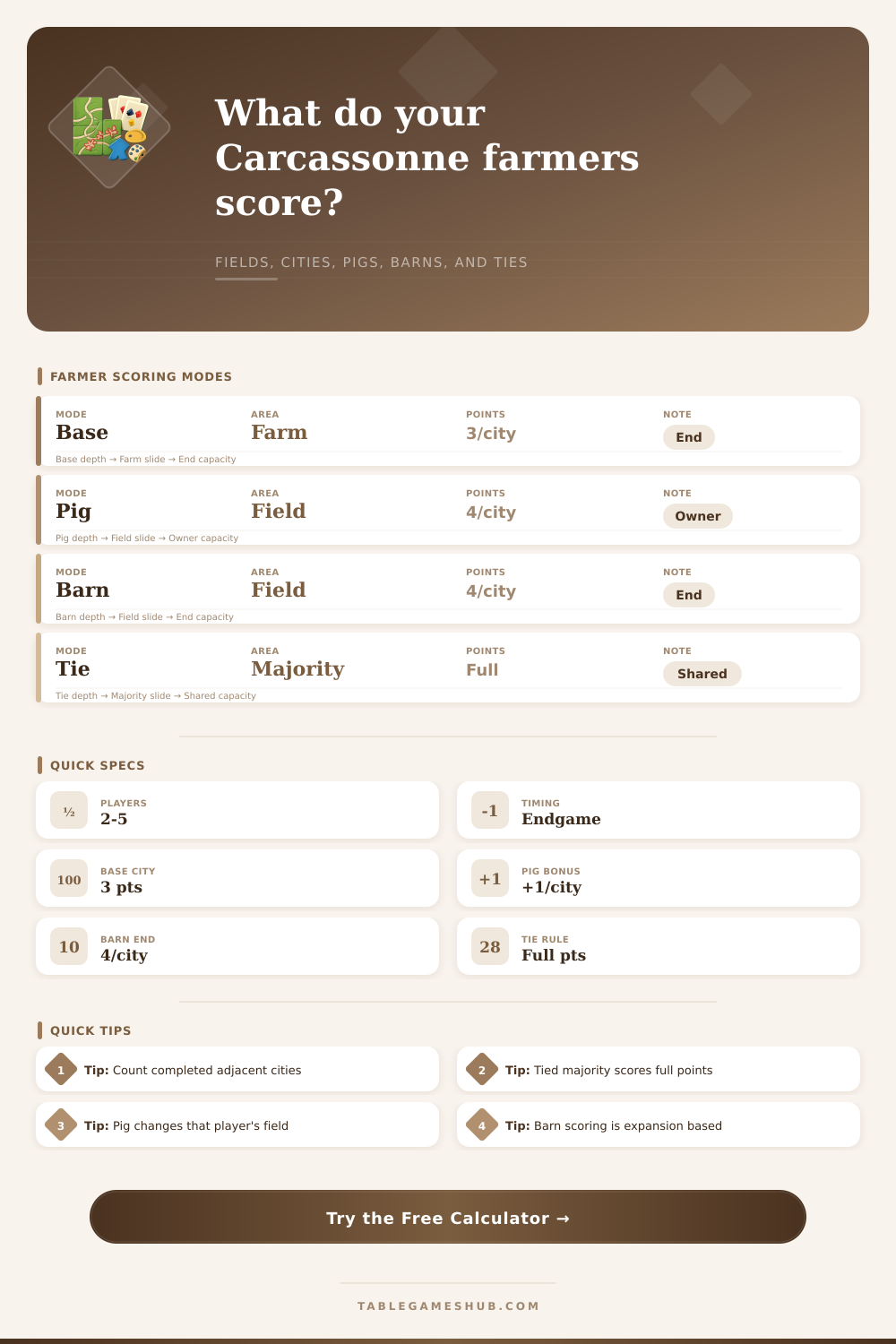
| Traders and Builders pig | Your pig remains in the scoring field | Add 1 per completed city | Pig bonus mode plus pig status |
| Abbey and Mayor barn | Barn scores a field instead of farmers | Often 4 per completed city at end | Barn endgame or placement mode |
| River and Inns/Cathedrals | Field borders may be longer or trickier | No direct farmer value change | River or no-change mode |
| Your farmers | Highest opponent | Shared players | Scoring result |
|---|---|---|---|
| 1 | 0 | 1 | You control the field alone |
| 1 | 1 | 2 | Both tied players score full value |
| 2 | 2 | 3 | All tied majority players score full value |
| 1 | 2 | 1 | You do not score this field |
| 0 | 0 | 1 | No farmer score unless a barn scores it |
| Preset | Best use | Risk to check | Expected result |
|---|---|---|---|
| Big City Ring Field | One farm touches many completed cities | Duplicate city corners | High city multiplier |
| Shared Majority Farm | Endgame tie for most farmers | Wrong shared player count | Full score for each tied player |
| Pig Bonus Pasture | Traders and Builders field scoring | Pig must belong to scoring player | One extra point per city |
| Barn Endgame Field | Abbey and Mayor final field | Farmers may not score normally | Barn score replaces farmer score |
| Split Farm Trap | Roads divide nearby fields | Counting cities from another field | Lower corrected city count |
In many games of Carcassonne, the final turn feels less like strategy and more like geometry class gone wrong, just a lot of math at the end. Maybe it’s that big meadow that touches three or four cities and wraps around two more? Or maybe it’s corner counting which could change your adjacency and field ownership for all of them. Chances are, your opponent doesn’t understand any better where things go. The Carcassonne Calculator eliminates arithmetic friction in score disputes so you can concentrate on playing tiles not doing math.
Scoring: Farmers gain points for each city that borders their field, which is the simple part of the game. Under moddern rules, cities is worth 3 points apiece. The tricky part is determining what is touching a field. Any corner or edge of the city that touches the farmer’s segment counts as a city. It’s common for players to miscount here by adding buildings close to the green area but failing to determine whether there are walls or roads separating the fields into separate areas.
How to Score Farmers in Carcassonne
The tool will help you pick out such separate area so that multiple farms aren’t merged into a single point count. Whoever has the most farmers on one particular piece of grass, wins. If that number is more than what any other player counted then you get those points. If you tie with another player for the top amount both of you gets the points. So ties aren’t bad, they’re good! Everybody gets an equal point value when it’s a tie.
Just plug in your number of farmers vs the highest opponent’s number plus add in however many people tied with you. This way you know exactly if you’ll get lots of points or if it won’t make a difference at all. That way you don’t have to try to remember each opponent’s placement and city count.
The downside of expansions is they introduce complexity which can be a turn off for casual gamers. From *Traders and Builders*, the Pig awards an additional point per city if it’s scored by its owner (so they also has to score that field). From *Abbey and Mayor*, the Barn alters the value entirely or changes the timing. There isn’t any expectation that anyone needs to remember all these interactions between expansion modifiers and underlying base game rules. Just choose which ones you want active and it will automatically set the number of points per city. That way people argue over the strategy behind tile placements instead of who gets to use what house rules.
There is a psychology to farm scoring too. Ten cities in a field may sound like 30 points…until you remember that three of those cities aren’t complete yet. Unfinished cities score nothing for farmers, they represent potential, not profit. To prevent getting carried away, the calculator treats finished versus unfinished structures differenty. It avoids the mistake of treating a partially constructed cathedral as certain points. Enter how many unfinished cities you have and let it count down for you, but don’t expect those to boost your final tally. That’s important when weighing the choice to block someone’s city or put another farmer there.
Eventually tiles will be rotated and roads wind into greenspace and the board state gets messy. In these situations memory fails. Having a preset scenario helps reset how we see things. Whether it’s a split farm from an early road placement or a ring field around a central cluster of cities, there is a baseline to reference for what to expect. How shared control splits the points? How do duplicates play out? This shows it all.
At its heart, Carcassonne is a game about denial and theft. It’s about building cities around a farmer who sits unsteadily on the edge of a piece of grass like some kingmaker. But to score that farmer, you should of had patient play throughout and exact moves near the end of the game. There’s counting meeples, tracing out lines, checking for completion.
Once you have an idea of what the board looks like, the arithmetic flows easily. Then when things finally click into place and you get the right number of points, the reveal feels deserved. It doesn’t so much feel like winning a game as solving one.