Ark Nova Zoo Calculator
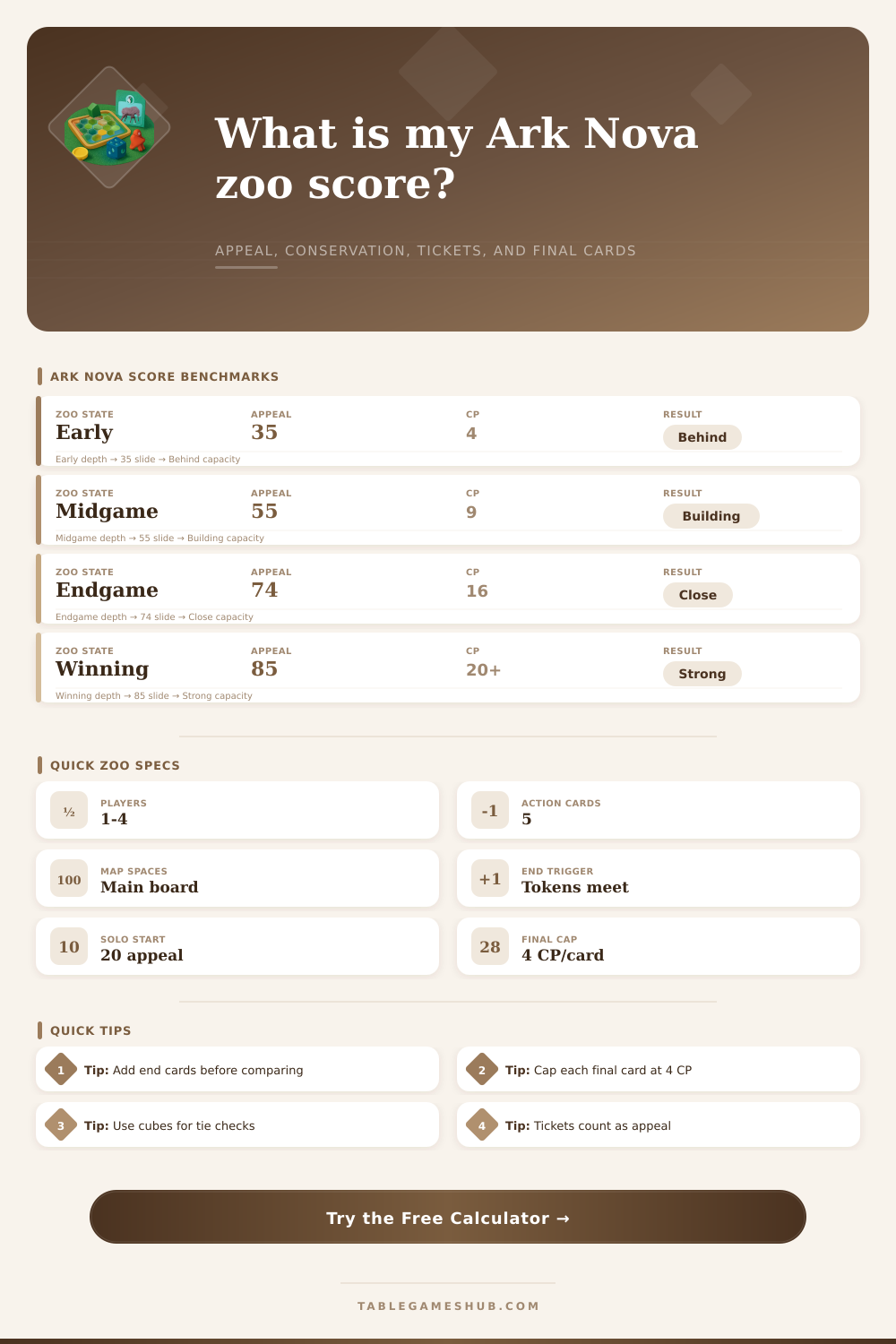
Total your zoo before final scoring: tickets, appeal, conservation points, reputation, animals, sponsors, enclosures, and the target number.
| Scoring element | How it enters the calculator | Typical source | Final-score note |
|---|---|---|---|
| Appeal counter | Direct appeal total | Animals, sponsors, icons, bonuses | Compared directly to target number |
| Ticket icons | Added as uncounted appeal | End-game cards or delayed reminders | Tickets are still appeal for scoring |
| Conservation points | Converted into target reduction | Projects, donations, card effects | First 10 CP are lighter than later CP |
| Final scoring cards | Added before VP comparison | Kept end-game objective cards | Each card awards at most 4 CP |
| Supported projects | Tie-breaker count | Player cubes removed from map | Higher count wins tied VP |
| Zoo profile | Animals | Sponsors | Covered spaces | What the calculator watches |
|---|---|---|---|---|
| Lean conservation zoo | 10-14 | 5-8 | 16-22 | High CP can offset moderate appeal |
| Animal-heavy appeal zoo | 18-24 | 4-7 | 22-30 | Needs enough conservation to cross |
| Sponsor engine zoo | 12-18 | 10-16 | 18-26 | End-game appeal and CP swings matter |
| Research icon zoo | 12-18 | 7-12 | 18-25 | Final scoring cards often decide it |
| Final CP | Estimated conservation value | Estimated target appeal | Classic VP at 80 appeal |
|---|---|---|---|
| 8 | 16 appeal-equivalent | 98 | -18 VP |
| 12 | 26 appeal-equivalent | 88 | -8 VP |
| 16 | 38 appeal-equivalent | 76 | +4 VP |
| 18 | 44 appeal-equivalent | 70 | +10 VP |
| 20 | 50 appeal-equivalent | 64 | +16 VP |
| Step | What to add | Calculator field | Common miss |
|---|---|---|---|
| 1 | Brown end-game appeal | Sponsor end-game appeal | Forgetting sponsor card text |
| 2 | Brown end-game CP | Sponsor end-game CP | Adding CP after comparing too early |
| 3 | Final scoring card CP | Final scoring card conservation | Exceeding the 4 CP per-card limit |
| 4 | Ticket or appeal reminders | Uncounted ticket or appeal icons | Treating ticket icons separately |
| 5 | Supported project cubes | Conservation projects supported | Missing the tied-score tiebreaker |
Ark Nova‘s final round becomes almost a deep check of every aspect of your strategy. Tokens twitch as you try to recall what all the brown text on each sponsor card does, if you have any ticket icons in your hand that will count toward your total appeal, and most of all: Are there three of them? It is far too easy to miscount by three points when you are under pressure, and three points is one whole elephant exhibit’s worth of error in a game with such thin margins of victory.
Once you’ve plugged in your final numbers, the calculator up top does the math for you, no need to go through the mental gymnastics of multiplying conservation shields into target reductions, or remembering which sponsor bonus apply.
How to Score Ark Nova
Ark Nova scoring centers on this appeal/conservation split. To be relevant (high appeal), you must also conserve (positive conservation points). Because you get victory points based on crossing below a certain threshold, you need to keep conserving or you’ll fall behind. Balance determine whether you win or lose throughout your run.
As most people realize instinctively: More animals = more appeal! But they tend to undervalue conservation, even though its cost grows very quickly. During the early game, you get a bit of an advantage. The first ten shields are fairly easy to get with some initial donations and small projects. But once you hit ten, the cost per shield increase dramatically.
That makes a big difference when you’re inputting your data. Have 15 shields but only 60 appeal? Maybe you should build more enclosures; you’re not doing well, right? Nope; those additional shields have driven down the threshold so much that, though your zoo looks pretty modest, you could still be in a winning spot.
Until it’s too late Some sponsor cards trigger end-game rewards, like appeal or conservation points, at the end of the game in addition to their effects while in play. You can enter those delayed awards as well, so they will be properly included in your final score comparison. You don’t want to declare yourself behind if you’re really ahead because you forgot to count those bonuses prior to final comparison.
The tool supports ticket icons, which is a subtle detail, but these icons gets converted to appeal at the end of the game. Because players tend to think of tickets as money, they fail to realize that tickets function differently during gameplay, but are pure appeal when it comes time to tally scores. Removing this source of confusion about how you should mentally calculate your score is one benefit of using the tool.
In most situations, reputation and animal counts serve more as narrative markers than direct score drivers. Instead, they are narrative markers: seeing that number line up tells us we did something right, even if our VP total might look small on the paper. For example, a high reputation tends to correlate with having a good engine, since it opens up higher-quality cards and gives momentum bonuses. Still, it doesn’t contribute any points itself.
That’s why seeing that number match up is encouraging; it reassures me that I was playing the game well, despite my low VP total. Likewise, animal count represent efficiency, rather than pure strength. Having a lot of animals per space usually means you’ve used your action economy efficiently; there are fewer blank spots which tend to indicate indecisiveness or lack of planning when laying out the zoo.
Even though the total VP might be similar between two games, these measures show us what happened in each game. This helps us see why one score feels really satisfying while another score feels kinda hollow.
The tie-breaker system is another point that leads to poor decision-making due to confusion. In a close race, who supports which projects matters hugely. You can be one cube away from winning and still drop out of first place if you failed to clear sufficient cubes from your map during play. That’s a bit sneaky but it rewards players who consistently make an effort to conserve all game long, not those who suddenly become active near the end. Keeping track of your supported projects guarantees you’ll have a solid bead on the scoreboard at the end of each match.
Ark Nova ultimately celebrates those who see their zoo not as a collection of disconnected cards but as an integrated system. Each of its actions ought to serve some purpose, increasing your appeal or decreasing your target, preferably doing both with clever card play. At the end of the day, when it all comes together, the calculator offers a brief flash of insight that turns your jumble of cards and tokens into one clear-cut score. It serves as a reminder that although creating great animal habitats may be the goal, winning the game demands nothing less then cold, hard math.
Once the tickets have been tallied and the dust has settled, having a firm grasp on your performance means you’ll better know what worked (and what didn’t) so you can apply those lessons to the upcoming trip. And in the long-term, that’s more valuable than a handful of additional points on the scoreboard.