Oceans Score Calculator
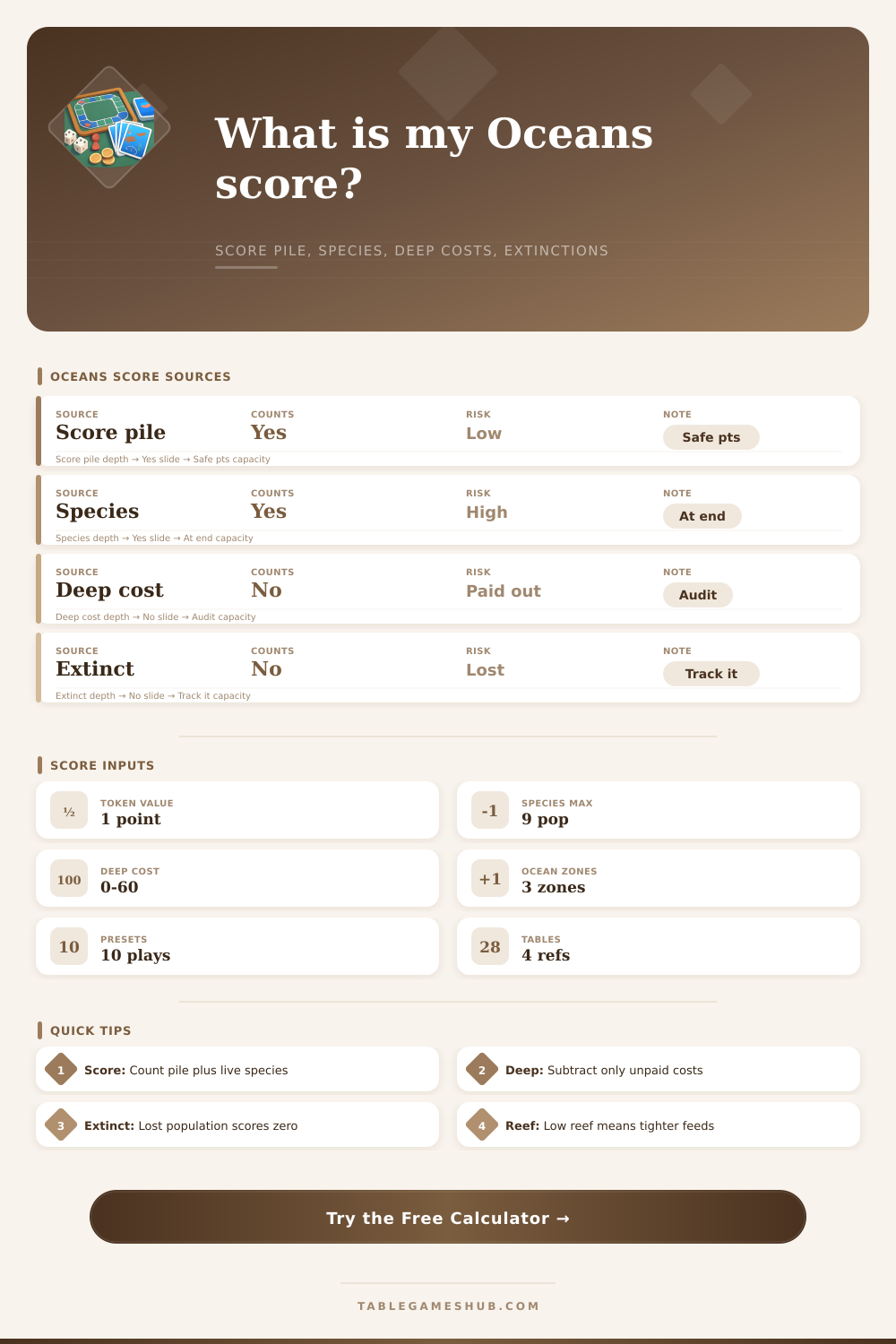
Total your Oceans score from secured population, surviving species boards, Deep card costs, reef pressure, ocean zones, and extinction losses.
| Score source | Official scoring treatment | Calculator input | Common mistake |
|---|---|---|---|
| Score pile population | Counts 1 point each | Population in your score pile | Forgetting Deep costs already paid out |
| Surviving species population | Counts 1 point each at game end | Population on your species boards | Counting at-risk boards that will die |
| Deep card costs | Population paid leaves your pile | Total Deep population cost paid | Subtracting twice after using current pile |
| Extinct species | Lost population scores zero | Population lost to extinction | Adding extinct board population back in |
| Manual scenario notes | Only if your table needs it | Manual scenario adjustment | Treating a variant note as a core rule |
| Board state | Reef reading | Ocean reading | Scoring implication |
|---|---|---|---|
| Early surface build | Reef has plenty | No zone empty | Board population can grow before scoring |
| Cambrian begins | Foraging tightens | First zone empty | Deep costs and faster aging matter |
| Predator table | Reef may be ignored | Zones may last longer | Species-board points are exposed |
| Final ocean race | Reef often low | Last zones nearly empty | Use 0 or 1 future feed action |
| Extinction spiral | Food sources unstable | Zones drained unevenly | At-risk population should be removed |
| Species condition | Board population | Age safety | Calculator treatment |
|---|---|---|---|
| Stable feeder | 4-7 tokens | Usually safe | Count unless targeted by predators |
| Fresh species | 1-2 tokens | Fragile | Move to at-risk if it cannot feed |
| Full board | 8-9 tokens | High value, visible | Count but watch overpopulation effects |
| Zero population | 0 tokens | Extinction danger | Enter under unable to age safely |
| Recently extinct | Removed | No score | Track as extinction loss only |
| Deep card audit | What to count | When to subtract | Breakdown note |
|---|---|---|---|
| Deep traits | Cost shown on card | Before-cost score piles only | Power bought with population |
| Deep events | Population paid at timing | Only if not already paid | Events leave no card in play |
| Low-cost Deep play | 0-2 population | Small audit line | Often efficient if it protects species |
| High-cost Deep play | 6+ population | Major tax if not recovered | Needs feed gain or survival value |
| Deep-heavy engine | Many cards, many costs | Use total Deep population cost | Compare final score to missed points |
Oftentimes the last few rounds of an Oceans game are a mess. The ocean board evaporates quicklyly. Your hand contains high-value cards that needs to be sacrificed at great cost. Species teeter at edge of destruction. It’s simple to get confused about what’s happening, are you winning? Are you merely scraping by?
Luckily, the calculator does the math for you. However, understanding that math require a mindshift in how you think about your resources. Instead of thinking of your population tokens as food items (which they technicaly are), you begin treating them like money, and this is worth much more then many players consider.
How to Score Points Correctly in Oceans
The vast majority of scoring mistakes occur due to forgetting that “extinct” is permanent, and zero population = extinct population. This tool separate those two things out from each other; there’s not some secret stash of points just sitting around waiting for you when the game ends (though it sure would of been nice). You can’t count those feeder fish with only 3 left on ’em as points, or you’ll feel like you’re ahead, but then a predator comes along and you’re dead. Instead, you need to model how many are likely to actualy make it till the end. How many survive compared to how many were alive in the board?
This is what the calculator allows you to input: expected survivors vs. Total # alive on the board. You face the facts of where you are on the board instead of wishful thinking your way through it.
Cards with deep powers further complicate things. These cards costs you points but gain you power, meaning you have to play them while paying population tokens out of your score pile. And guess what? That’s when most people start to get lost in audit process. That score pile is long gone, and you can’t take away from it any more.
The calculator simply allows you to set a timer. Do you want the calculation to be based off what is currently in your score pile, or what was there before you paid to use these expensive abilities? Pick incorrectly, and you end up double counting the hit. This makes your engine appear less efficient than it really is which changes how you view its efficiency.
Though it doesn’t score directly, the reef still plays a role in your final tally, and a dead reef make it harder to forage food in later rounds. You can input the current level of each ocean zone as well as any remaining reef token into the tool and it will estimate how many feeding actions you’ll reasonably be able to perform before time runs out. Fewer feedings mean fewer opportunities to expand your species (or defend them from becoming extinct). That creates pressure to play conservatively and score points instead of risking expansion and losing everything. So if you know you’re done with feedings, get what you got.
The second thing to keep in mind is how player count affects things quite a bit. With fewer players, you have less competition for food. This means your species will survive on the board longer with larger numbers of it. With four players, the mayhem rise and the extinction rate goes up accordingly which is reflected by the calculator’s notes. Remember, bigger numbers aren’t as stable if there are also several predators in the mix. You may enter a high number into the input field, but that number won’t stay stable if three other player are also hunting for food.
Each scenario has a table of common errors at the end of the tool. These explain how to do deeper card audits, such as the difference between paying costs before or after, and what to do with extinct species, which is a pure loss rather than partial credit. So it helps avoid over-estimating your late-game lead by making it all a guided review of your cards instead of a guessing game.
In the end, scoring Oceans is not about what you had halfway through the game, nor is it about what you hoped to build, it’s about what is left and being honest with yourself about what is safe to age and what species are still breathing. The only points that matter once the ocean is emptied out are the points you’ve secured, and the calculator makes clear what those points are in terms of your tokens. Before playing the last card, you’ll have a precise understanding of where you’re at.