KeyForge Aember Calculator
Check forge readiness, steal and capture swings, chain draw drag, and key tempo from the board state you have right now.
Use the fields to estimate whether your Archon can forge at the next forge step, how much pressure your steal or capture creates, and how chains change your hand refill.
Aember Tempo Result
| Forge State | Typical Check | Tempo Meaning | Calculator Input |
|---|---|---|---|
| First key | 6 aember before tax | Establishes race pace | 0 keys forged |
| Second key | 6 plus board modifiers | Forces opponent control | 1 key forged |
| Final key | 6 plus heavy disruption | Win condition check | 2 keys forged |
| Taxed key | Base plus modifier | Needs buffer aember | Cost modifier |
| Chains | Cards Drawn Fewer | Refill at Hand 6 | Tempo Note |
|---|---|---|---|
| 0 | 0 fewer | 6 cards | Full refill |
| 1-6 | 1 fewer | 5 cards | Light drag |
| 7-12 | 2 fewer | 4 cards | Medium drag |
| 13-18 | 3 fewer | 3 cards | Heavy drag |
| 19-24 | 4 fewer | 2 cards | Severe drag |
| Effect | Your Pool | Opponent Pool | Key Tempo Impact |
|---|---|---|---|
| Gain | Increases by full amount | No direct change | Improves your forge gap |
| Steal | Increases by stolen amount | Decreases by same amount | Best two-way swing |
| Capture | No direct gain | Decreases until released | Delays their forge check |
| Forge tax | Needs more aember | May also tax them | Creates buffer pressure |
| House Plan | Common Aember Role | Watch For | Calculator Focus |
|---|---|---|---|
| Logos | Setup and draw speed | Hand refill after chains | Chain draw drag |
| Shadows | Steal and tempo reversal | Opponent pool cap | Steal swing |
| Untamed | Burst gain and key cheat | Overcommitting aember | Forge buffer |
| Sanctum | Capture and key tax | Captured aember returning | Opponent delay |
| Saurian | Exalt and high board value | Large returned stacks | Risk buffer |
In the game of KeyForge, a player must manage a resource called aember. Managing aember is important for the game because the amount of aember that a player accumulate determines when they can forge a key. Most games is won by the player that is able to reach the required amount of aember before the opponent do.
The required amount of aember to win can change based off the tax that is introduced to the game or if one of the opponent’s action incorporates the use of disruption. Each player must account for the effect that actions like steal, capture, chains, and disruption can have upon their aember total. However, it can be difficult for players to accurately calculate these changes to aember in there mind.
How to Use the Aember Calculator
One tool that can assist a player in managing their aember total is an aember calculator. The aember calculator is helpful in that it calculates the aember total for a player based upon the same variable that players account for in their game of KeyForge. To use the aember calculator, players enters their current aember pool in the aember calculator.
Additionally, players enter their opponent’s aember pool in the aember calculator. Players enter the amount of aember that they will gain during their turn. Additionally, players enter how much aember that they will lose to disruption during that turn.
The aember calculator displays the forge cost after adjusting for any modifier that may be applied to aember during that turn. Furthermore, the aember calculator displays the projected gap in aember between the player and opponent after applying the steal and capture that the player will use during the turn. Additionally, the aember calculator also displays a safety buffer for that player, indicating whether or not the buffer that the player intends to use is enough to prevent losing to their opponent.
Furthermore, because the aember calculator tracks the number of keys that each player possesses, it also indicates whether the player will have a second key or a final key after forging during that turn. Thus, the aember calculator indicates to the player how aggressive or non-aggressive they should be during their turn. Two action that may be used during a player’s turn are steal and capture.
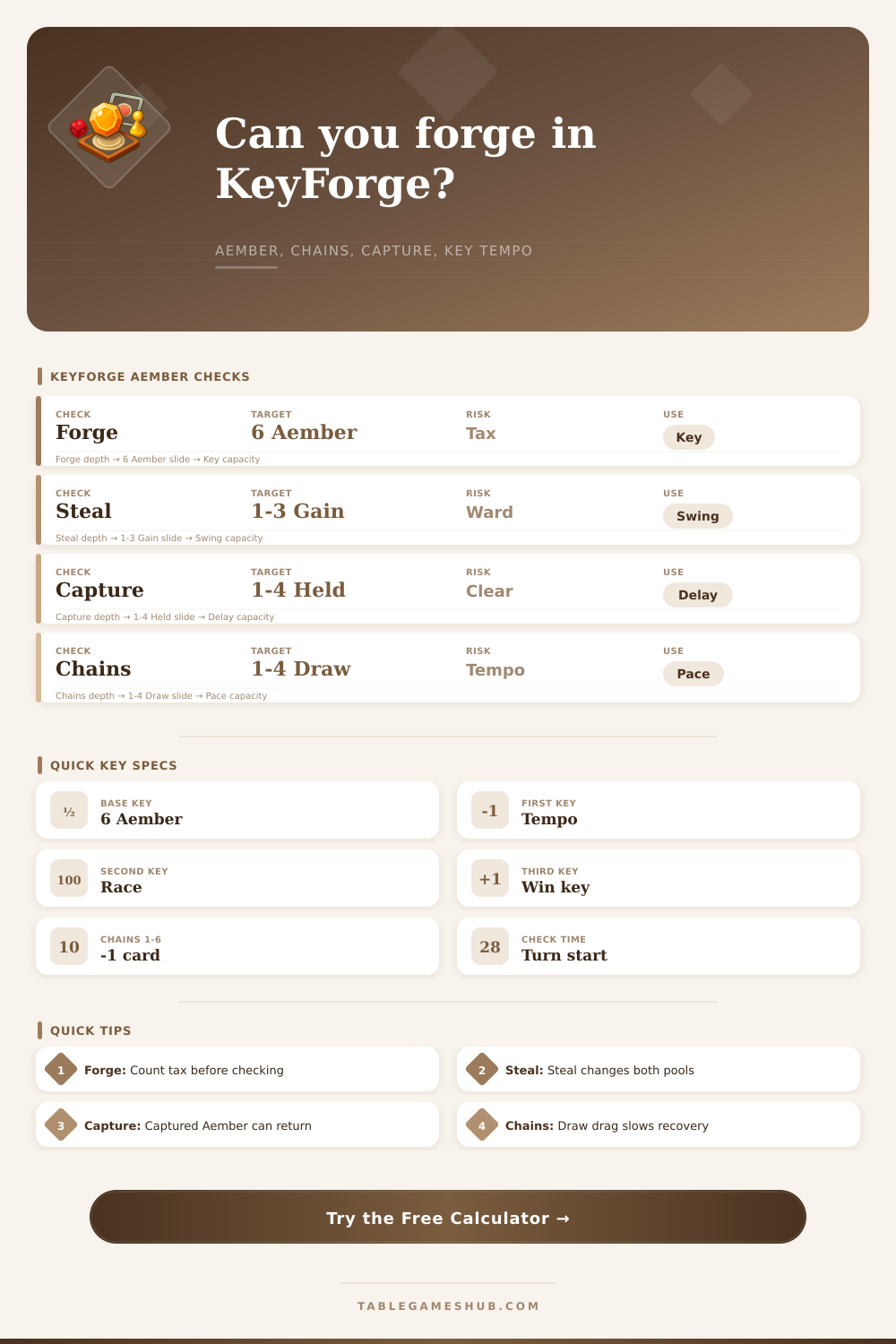
Steal is a two-way swing, indicating that the action will remove a certain amount of aember from the opponent’s pool while also adding that amount of aember to the player’s aember pool. Capture, however, does not contribute to a player’s ability to forge a key. Rather, the action can be used to ensure that the opponent’s aember pool drops to the required aember amount that is necessary to win the game.
The aember calculator separates the effects of steal and capture to show how each of those actions will contribute to the aember gap between the player and opponent. Chains will not impact a player’s aember total. However, they will impact the number of card that the player draws during their next turn.
Using actions and burning actions to forge keys will contribute to the number of chains that a player have in their hand. Thus, those who use many actions may eventually encounter difficulties during their next turn if they have many chains left in their hand. The aember calculator includes a reference table that allows for a player to easily determine how many aember is lost due to a specified number of chains.
The type of house that a player chooses will determine which mechanic that they will use during their games of KeyForge. For instance, players that use logos decks find value in the use of chain drag. Players that utilize shadows decks find value in the number of aember that is stolen and the aember pool of the opponent.
Additionally, players that use the sanctum or saurian decks find value in the use of capture and tax. Thus, the aember calculator includes a house selector that allows a player to select their house when using the aember calculator. When the player uses that house selector to select a player’s house, a note is included that explains which mechanic are important to that house.
Many players make mistake during games of KeyForge. For example, players may treat each type of aember as if it is the same as another type of aember. However, each type of aember can behave differently.
For example, aember that the player gains stays with the player; however, stolen aember also stays with the player but also removes aember from the opponent at the same time. Additionally, aember that one player captures and a creature holds does not immediately contribute to the player’s aember total but is delayed until the creature passes control to another player. Additionally, aember that is captured can return to the opponent if the creature that captured the aember dies.
Additionally, tax can increase the amount of aember that each player must have to forge their keys. Players must remember these difference. For example, players who do not remember these distinctions may celebrate when their opponent is captured but may fail to notice that tax has increased their own aember cost that must be met to forge their own key.
The aember calculator cannot see the hidden information that may be held by either player. Additionally, the aember calculator cannot determine the house that the opponent will select next turn. However, it can help to players avoid the arithmetic error that can occur between turns.
Once the aember calculator has performed its calculations and provided the player with an understanding of their aember total and their opponent’s aember total, the player can make a decision regarding whether to forge for their key, whether to hold onto their aember for a safety buffer, or whether to spend their actions to remove any of their threats to their aember total. Furthermore, the aember calculator can help to stop the player from second guessing their decision during games of KeyForge. Additionally, with experience using the aember calculator, the player will be able to recognize when it is more valuable to use a steal than to use a capture during their turn.