🎲 Backgammon Pip Count Calculator
Total every checker by point, add bar penalties, track borne-off men, compare the race, estimate wastage, and read bearoff readiness.
Point 1 is closest to bearing off. Point 24 is farthest away. Enter only checkers still on the board.
Use the opponent's own perspective as well: their point 1 is nearest their bearoff.
| Metric | Your side | Opponent side | Formula note |
|---|
| Board area | Point numbers | Pip meaning | Race note |
|---|---|---|---|
| Home board | 1 through 6 | Low remaining pips | All live checkers must be here before bearing off. |
| Outer board | 7 through 12 | Medium remaining pips | Usually near racing contact but not bearoff-ready. |
| Midpoint | 13 | 13 pips per checker | Often two to five checkers in opening and holding games. |
| Back board | 18 through 24 | High remaining pips | Anchors and runners keep race count high. |
| Bar | 25 equivalent | Highest single penalty | Must re-enter before moving elsewhere. |
| Position type | Typical count | Contact level | Calculator focus |
|---|---|---|---|
| Opening layout | 167 each | Full contact | Baseline verification and midpoint count. |
| Pure race | Under 100 | Low contact | Race lead, wastage, and average roll timing. |
| Holding game | 90 to 140 | Medium contact | Deep anchor pips and home-board readiness. |
| Bearoff race | Under 50 | No contact | Borne-off men, gaps, and rolls remaining. |
| Bar-contact race | Variable | High swing | Bar pips and checker-count audit warnings. |
| Wastage source | Why it matters | Calculator proxy | Adjustment |
|---|---|---|---|
| Gaps in home board | Missed bearoff numbers waste dice | Empty home points below live checkers | Adds 0.8 pips each |
| Heavy low stacks | Many checkers on 1 and 2 need extra rolls | Stack over three checkers | Adds 0.7 pips each |
| Outside checkers | Must enter home before bearing off | Checkers on points 7 through 24 | Readiness penalty |
| Bar checkers | Must re-enter before all movement | Bar men at 25 pips | Adds 2.0 waste each |
| Crashed board | Low points fill before high points clear | Bearoff speed model | Adds model drag |
| Readiness band | Score range | Position look | Practical read |
|---|---|---|---|
| Locked out | 0 to 35% | Bar men or many outside checkers | Pip lead can vanish because entry and clearing come first. |
| Clearing | 36 to 65% | Most checkers home, some outside | Race is real but bearoff timing still has friction. |
| Nearly home | 66 to 85% | All but a few checkers on points 1 through 6 | Wastage and gaps matter more than raw count. |
| Bearoff-ready | 86 to 100% | All live checkers home or borne off | Count rolls remaining and avoid low-point stacks. |
Audit the 15 checkers first
A wrong checker total makes every pip result wrong. The warning box flags each side when board, bar, and borne-off counts do not total 15.
Do not treat all pips equally late
In bearoff positions, gaps and stacks can make a lower raw pip count play slower than a smoother board with a slightly higher count.
The race in backgammon are determined by the number of pips each side of the players must travel to win the game. The side that bears off its checkers before the opponent bears off the opponent’s checkers will win the race. In order to determine which side is winning the race, each side of the players must count the number of pips that they must travel in order to win the game.
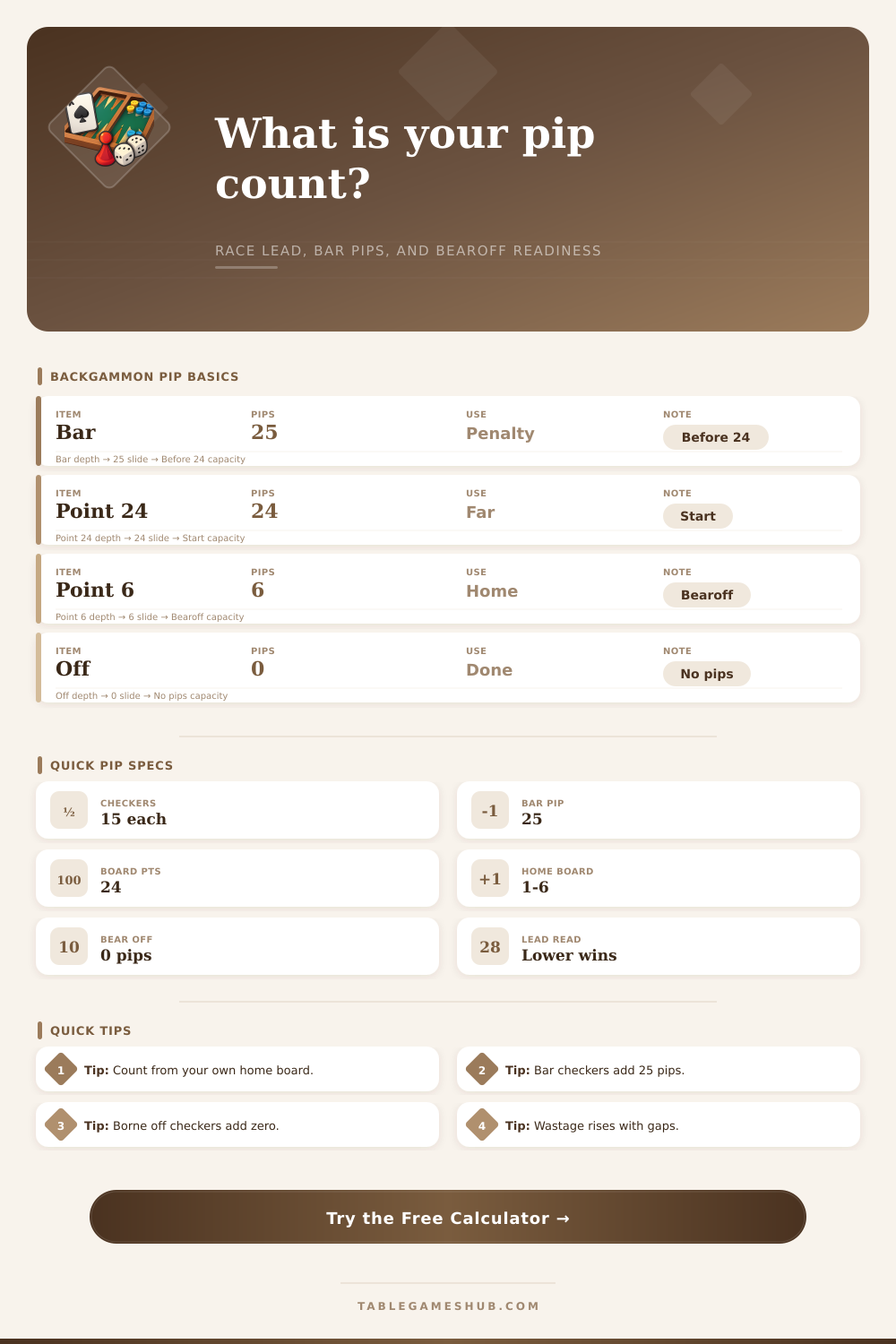
Each of the points on the backgammon board is associated with a number of pips. The point of the board that is closest to the bearoff tray is point one, and the point that is the furthest from the bearoff tray is point twenty-four. The bar, which is the area of the board that is between the two players, is considered to be point twenty-five.
How to Count Pips and Use a Pip Count Calculator
To calculate the total number of pips that each side must travel to win the game, each player add up the number of points of each of its checkers that remain on the board, and twenty-five points for each of its checkers that are located on the bar. Checkers that have been borne off of the board are not counted in this total. This total count represents the total number of pips of work that each side has to perform to win the game.
Each player must calculate the total pip count for each player’s checkers. The player whose total is lower than the opponent’s total is the player that has less work to do in order to win the race. However, the player with the lower total is not necessarily the winner of the race.
The concept of friction for the race creates wastage for each player. Wastage is a measure of the number of pips of each player’s checkers that are wasted due to gaps in the opponent’s home board, the number of checkers that are present on the lowest points of the opponent’s home board, and the number of checkers that are still outside the opponent’s home board. The pip count calculator automatically calculates the wastage for each player, should the player enter the number of checkers on the board and the borne-off checkers.
Many beginners of backgammon make mistake when counting the pips for the race. One of the most common error is only counting the checkers that are on the board, but forgetting to count the checkers that are on the bar. Additionally, another mistake that many beginners make is assuming that each pip is the same as each of the other pips on the board.
The last few pips to be borne off the opponent’s home board from points one and two require more rolls of the dice than pips that must be travelled from points four and five. The pip count calculator can flag these issues for the player so that the player can become aware of these issues. The context of the backgammon match can impact the interpretation of the pip counts.
If the players are playing a pure money game, the players may use the pip counts as the basis for determining which player is winning the race. However, in match play, the value of the game cube and the score of the match will impact the lead that each player need in order to win the race. It is possible that each player’s position on the board may appear to be even, but one position may actually be a strong pass for the player who is to move next.
The readiness score that the pip count calculator calculates indicates the percent of each player’s army that is ready to enter the home board and bear off, which allows the player to determine whether the pip lead is real or temporary. Reference tables include the typical range of pip counts in different stages of a game. At the opening of the game, the pip counts are usually near one hundred sixty-seven pips per player.
Once the players begin to come into contact with one another, the pip counts will drop below one hundred. During the bearoff phase of the game, the pip counts will fall below fifty, and each pip that a player’s checkers remains on the board during this phase indicates a potential delay for that player in bearing them off the board. Knowing the typical range of pip counts for each phase of the game can help the backgammon player to avoid reacting excessively to changes in a player’s pip count during the game.
The behavior of the players’ dice can impact the race. The average roll of two six-sided dice is eight pips of movement for each player’s checkers. However, this average roll hides the fact that sixes and ones appear with equal frequency.
If the player’s checkers is crashed into the opponent’s home board and the points near the opponent’s home board are filled, sixes will result in wasted rolls. If the player’s checkers are positioned on the board in a way that permits the checkers on the players’ home board to be borne off the board immediately with rolls of six, the player will have a better chance of winning the game. The wastage estimate for each player permits the player to estimate how many rolls is required by the player to win the game.
This estimate is not exact, but may be of more use to the player in making decisions about the game than the raw pip count. Certain anchors that the players have for their checkers impact the game in ways that is unrelated to the pip count. For instance, if one player has an anchor for the opponent’s checkers deep within the opponent’s home board, it prevents the opponent from increasing their racing speed on the board.
Additionally, a checker that is on the midpoint of the board (point twelve) may have an expensive pip count to bear off, but a checker that is on the midpoint is only thirteen pips from safety and can usually be brought in faster than any other checker on the board. While the calculator cannot take the place of a player’s judgment of the game, the calculator can provide a baseline for that player to start to understand the game. Each player has fifteen checkers, so any total that is not calculated for fifteen checkers is invalid.
The warning box for the pip count calculator will alert the player to any total that is not calculated from fifteen checkers. The warning box for the player removes the need for the player to become distracted while playing the game. Having obtained the numbers from the pip count calculator, the player must interpret those numbers.
A lead of ten pips in the race usually indicates a winner when both players are in the process of bearing off their checkers. However, a lead of ten pips is generally meaningless if both players still have any checkers on the bar or outside of the opponent’s home board. The readiness percentage can help to distinguish between these situations.
A readiness percentage that is low for any player indicates that the raw lead that the opponent has may vanish before either player has a chance to use that lead to win the race. Backgammon rewards those players who can read the pip count and the context of the race. The pip count calculator will calculate the pip counts for the backgammon player, but the player must learn to read what the calculator’s numbers indicates about the game.