🃏 Double Deck Pinochle Score Calculator
Total bid pressure, meld classes, marriages, pinochles, runs, tricks, counters, and set logic for an 80-card double deck hand.
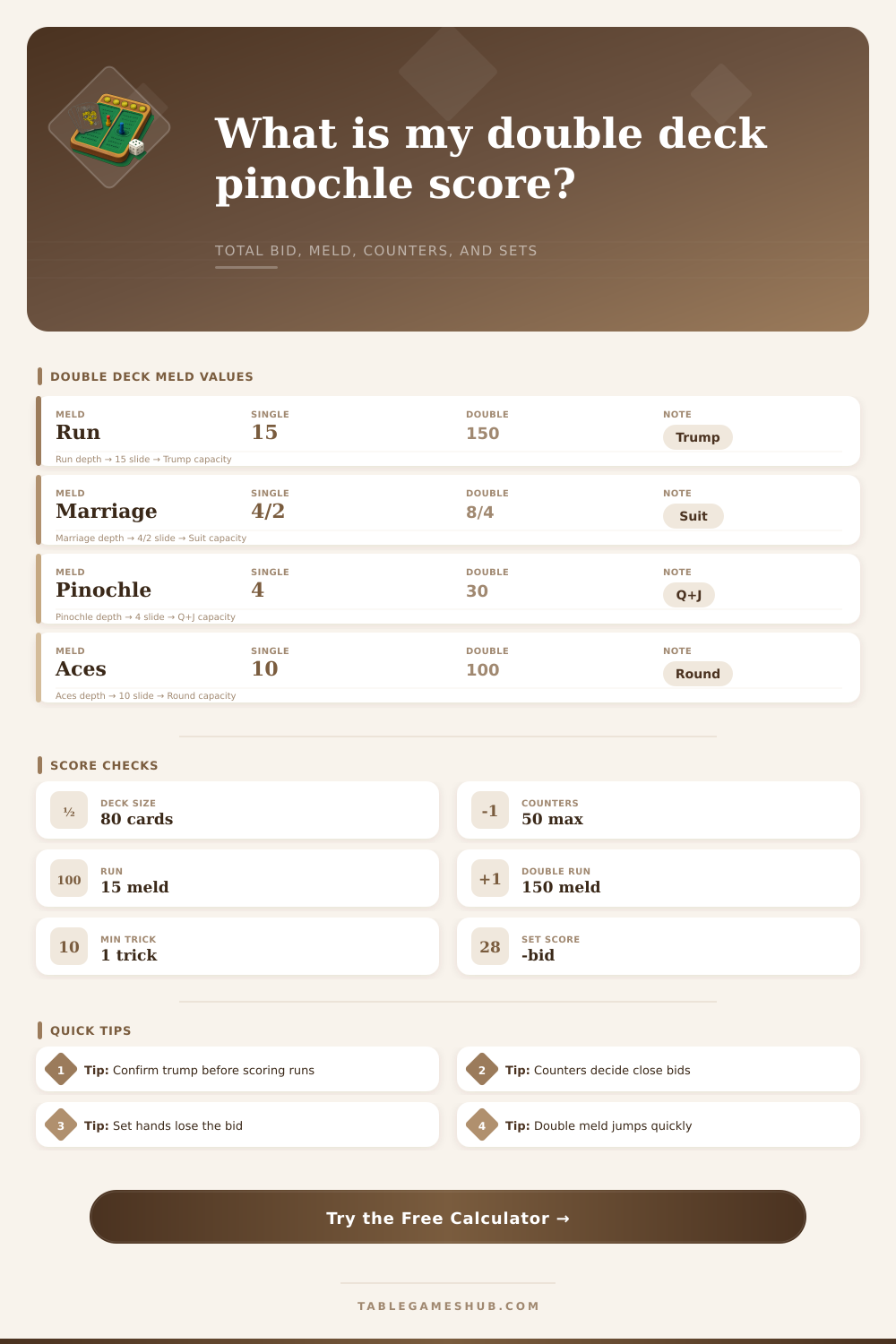
| Meld Class | Single | Double | Triple / Quad |
|---|---|---|---|
| Run in trump | 15 | 150 | Table call |
| Pinochle | 4 | 30 | 60 / 90 |
| Aces around | 10 | 100 | 150 / 200 |
| Kings around | 8 | 80 | 120 / 160 |
| Marriage Type | Requirement | Classic Value | Calculator Field |
|---|---|---|---|
| Royal marriage | K-Q trump | 4 | Royal marriages |
| Plain marriage | K-Q non-trump | 2 | Non-trump marriages |
| Double royal | Two K-Q trump | 8 | Enter 2 |
| Mixed marriages | Several suits | Sum each pair | Split by trump |
| Counter Source | Cards / Event | Max Count | Score Effect |
|---|---|---|---|
| Aces | 8 aces | 8 | Counter pile |
| Tens | 8 tens | 8 | Counter pile |
| Kings | 8 kings | 8 | Counter pile |
| Last trick | Final trick | 1 | Included in 50 |
| Set Situation | Trigger | Common Posting | Calculator Rule |
|---|---|---|---|
| Bid missed | Meld + counters below bid | Negative bid | If short, lose bid |
| No trick | Zero tricks taken | Meld denied | If no trick, lose meld |
| Saved contract | Score meets bid | Score total | No set |
| Zero table | House penalty | Post 0 | If short, score zero |
Tip 1: Separate meld from counters
A strong meld hand can still miss the contract if the declaring side does not capture enough counters during trick play.
Tip 2: Pick the set rule first
Double-deck tables vary on failed contracts, so choose the penalty rule before comparing bid margins or posted score.
Pinochle is a card game that rewards player who can read there hand and determine if the score will be realistic. Scoring is important, as a single misstep with meld or counter score can result in the partnership earning a set. A set occur when a partnership cannot reach their bid total.
Thus, many players will keep score during the game. The score is calculated based off the meld and counter scores for each partnership. Meld is the value of the combinations of cards that a player hold in there hand.
How to Score and Bid in Pinochle
Counters is the number of points that a player recieve for winning specific cards during the round. Meld scores are only earned if a player takes at least one trick, though some table use different rules for meld scoring. Counters total a possible maximum of fifty point for a double deck hand.
The total score for a player is represented by the sum of there meld and counter scores. Thus, each partnership must consider both of these score when making a bid for there hand. A bid represents the number of points that a player partnership will score during the round.
Bids can signal the risk that a partnership is willing to take. For instance, a sixty point bid may be relatively safe with a number of marriage in the hand, but the same bid is potentially dangerous for the same partnership if they do not have enough counters to fulfill the bid. A calculator can assist a partnership in the mathematics behind the bid.
The calculator can ask for the bid amount, the meld categories, and the counter score, and then it remove the mathematics from the equation so that the partnership can focus upon the bid itself. One of the largest categories of meld is run. A run consist of the ace, ten, king, queen, and jack of the same suit, and is worth fifteen points.
Two runs are worth one hundred fifty points. A partnership that has a run can be more aggressive with their bidding. However, even partnerships that have a double run can be at risk if they do not win enough counter to reach there bid.
The calculator accounts for the number of single and double runs that is held. Next are marriages. A royal marriage consist of the king and queen of the same suit as the trump suit, and is worth four points.
A plain marriage consist of a king and queen of any suit other than the trump suit, and is worth two points. Because marriages can be of any suit in the deck, players will often aim to collect a number of marriage. The number of plain marriages can make or break a bid.
Plain marriages dont require the partnership to win trick with the trump suit. Pinochle and around class are the last meld categories. A pinochle consist of the queen of spades and the jack of diamonds, and is worth four points.
A double pinochle is worth thirty points. An around consist of aces and kings of each suit, and acquiring a second set of these winning cards will score the partnership rapidly. The calculator allow a player to select each around category class so that the meld score is represented correctly.
Counters are the most variable in the game. Counters are earned for winning aces, tens, kings, and for winning the last trick. With fifty points as the maximum score for counters, players will use there counters to reach there bid total.
Should a partnership win there bid but score few counter, there meld score must be high enough to avoid a set score. Thus, players must pay attention to counters during the round. The rules for a set can vary from table to table.
For example, some tables will subtract a player’s bid from the score if the player fail to win there bid. Other tables will deny all meld points if a player fails to win any trick. Other tables will score the partnership zero if they score short of there bid.
These rules are included in the calculator so that each partnership can select the rule they use. Checking the score for a round before play begins allow the partners to discuss meld and counter score before play. One player might envision meld but not realize that the counter score is relatively low.
Running the numbers together before play will allow each partnership to find these difference. Because both partners know the meld score and counter needed for each round, any argument will occur after the round is over. Players eventually develop knowledge of which meld categories is reliable for reaching high scores and which categories depend upon luck.
For instance, although a player may have five marriages, should the opponents win the trick with high valued cards, those marriages will not score. However, having a double run will allow the partnership to win the bid with a relatively low counter score. Players can recognize these meld categories, and the calculator removes the mathematics so that players can focus upon these meld categories.
Thus, by understanding which meld categories to focus upon, a partnership can make a bid that will either focus upon safety or aim for higher scores.