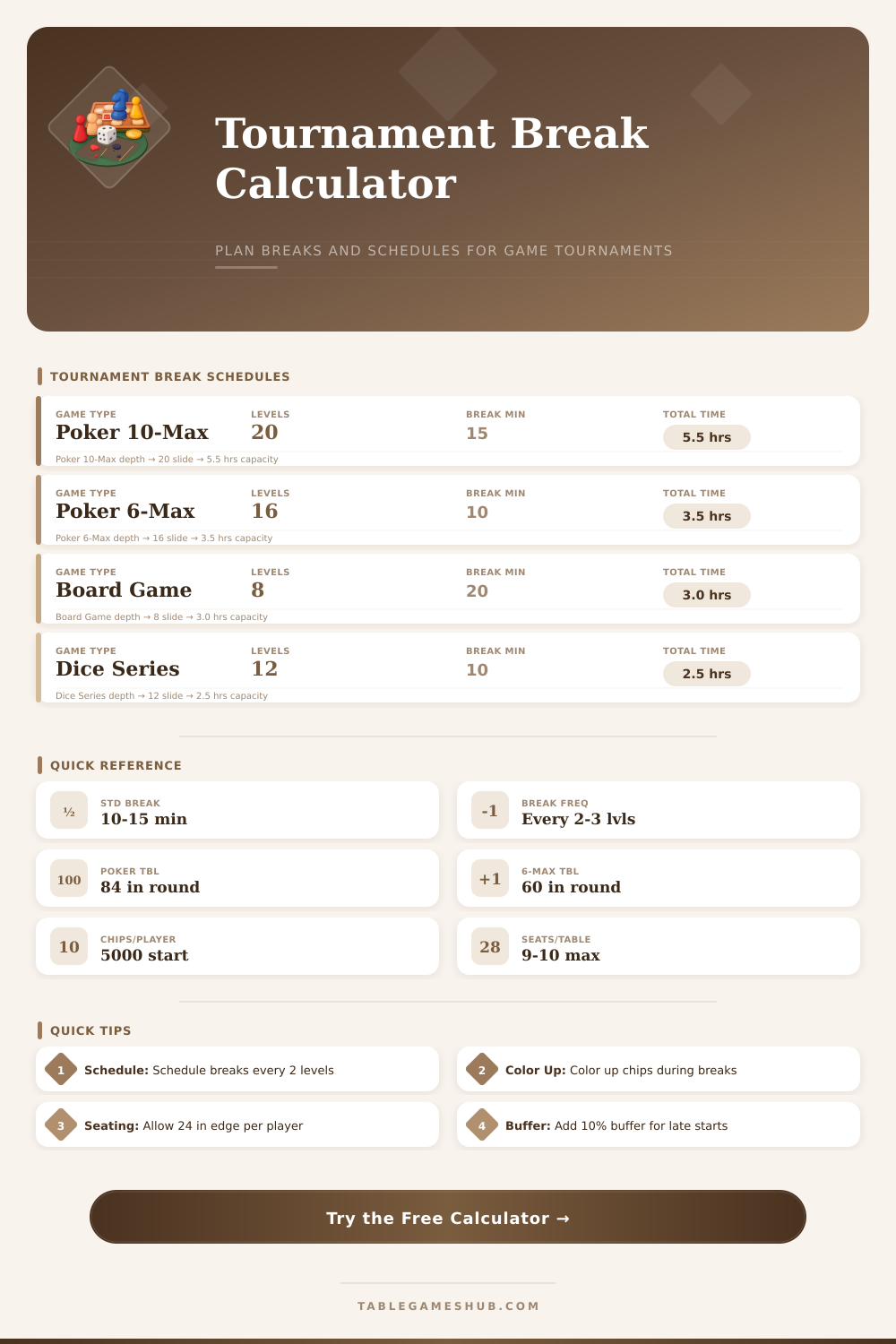
Tournament Break Calculator
Plan break schedules and timing for poker, board game, and card game tournaments
| Game Type | Recommended Table Size | Playing Surface Area | Rail Height | Player Capacity |
|---|---|---|---|---|
| Poker 10-Max | 84" round | 4,616 sq in | 4-6 in | 10 |
| Poker 6-Max | 60" round | 2,827 sq in | 4-6 in | 6 |
| Blackjack | 72x42" semi | 3,024 sq in | 3-4 in | 7 |
| Board Game | 48x36" rect | 1,728 sq in | N/A | 4-6 |
| Game | Deck/Piece Count | Accessories Needed | Storage Size |
|---|---|---|---|
| Poker | 1 deck + 500 chips | Dealer button, timer | 12x8x4 in |
| Blackjack | 6-8 decks | Shoe, discard tray | 18x12x6 in |
| Board Game | 1 complete set | Dice, scorepad | 12x8x4 in |
| Dice Game | 5+ dice | Scorepad, cup | 6x4x3 in |
| Player Count | Tables Needed | Chips Per Player | Est. Duration |
|---|---|---|---|
| 10 | 1 | 5,000 | 3-4 hrs |
| 20 | 2 | 5,000 | 4-5 hrs |
| 40 | 4 | 5,000 | 5-6 hrs |
| 100 | 10 | 10,000 | 8-10 hrs |
Tournament pauses are times when no tournament is scheduled. During such pauses it is useful to rest your mind and a bit change your physical state. Taking small pauses can help you fix things, relax and ensure a smooth transition to the next part.
In some long tournaments, for instance those that last 10 to 12 hours, you can schedule an hourlong pause for dinner. Pauses also can happen every 4 to 5 levels, usually with “coloring up”. Those pauses can be longer early, because there are more players and the line for the toilet is longer.
Tournament breaks and tie breaks
When the number of players declines, the pauses become shorter. It is important to also use the pauses to rehydrate.
In certain games, for instance Tabbycat, the term has other meaning. The elimination rounds, occasionally called “outrounds” or the final series, are called break rounds. The qualification of teams to compete in the elimination phase of tournament is known as the break.
In some simulators, the prelims decide if a player will break, during the elimination rounds show how far they will advance.
Occasionally players need a tie-breaker. A tie-break is a game used to determine the winner when a set is tied 6-6. That evolved to the traditional 12-point, or “first to seven”, tiebreaker used today.
In round-robin tournaments, you favor the player that beat opponents with the most tournament points in the tie-break. Swiss-system tournaments, that is common in chess and card games as bridge, use other criteria to break ties. This is necessary when prizes are indivisible, as trophies, titles or qualification for other tournament.
Detailed informations about tie-breaks usually can be found in the official rulebook of the event. In some group tournaments, the points of every game can serve to break ties.
In tournament surroundings, players can face a bubble situation. Occasionally the last few players in tournament will all agree that the bubble gets their buy-in back. If a player buys in the last moment, that can turn a break-even player into a winning player.
A better player can expect to build a bigger stack during the reentering period, while a weaker player will usually lose chips. If cash games are available, a player maybe favors to play in the cash game until the tournament blinds match the cash game.