⚔ Kill Team Points Calculator
Roster builder, mission scoring & operative optimization
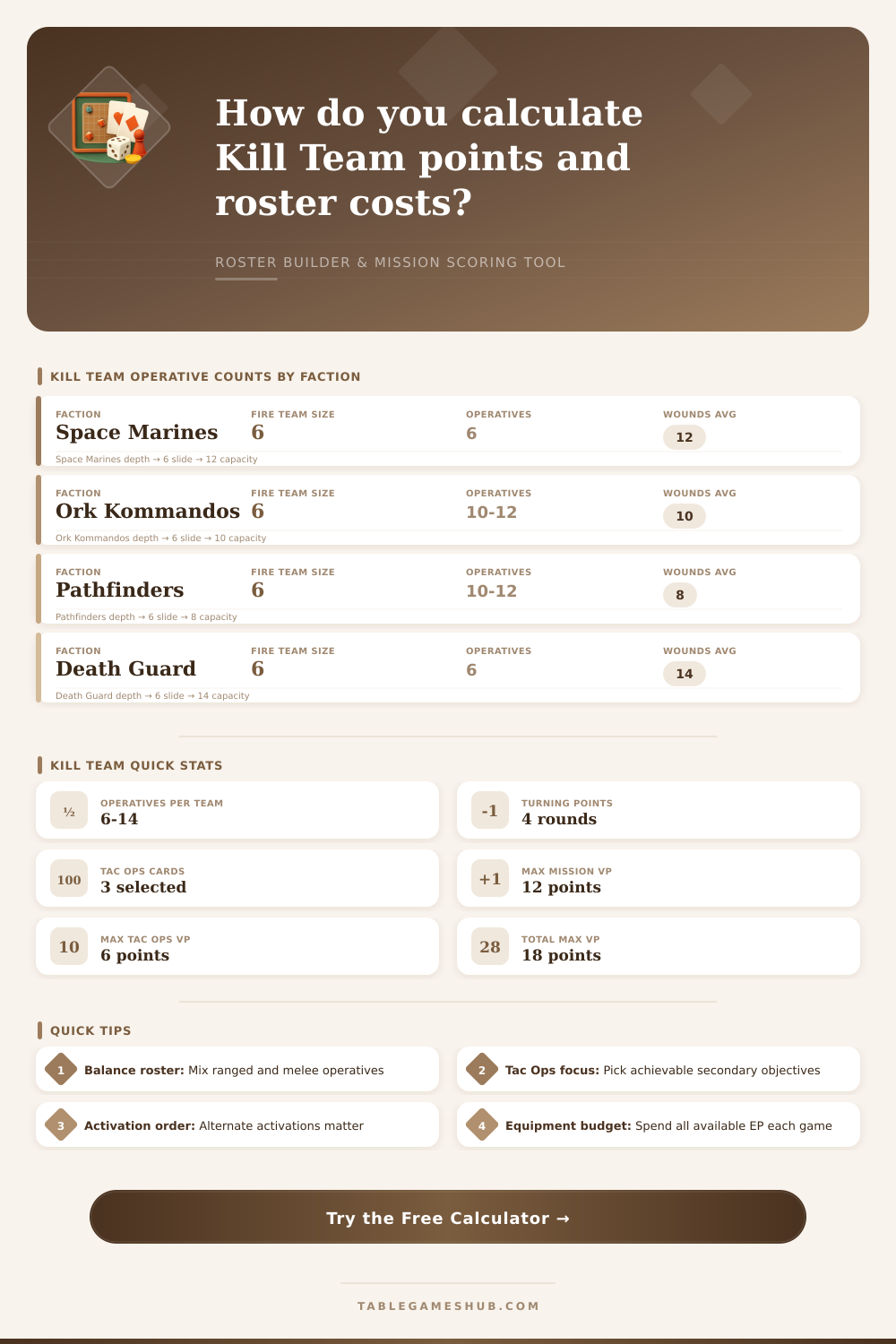
| Faction | Operatives | Avg Wounds | Move | APL |
|---|---|---|---|---|
| Space Marines | 6 | 12 | 3⬤ / 6" | 3 |
| Ork Kommandos | 10-12 | 10 | 3⬤ / 6" | 2 |
| Tau Pathfinders | 10-12 | 8 | 3⬤ / 6" | 2 |
| Death Guard | 6 | 14 | 2⬤ / 4" | 3 |
| Harlequins | 8 | 8 | 3⬤ / 6" | 3 |
| Veteran Guard | 10-14 | 7 | 3⬤ / 6" | 2 |
| Custodes | 3-4 | 18 | 3⬤ / 6" | 4 |
| Tyranid Warriors | 6 | 13 | 3⬤ / 6" | 3 |
| VP Source | Max Per TP | Total Available | Notes |
|---|---|---|---|
| Primary Mission | 3 | 12 | Scored each Turning Point |
| Tac Op 1 | 1 | 2 | Select from archetype deck |
| Tac Op 2 | 1 | 2 | Revealed during game |
| Tac Op 3 | 1 | 2 | Timing is key |
| Equipment Tier | EP Cost | Examples | Typical Usage |
|---|---|---|---|
| Tier 1 | 1-2 EP | Grenades, ammo | Common upgrades |
| Tier 2 | 2-3 EP | Medkits, comms | Specialist gear |
| Tier 3 | 3-4 EP | Heavy weapons, relics | Key operatives |
Kill Team is a skirmish combat game set in the same universe as Warhammer 40,000. It uses the same miniatures but has different rules, that means fast tactical games for 2; 4 players in shorter time. You can think about it as a more compact and more tight version of full 40K.
Important to know that Kill Team and Warhammer 40K look alike, but stay different games. The points systems do not match. In the original Kill Team you used points to build your squad, and the maximum amount was 200.
Kill Team: A Faster, Smaller Warhammer Game
For instance, the included Space Marine squad was worth 190. In regular 40K, if two armies enter the field with a cost of 1,000 points that should be a fair fight. But Kill Team works on a much smaller scale.
Usually the point limit for games is 100. During a long-running campaign, that limit can slowly rise according to the campaign progress. Commanders can be used in 200 point games, and there are also scenarios with a 100 point limit.
Even so those are suggested limits, not hard and fixed rules. Playing at 137 points is totally fine, if your opponet agrees.
Here is where things get more interesting. In Kill Team 2nd Edition, points officially belong to the past. The game moved to a new quota system for list-building instead of the traditional points.
That is quite a big change compared with how everything before worked.
The game runs on alternating activations. Each operative gets activated once per turn and can do a number of actions equal to their Action Point Limit, which usually is 2. Movement is measured by means of a geometric gauge system: a triangle equals 1 inch, a circle 2 inches, a square 3 inches, and a pentagon six inches.
A movement of 3 circles is pretty average.
Also Command Points work differently than in 40K. You generate them every round, instead of having a big stockpile at the start. Every player generates 1 Command Point and adds it to there pool. You can spend these on Strategic Ploys, which help the kill team during the game.
Games end after four Turning Points, and in total 21 points are possible. Six points are available for every operation type, plus an extra three for reaching a score of 5 or higher from the primary operation. Scoring 4 points three times is very difficult.
Scoring 3 points on four turns is still difficult, but doable. Elite teams tend to be stronger per model, so they probably score more kills. Larger teams are more likely to hold objectives.
No matter what, killing at least one model a turn andholding one objective a turn matters. There is also a points tracker app for iOS and Android to help keep the score.