🧬 Conway's Game of Life Calculator
Simulate generations, analyze patterns, count live cells & explore oscillators, spaceships and still lifes
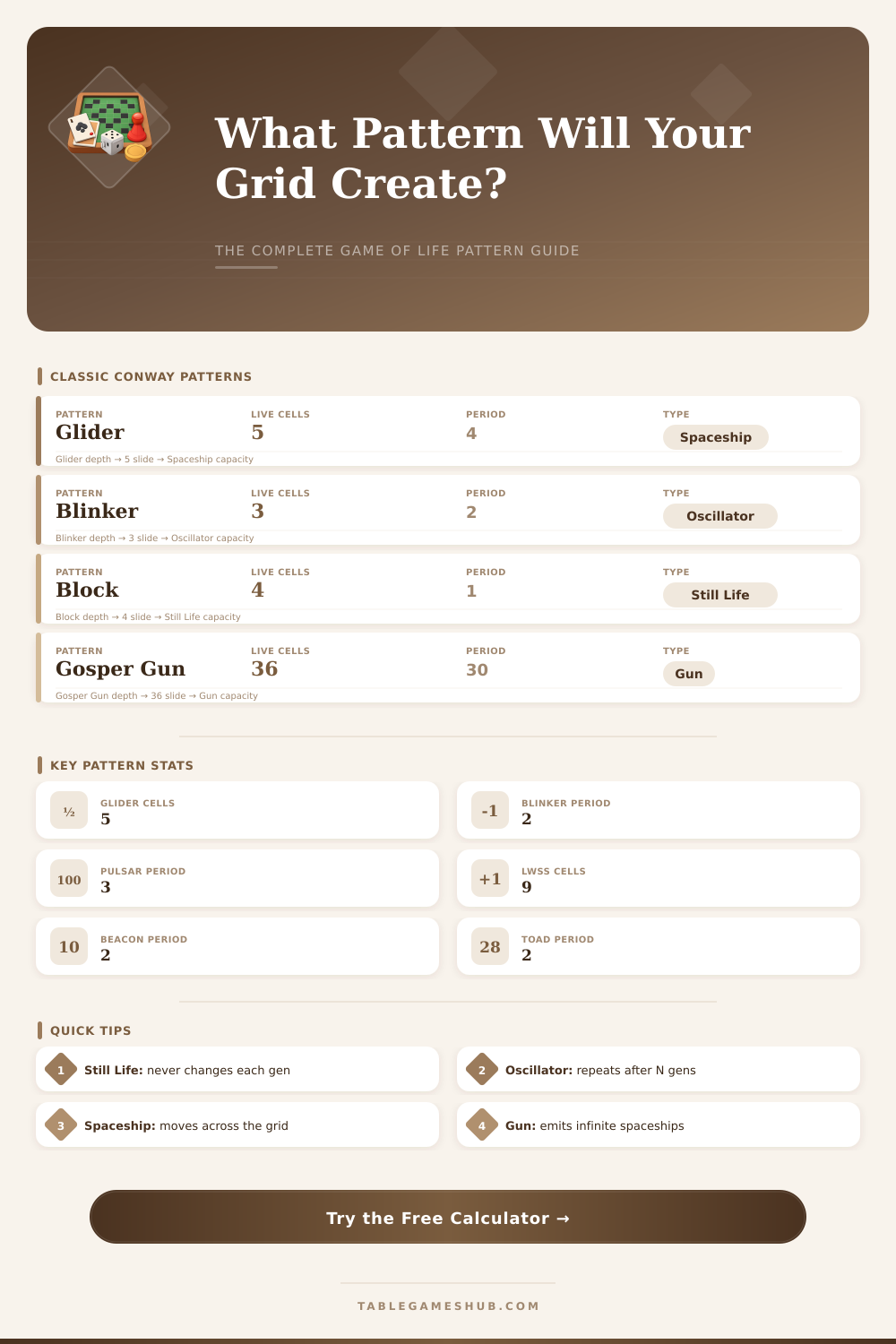
| Pattern Name | Type | Live Cells | Period | Bounding Box | Discovery |
|---|---|---|---|---|---|
| Block | Still Life | 4 | 1 | 2×2 | 1970 |
| Beehive | Still Life | 6 | 1 | 4×3 | 1970 |
| Loaf | Still Life | 7 | 1 | 4×4 | 1970 |
| Boat | Still Life | 5 | 1 | 3×3 | 1970 |
| Blinker | Oscillator | 3 | 2 | 3×1 | 1970 |
| Toad | Oscillator | 6 | 2 | 4×2 | 1970 |
| Beacon | Oscillator | 6 | 2 | 4×4 | 1971 |
| Pulsar | Oscillator | 48 | 3 | 13×13 | 1970 |
| Pentadecathlon | Oscillator | 15 | 15 | 10×3 | 1971 |
| Glider | Spaceship | 5 | 4 | 3×3 | 1970 |
| LWSS | Spaceship | 9 | 4 | 5×4 | 1970 |
| MWSS | Spaceship | 11 | 4 | 6×5 | 1970 |
| HWSS | Spaceship | 13 | 4 | 7×5 | 1970 |
| Pattern | Starting Cells | Lifespan (Gen) | Final Pop. | Final Pattern Count |
|---|---|---|---|---|
| R-Pentomino | 5 | 1103 | 116 | Various |
| Diehard | 7 | 130 | 0 | Vanishes |
| Acorn | 7 | 5206 | 633 | Multiple |
| Thunderbird | 5 | 243 | 0 | Vanishes |
| Pi Heptomino | 7 | 173 | 56 | Multiple |
| B-Heptomino | 7 | 148 | 26 | Multiple |
| C-Heptomino | 7 | 328 | 0 | Vanishes |
| Rule Name | Birth | Survive | Character | Density |
|---|---|---|---|---|
| Conway Life (B3/S23) | 3 | 2,3 | Chaotic | Medium |
| HighLife (B36/S23) | 3,6 | 2,3 | Self-rep. | Medium |
| Day & Night (B3678/S34678) | 3,6,7,8 | 3,4,6,7,8 | Symmetric | High |
| Seeds (B2/S) | 2 | None | Explosive | High |
| Life Without Death (B3/S012345678) | 3 | All | Expanding | Very High |
| Mazectric (B3/S1234) | 3 | 1,2,3,4 | Maze-like | Low |
| Anneal (B4678/S35678) | 4,6,7,8 | 3,5,6,7,8 | Smooth | Medium |
Conway’s Game of Life is not a typical video game at all. In 1970 the British mathematician John Conway created this cellular automaton, that caught the attention of many after Scientific American published an article about it that same year. To be clear, it has no relation with the famous board game from the 1980s. This creation is way stranger and honestly more interesting.
Imagine a huge board with squares extending in two directions. Here is your playing field. Every cell in that grid can be alive or dead, that is the just two possible states.
What is Conway’s Game of Life?
What makes it so thrilling: it is a game without a player, so you lay your cell arrangement first and later only watch what it does. The system itself moves from that moment without your help. Everything that happens results diretcly from the initial setup of yours.
How do the rules work? Surprisingly, they are simple. Every cell has eight neighbours around it in all directions.
In every generation, the fate of cells; life or death… Depends entirely on those neighbours. A dead cell comes alive, if it has exactly three alive neighbours in the next step.
An alive cell with two or three alive neighbours lasts to the next generation. Beyond everything else, either it dies or stays dead. That is the whole system.
Truly surprising is, how such basic rules create incredibly complex patterns. Those forms move, grow, make computers, they act almost like living creatures. It gives a bright way to research, how life itself could evolve, reduced too pure math and logic.
The name “Game of Life” suggests kindly, that Conway did not intend to copy the real world here. Rather, he explored the weird emergent behavior, that comes from a series of simple logical steps. The more you sink in it, the more philosophical it becomes.
There is also something called Turing completeness in the game. Basically, if you arrange the cells well, you can run anything computable by means of Conway’s Game of Life. Folks even created patterns, that generate other Games of Life inside of them.
More than fifty years later, the creation of Conway still reveals new mysteries.
For folks that learn to program, this became a favourite first task. It is not much harder than doing tic-tac-toe. A programmer in their first semester can create a working version without big effort.
Truly, you need only a two-dimensional grid and some rules. You will find programs in various languages like Python, Lua, JavaScript, and in platforms like Roblox or engines like Godot. There is a whole book titled “The Game of Life of Conway: Math and Programming”, that covers both the math puzzles and the challenges of building it.
Online, there lives a community, that shares findings about patterns. And new discoveries andclassics, that exist from long ago.