🐉 D&D 3.5 Challenge Rating Calculator
Calculate encounter CR, XP awards, and difficulty for D&D 3.5 Edition — balance any party vs. any monster group
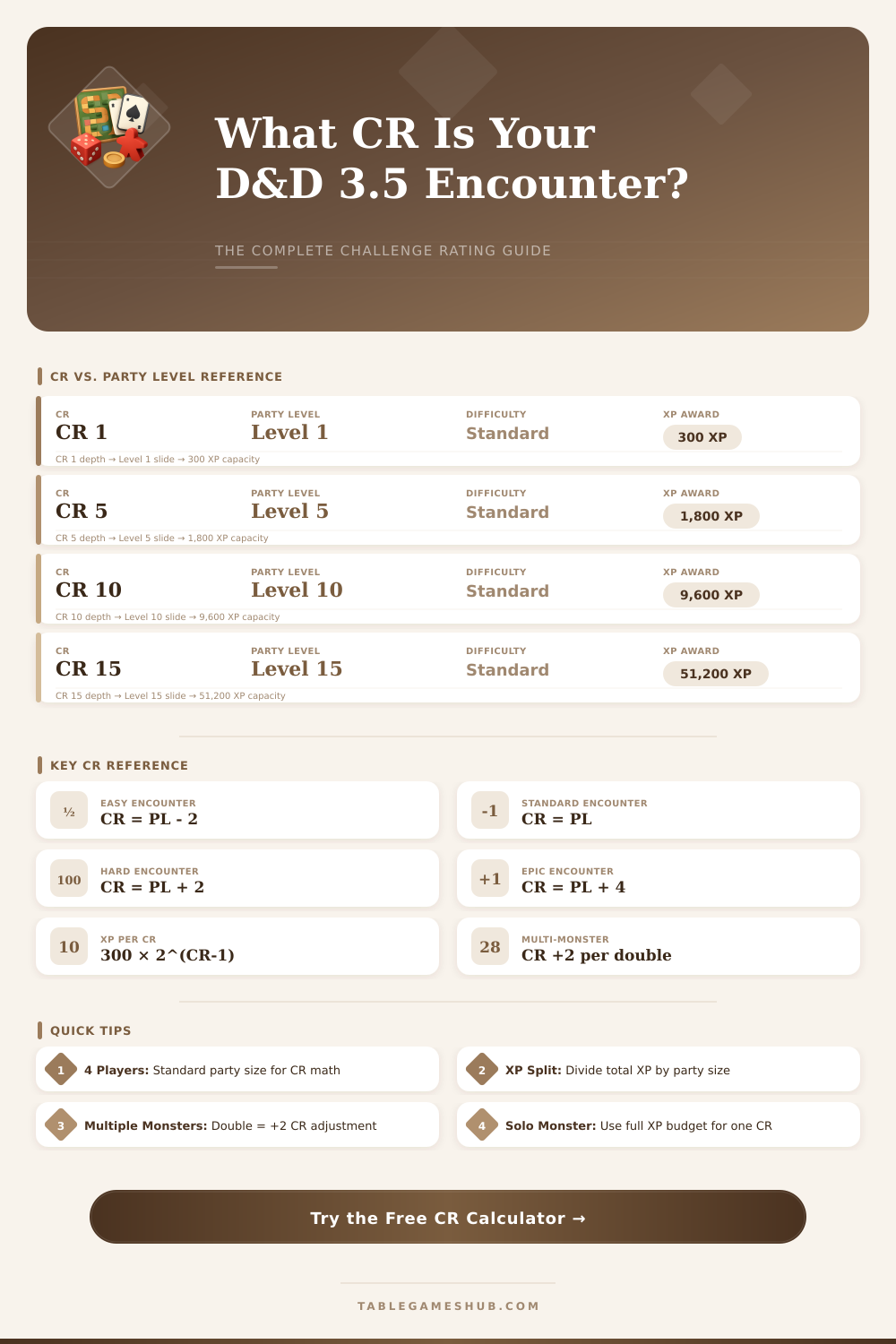
| Challenge Rating | XP Award (4 PCs) | XP Per PC | Equivalent Party Level |
|---|---|---|---|
| CR 1/4 | 75 XP | ~19 XP | Level 1 |
| CR 1/2 | 150 XP | ~38 XP | Level 1 |
| CR 1 | 300 XP | 75 XP | Level 1 |
| CR 2 | 600 XP | 150 XP | Level 2 |
| CR 3 | 900 XP | 225 XP | Level 3 |
| CR 4 | 1,200 XP | 300 XP | Level 4 |
| CR 5 | 1,800 XP | 450 XP | Level 5 |
| CR 6 | 2,400 XP | 600 XP | Level 6 |
| CR 7 | 3,600 XP | 900 XP | Level 7 |
| CR 8 | 4,800 XP | 1,200 XP | Level 8 |
| CR 9 | 6,000 XP | 1,500 XP | Level 9 |
| CR 10 | 9,600 XP | 2,400 XP | Level 10 |
| CR 12 | 19,200 XP | 4,800 XP | Level 12 |
| CR 15 | 51,200 XP | 12,800 XP | Level 15 |
| CR 20 | 307,200 XP | 76,800 XP | Level 20 |
| Number of Monsters | CR Adjustment | Example (CR 2 each) | Effective Total CR |
|---|---|---|---|
| 1 Monster | +0 CR | 1x Orc (CR 1/2) | CR 1/2 |
| 2 Monsters | +2 CR | 2x Orc (CR 1/2 each) | CR 2 |
| 4 Monsters | +4 CR | 4x Orc (CR 1/2 each) | CR 4 |
| 8 Monsters | +6 CR | 8x Goblin (CR 1/3) | CR 5 |
| 16 Monsters | +8 CR | 16x Kobold (CR 1/4) | CR 6 |
| 2 Monsters (CR 5) | +2 CR | 2x Troll (CR 5) | CR 7 |
| 4 Monsters (CR 5) | +4 CR | 4x Troll (CR 5) | CR 9 |
| Mixed Group | Varies | 1 CR5 + 4 CR2 | CR ~7 |
| Difficulty | Encounter CR vs. APL | Typical Outcome | XP Modifier |
|---|---|---|---|
| Trivial | CR = APL - 4 or less | Auto-win, no resource drain | 50% |
| Easy | CR = APL - 2 or -3 | Minor HP loss, no spell use | 75% |
| Standard | CR = APL or APL - 1 | Moderate resources used | 100% |
| Hard | CR = APL + 1 or +2 | Significant HP/spell drain | 125% |
| Epic | CR = APL + 3 or +4 | PC death possible | 150% |
| Near-Impossible | CR = APL + 5 or more | TPK likely | 200% |
| Monster | CR | Type | Base XP (4 PCs) |
|---|---|---|---|
| Kobold | CR 1/4 | Humanoid | 75 XP |
| Goblin | CR 1/3 | Humanoid | 100 XP |
| Orc | CR 1/2 | Humanoid | 150 XP |
| Skeleton | CR 1/3 | Undead | 100 XP |
| Zombie | CR 1/2 | Undead | 150 XP |
| Giant Spider | CR 1 | Vermin | 300 XP |
| Hobgoblin | CR 1/2 | Humanoid | 150 XP |
| Gnoll | CR 1 | Humanoid | 300 XP |
| Ogre | CR 3 | Giant | 900 XP |
| Troll | CR 5 | Giant | 1,800 XP |
| Hill Giant | CR 7 | Giant | 3,600 XP |
| Young Red Dragon | CR 10 | Dragon | 9,600 XP |
| Adult Red Dragon | CR 15 | Dragon | 51,200 XP |
| Ancient Red Dragon | CR 19 | Dragon | 204,800 XP |
| Balor Demon | CR 20 | Outsider | 307,200 XP |
Challenge Rating (or simply CR), as one commonly says, serves to help the Dungeon Master create encounters that genuinely match the ability of the party according to their level. Instead of guessing whether a monster will provide a fun fight or a total massacre it offers a fast guide about the real threat of a creature. The system is based on the idea that you lead a group of four average, well prepared players, not a team of gods or a set of total newcomers.
The idea seems quite simple. A creature with CR 5 should give a good challenge to four players at level 5. If it goes past that, the monster becomes genuinely dangerous.
What is Challenge Rating?
Under this, the party likely will not sweat. A healthy and well equipped group should beat a same-level monstre without needing amazing plays.
Creatures you find with CR of 0 to 30. For reference, a monster at CR 10 answers for a medium challenge against four characters at level 10. At the bottom end, CR 1/4 indeed would upset one alone character in a duel.
About CR 1/8? Two such creatures are needed to push one person to sweat. And CR 0 simply adds flavor, no real danger.
Here it becomes complex however. Challenge Rating is not holy law. It only gives a rough number, that quickly fails when you consider the details of your game.
Every team plays differently. A group full of clerics and paladin heroes tears through undead as if they would be paper, while wizards maybe have hard work. The economy of actions commonly throws everything off, four characters of your party, each acting in turn (sometimes with several attacks combined), can crush one alone giant.
And the other way: many creatures seem terrible according to there stats, but have weak defenses like paper. Some monsters strike very hard, but with only few points of health, which quickly lowers their Challenge Rating value.
The size of the party affects more than many think. Three characters at level 3 against a CR 3 monster feels differently than six at same level facing a CR 7 creature… The general trouble ends almost equal, but the feelings entirely change.
A little set of enemies that matches the party level works better than throwing thirty CR 1 creatures against level 10 players. That simply bores everyone.
Challenge Rating receives constant criticism, and not without reason. Some DMs see it as nearly useless. Others defend it with big passion.
The reality is that any game master can adjust the CR of a monster in the moment to create chaos. Many Dungeon Masters end up boosting creatures or adding support to keepfights alive. There are also other methods, for instance, point values, where balanced encounters need equal points on both sides.
Other tools exactly estimate how many hit points and resources the characters will use during every struggle.