⚔️ Pathfinder 2e Challenge Rating Calculator
Calculate encounter XP budgets, difficulty ratings, and creature CR values for balanced PF2e adventures
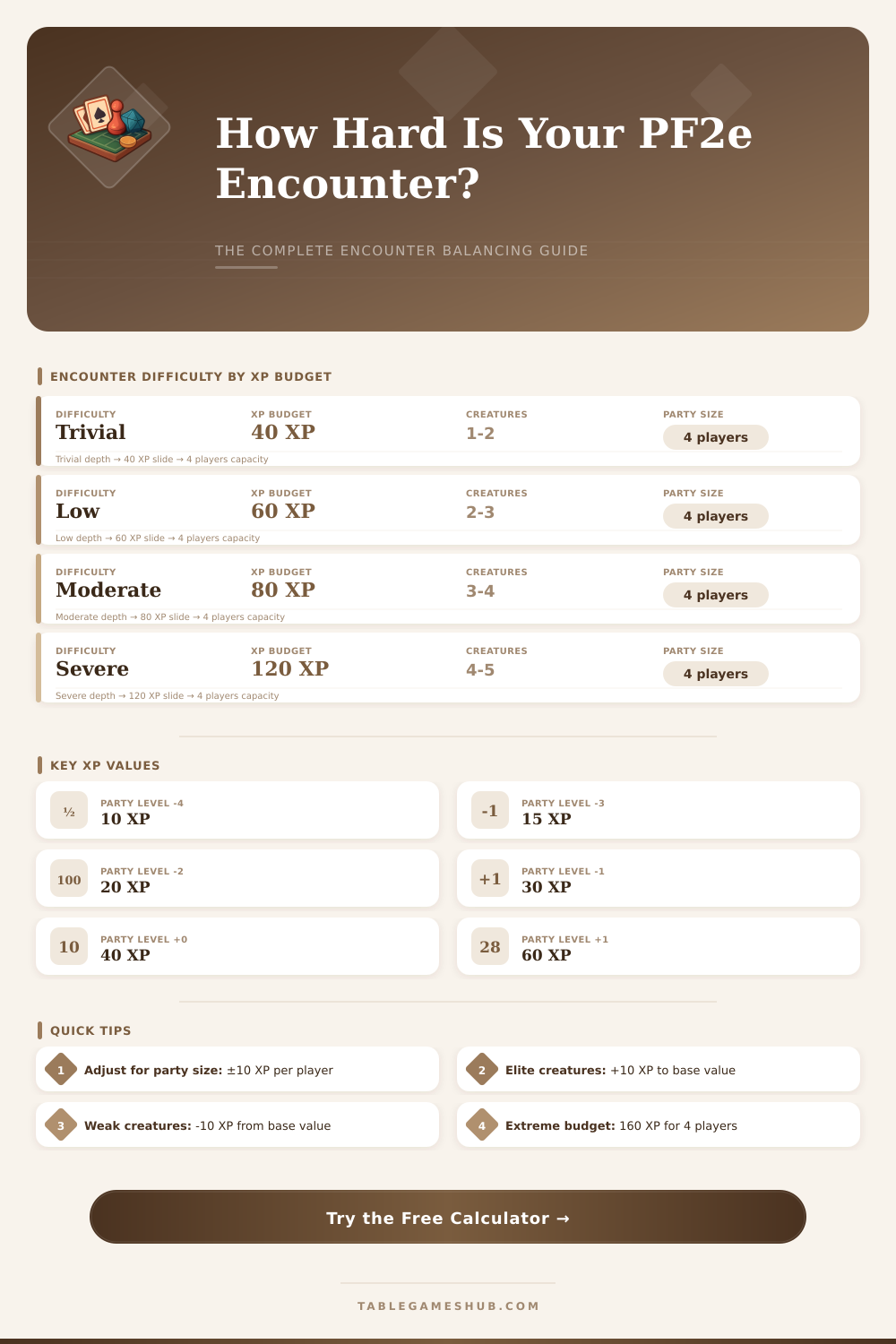
| Creature Level vs Party | Base XP Value | Elite XP | Weak XP | Typical Role |
|---|---|---|---|---|
| Party Level −4 or lower | 10 XP | 20 XP | — | Minion / fodder |
| Party Level −3 | 15 XP | 25 XP | 10 XP | Weak minion |
| Party Level −2 | 20 XP | 30 XP | 15 XP | Standard minion |
| Party Level −1 | 30 XP | 40 XP | 20 XP | Skirmisher |
| Party Level +0 (equal) | 40 XP | 50 XP | 30 XP | Standard foe |
| Party Level +1 | 60 XP | 70 XP | 50 XP | Strong foe |
| Party Level +2 | 80 XP | 90 XP | 70 XP | Boss candidate |
| Party Level +3 | 120 XP | 130 XP | 110 XP | Solo boss |
| Party Level +4 | 160 XP | — | 150 XP | Extreme boss |
| Party Size | Trivial | Low | Moderate | Severe | Extreme |
|---|---|---|---|---|---|
| 1 Player | 10 XP | 15 XP | 20 XP | 30 XP | 40 XP |
| 2 Players | 20 XP | 30 XP | 40 XP | 60 XP | 80 XP |
| 3 Players | 30 XP | 45 XP | 60 XP | 90 XP | 120 XP |
| 4 Players | 40 XP | 60 XP | 80 XP | 120 XP | 160 XP |
| 5 Players | 50 XP | 75 XP | 100 XP | 150 XP | 200 XP |
| 6 Players | 60 XP | 90 XP | 120 XP | 180 XP | 240 XP |
| Role | Typical Level Offset | Count in Moderate | XP Contribution |
|---|---|---|---|
| Solo Boss | Party +3 | 1 | 120 XP |
| Boss + Lackeys | +2 boss, −2 lackeys | 1+2 | 80+40 XP |
| Elite Squad | Party +1 each | 1 | 60 XP |
| Standard Gang | Party +0 each | 2 | 80 XP total |
| Weak Horde | Party −2 each | 4 | 80 XP total |
| Minion Swarm | Party −3 or lower | 6+ | 90+ XP |
Pathfinder 2e has a surprising twist when dealing with trouble, especially if you spent hours with other tabletop role-playing games. Here is what commonly surprises most people: it no genuinely applies the typical system of Challenge Rating as one could imagine.
In less fresh versions of Pathfinder and alike games, the Challenge Rating (CR for short) is a base value, that points, how dangerous a monster, trap or danger will be. Bigger CR shows bigger threat. Every creature or fence has XP-value, that one binds to its CR.
How Pathfinder 2e Uses Challenge Ratings
To create an encounter, one adds creatures and risks, until the total XP reach the planned limit. One starts with the most powerful and terrible element, later add smaller helpers to complete it.
If one takes the old method as standard, an encounter with CR equal to the Average Party Level (APL) of your team should fall in the range of mid-trouble for four members. This assumes, that you play with players made according to basic rules of folks, that no too cares about big optimizing. When your group likes to perfect things, maybe you need to choose higher CR, so that the situation stays exciting.
For a player of 16th level, it would sit somewhere between CR 15 and 17. Races, classes, feats and gears all affect, where it exactly fits in that span. An encounter of mid-level trouble, that uses a bit of daily resources like magic items or some rounds of special resources, but without big dangers, normally lines up with CR equal too the level of the party.
Encounters of low threat seem scary at first sight, but almost never endanger the whole group, unless some choose genuinely bad actions. One of moderate threat genuinely pushes and tests your team, although they rarely end the adventure here.
Game masters can keep secret the CR for every monster, trap, fence and even social challenges regarding party weaknesses. After the session ends, one gives XP according to that CR. Mind even so, any with CR 10 or more under the APL of the party does not deserve genuinely XP-prizes.
They simply too easy to be serious.
Some game masters took enemies directly from the bestiary and use them without changes. Others alter the location of creatures, keeping their rules, but giving them an entirely new face to fit your story. Like this the balance of trouble stays right for the real level of your players.
Pathfinder 2e itself does not apply “Challenge Rating” with values like 14, 16 or 18. The math works entirely otherwise. Online one finds tools to build encounters, that are made specially for the second edition of Pathfinder.
When players begin leveling, those early struggles soon become simple. A player with +20 in Athletics, that faces a DC 10 task? It almost certainly succeeds; and reachescritical success almost 95 percent of the time.